Search

Friday, 11 August 2023

A Decade of Bullshit Jobs

In a recent Jacobin essay, the sociologist Matteo Tiratelli took issue with David Graeber's celebrated idea of bullshit jobs. His purpose was not to say that they didn't exist, though he convincingly shows that the definition of the term is misleading, but that the heart of the matter is not a subjective sense of meaninglessness but a disconnect between work and the common good: "David Graeber’s Bullshit Jobs asked a vital question about contemporary capitalism. But its theoretical starting point led it down a blind alley. The central problem with work today is not that a growing proportion of people feel their own job to be pointless. It is that the economy as a whole is not oriented around satisfying true human needs. Instead, we find our working lives consumed by dysfunctional bureaucracies that constrain our capacity for play and creativity. We waste time trapped in processes that exist only to give our bosses more control over us. And we’re directed to jobs that wouldn’t exist if people had the power to choose where to invest our increasingly scarce resources. That is where the real bullshit lies."

Where Graeber and Tiratelli overlap is in the assumption that bullshit jobs play a disciplinary role, both by occupying us and so preventing dissent at the level of society and by keeping us under the thumb of  bureaucratic management within the confines of the firm. But for me this misses out a crucial question. If we accept that many jobs are pointless, in the sense that their disappearance would not be a negative and might even be a net positive for society, why do they exist? Put another way, why do capitalists spend money on tasks that don't need doing and which they appear not to value? In his How to be an Anti-capitalist in the Twentieth Century, Erik Olin Wright notes one of capitalism's self-destructive tendencies: "Each employer wants to pay employees as little as possible in order to maximize profits, but this then depresses the buying power of consumers in the market, which in turn makes it harder to sell the things capitalists produce". It doesn't make much sense to heighten the exploitation of labour and then fritter away the gains on unnecessary roles that produce no surplus value.

A key sociological point to make about bullshit jobs, at least in the examples favoured by Graeber, is that they are predominantly "white collar", as we used to say. We can all think of pointless jobs that are coded working class, such as security guards, but the dominant image that comes to mind is someone in an office laboriously updating a spreadsheet that no one else will look at. In other words, regardless of the physical and cognitive demands of the work, these jobs are typically occupied by people who would be considered middle class, whether under-employed professionals or harried clerks. Paying supernumerary workers to ensure a large enough middle class to both preserve political dominance and maintain a buying public for goods and services is rational in aggregate, but self-interest would rule it out at the level of the specific firm. Capitalists are themselves subject to capitalist ideology, hence they are capable of irrational actions, even actions contrary to their own immediate interests, if they serve to preserve the capitalist order. But even so, there is a clearly a gap in the theory when it comes to coordination. And as ever when we are faced with a collective action problem, it makes sense to look at the role of government.


Tiratelli sees an avenue of coordination in the welfare state. "The growth of education and health care as an employer of last resort is intimately bound up with the decline of manufacturing ... the social power that industrial workers once had allowed them to win substantial concessions from the state and from capital, concessions that often took the form of expanded welfare provision. While those manufacturing jobs have been automated and offshored, the welfare states they created have lingered on, often under attack but generally accounting for a growing share of GDP and of working-class employment." There is something to be said for this, not least that the conservative political desire to "shrink the state" never actually manages to reduce it in any meaningful way, even as it shifts resources from the needy to favoured groups (consider the cross-party consensus to preserve the two-child benefit cap versus the acceptance that public money should be spent on the private school fees of diplomats' children).

But Tiratelli's theory is also unsatisfactory because of his focus on the working class. What we actually see in the welfare state is increasing labour exploitation and proletarianisation. As he notes himself, "They are increasingly underfunded when compared with the demands placed on them. They are poorly paid, insecure, and casualized. Professional autonomy has been decimated. And the prestige attached to these vital roles has been systematically eroded". This description shares many of the characteristics of the "precariat", but that concept obviously extends beyond the working class to the middle class. Indeed, the emergence of the idea reflected the extension of traditional practices from working class jobs to middle class ones, such as casualisation and piece-work. What were once accepted as necessary features of the market became a social "problem" only after this shift. But precarity extends well beyond the public sector to encompass the private, and arguably is more rife in the latter because the former has retained greater labour rights. The problem of coordination in the private sector remains.

When I first addressed this issue a decade ago, in response to Graeber's original essay, I suggested that the solution to the conundrum lay in the work of Ronald Coase, specifically his theory of transaction costs for firms. In a nutshell, firms will keep certain skills inhouse to meet intermittent need because this is ultimately cheaper than outsourcing, however this leads to the creation of unnecessary administration tasks to fill the downtime. As the firm grows, this work is gradually consolidated into distinct roles: bullshit jobs. However, there remains the countervailing tendency for technology to reduce transaction costs, so making intermittent outsourcing more attractive (this is the essence of the "gig economy"). Combined with the suspicion that recovery from recession would see a higher turnover in firms and an end to what appeared to be job-hoarding, my conclusion was that "In the face of this pincer movement, the decline in bullshit jobs seems likely and thus Graeber's essay takes on the air of a lament for a soon-to-disappear world, not unlike the typing-pools and reprographic offices of yore."


That prediction (though only semi-serious) has proved wrong. Recovery has been weak and the long-tail of low productivity firms stubbornly persistent: the great shakeout hasn't happened. The statistical decline in bullshit jobs that Tiratelli finds depends on his assumption that such jobs are predominantly working class, but that in turn rests on a subjectivity about how society values work (e.g. cleaners, labourers, sales staff) and the consequent lack of self-worth this gives rise to. The subject is bedevilled by the methodological issue that worth is reported by the worker, not established by any external, objective means. Thus the bullshit jobs that infest the corporate world can be defended by their occupants simply adopting a belief that they "add value" to a business. The key insight implicit in Graeber's essay is that, however they are defined, there was a noticeable increase in bullshit jobs during the 1990s and 2000s, yet this occured at precisely the time that many firms were outsourcing peripheral functions and even offshoring core operations.

If this is not simple coincidence, it suggests that bullshit jobs are a characteristic of globalisation, but this would lead us to expect them to decline as globalisation has itself cooled after 2008 and even gone into reverse with onshoring and inhousing. This does not appear to have happened, at least not in the corporate sector. The pandemic and ensuing lockdown led many people to question the value of their work. This was both in the sense of putting their careers in perspective as people around them died and in discovering that they could accomplish a week's tasks in a couple of days if they worked from home and thus avoided the "frictions" inherent in an office job, though the greatest friction, poorly-managed meetings, got worse for many with the shift online. That some companies have now insisted that workers return to the office, ironically including Zoom, suggests that the disciplinary role posited by both Graeber and Tiratelli is real, though that clearly covers both useful and useless roles. What we still don't have is any greater clarity on why firms continue to indulge the latter. 

The simplest explanation is probably that firms do not know how to properly evaluate cognitive roles (consider the story of Elon Musk assessing programmers by the quantity of code they produced). They know there is waste and inefficiency, but it cannot be isolated as easily as on a production line. As no one firm has an advantage over any other in this respect, the overhead can be accepted simply as the cost of doing business, much as the inefficiency inherent in any bureacratic system has long been tolerated. The great promise of information technology was that it would improve bureaucracy by eliminating the human factor. The great promise of the Internet was that it would transfer the burden of administration onto customers. Both have only been partial successes. The next great hope is that AI will somehow do away with the need for many cognitive roles, though it should be obvious that, as with previous technologies, this is likely to simply generate novel bullshit jobs in its train. It appears that bullshit is simply a feature of any cognitive work, and as that type of work expands as a share of the labour force under the pressure of continuing automation, we can expect such jobs to proliferate.

Friday, 21 July 2023

Absolutism

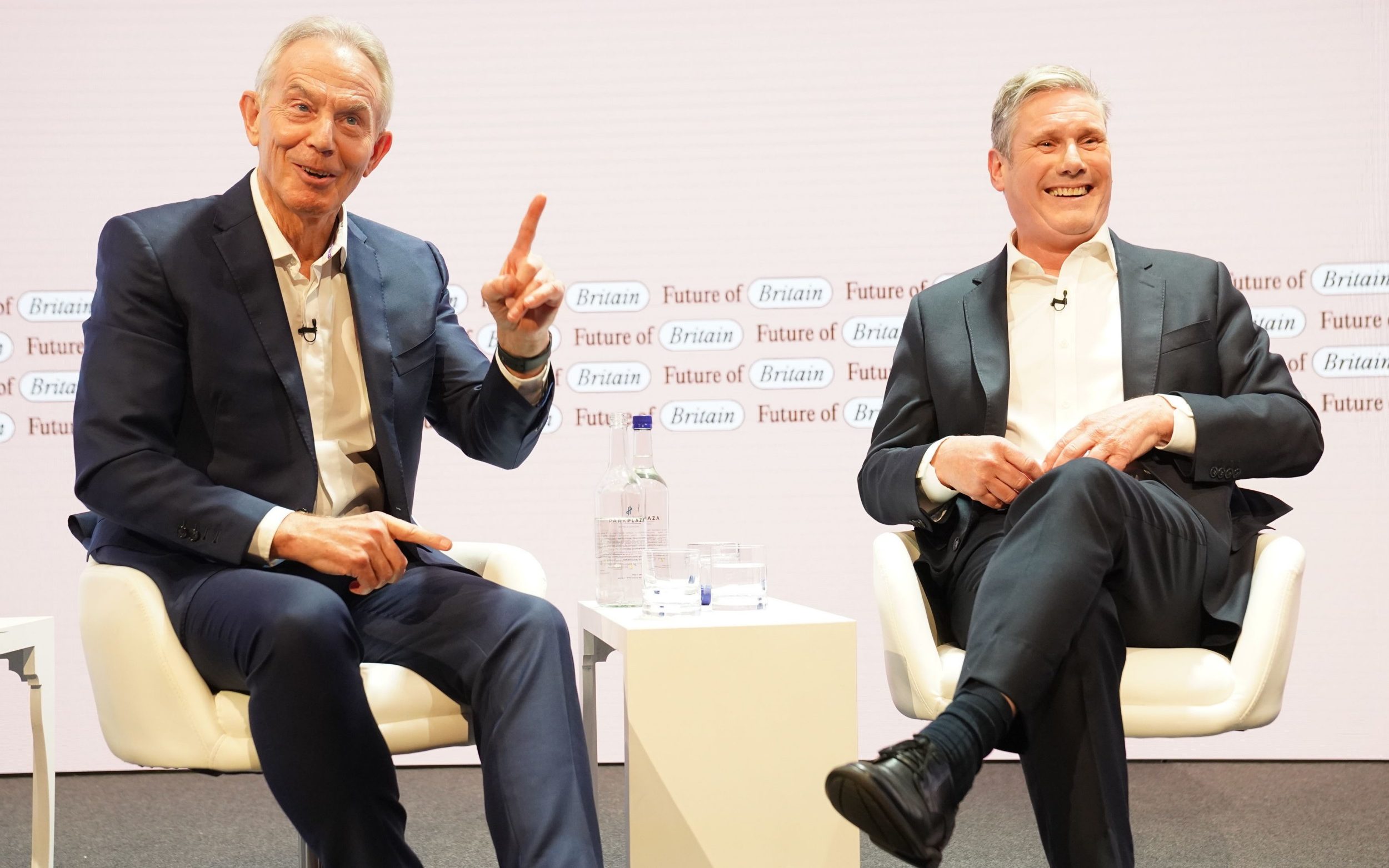
The major political event of the summer may turn out to be not the Uxbridge by-election but the public anointing of Keir Starmer by Tony Blair. This went beyond a simple laying on of hands to a very public mind-meld on the "tough decisions" that will have to be taken around public services after 2024. What was interesting in the press coverage was not simply the emphasis on ideological continuity, which won't come as a surprise to anyone, but the recognition that this public performance was also about rehabilitating Blair, or perhaps more accurately reassuring him that the party was now safe for him to approach. John Crace in the Guardian, who rarely manages to delve beyond the surperficial, made the point that "Blair needs Starmer to prove to himself that he’s still alive. That all those wilderness years were worthwhile. That he still means something. And Starmer needs Blair as a signpost to the future. That after four election defeats, there is a clear path to victory." What this does reveal, if unconsciously, is how much Labour's politics is now about personality rather than policy.

This was made clear in the aftermath of the three by-elections on the 20th of July. Having not unreasonably written off Somerset and Frome long before the count, Labour then managed to turn two excellent results, a gain in a traditionally Tory seat and a big vote improvement in one until recently seen as safe enough for an indolent Prime Minister, into a witch-hunt targeted on a slightly less right-wing Labour London Mayor. Together with the relentless briefing against the hardly-radical Andy Burnham and the blackballing of Jamie Driscoll, this emphasised how much Labour's politics have expanded from simple left-right factionalism to the personal factionalism that was a feature of the New Labour years, most obviously the division between Blairites and Brownites (predictably, Ed Miliband is still being briefed against and you can't help suspecting that the rowing back on green commitments is as much about discomfiting him as pursuing "fiscal responsiblity").

Historically, Labour leaders have tended to respect the separate democratic legitimacy of local government, even when at loggerheads. For example, Neil Kinnock's fulminations against Liverpool City Council in the mid-1980s were just that: fulminations. Though the party moved to expel Militant Tendency members, its attitude towards Labour town halls didn't go beyond chiding. This could be excused by the fact that Labour wasn't in power nationally, but the same approach was largely taken by New Labour when it had full control of central government. Blair famously blackballed Ken Livingstone, but after the latter ran and won the London Mayoralty as an independent, he was allowed back into the party and re-elected on the Labour ticket. Though the move by the Blair government to create London Underground as a public-private partnership was a clear attempt to clip the Mayor's wings, Livingstone was eventually vindicated as it was brought back under Transport for London control during the Brown years.

Under Starmer, there has already been a step-change in relations with local government that can only presage a more interventionist approach once the party is in control at Westminster. This goes beyond rigging selections and marginalising the left to actively undermining anyone who appears to be developing a personal popularity that might provide a focus for opposition to the leadership, hence the briefing against the likes of Sadiq Khan and Burnham, neither of whom has ever shown either the ambition or independence of Livingstone. The attack on the London Mayor in particular is telling given that he hails from the party right. While some assume the fuss over ULEZ and whether it had a bearing on the Uxbridge result is simply an excuse to further water down the party's climate change policy and reassure reactionary voters elsewhere that Labour is on the side of the "hard-working motorist", it shouldn't be ignored that this is also about pre-emptively telling Khan that local government policy will not be independent of central government diktat.


A sub-plot in the summer commentary was the election in Selby and Ainsty of the "briefcase child", Keir Mather: a 25-year old apparatchik from the right of the party who has reliably parroted Starmer's preferred lines on all policy matters. While this elicited complaints about a lack of real world experience and charges of ageism on the part of his critics in equal measure, the obvious message to the wider party is that loyalty to the leadership is all that matters while the message to constituency parties and local electorates is that there will be no let-up in the parachuting of preferred sons and daughters into safe or winnable seats. These three developments - personal factions, centralised control and preferment - are characteristic of the turn towards governmental absolutism. All of these features were there under New Labour, but they had to be accommodated with the other tendencies of the party, towards democracy and diversity, and reconciled with the institutional authority of the trade unions. That accommodation and reconciliation now appears to be rejected.

Blair was ultimately a product of his class: a manadarin dilettante (consider his naivety over technology) with delusions of grandeur (consider Iraq) and a messianic zeal for a shallow modernity (consider his overuse of the word "modernisation"). Starmer is different in two respects. First, despite all the quibbling about whether his dad really was a worker or a manager, his social origins are clearly more "mundane" than Blair's and this informs his innate cultural conservatism, notably his anti-intellectualism. Blair may not have fully read Anthony Giddens, let alone Jurgen Habermas, but he paid lip-service to the idea of "thought". Starmer, with his reliance on focus groups and pessimistic readings of sociology (in the Goodhart and Goodwin mould), is clearly more interested in "instinct". Second, Starmer, with his long stint as DPP and proximity to the intelligence services (notably in Northern Ireland), is a creature of the state rather than just another posh boy who thinks he might make a good Prime Minister.

What I think this all adds up to is a heightening of the absolutist approach, which ironically co-exists with a lack of fixed principles. The old argument about not being able to do good without first winning power is being replaced by the argument that winning power is all that matters and if good is eventually to be done that will be a matter for the Treasury and market sentiment. The problem is not simply that the electorate is not being offered a message of hope but that it is being reminded in no uncertain terms that hope is for the naive. The prospect is not of a genuinely reforming administration (the "reform" promised for the NHS will clearly be just a repetition of yesterday's failed policies) but of a permanent government of conservative bureaucrats whose loyalty will be first to the political cartel and then to the interests of property. Activism will be frowned on unless it takes the form of lobbying through the cartel itself (so the gender critical will get a hearing but Extinction Rebellion and even Greenpeace will be anathematised). The police and intelligence services will be further reinforced.

In many ways this is the logical conclusion of the work of both Margaret Thatcher and Tony Blair. The creation of "politically constituted property" (in Ellen Meiksens Wood's phrase) through privatisation, allied with the growing importance of industry lobbyists at the public-private interface, has created an environment of sinecures and revolving doors. Corruption has dwindled in local government and the public sector not because of any moral revolution but because so much of it has been reclassified as legitimate market transactions. The pandemic did not reveal a sudden collapse in the due diligence of central government in awarding contracts. It merely publicised an already corrupt and compromised process. The worst people in the world (e.g. former MPs such as Angela Smith, Michael Dugher and Ian Austin) are held up not as paragons of virtue (that would be silly) but as valued non-execs and rightful office-holders. The glue of absolutism is hierarchy and the key message that the next government will deliver is: Know your place. That is the thread that runs from 1979 to today.

Signal and Noise

The government has proposed to "crack down on rip-off university degrees". This means that courses with "poor outcomes" - measured in terms of dropouts, low ensuing employment rates and wages, and high initial costs and student debt - will have their enrollments capped. Inevitably exceptions will be made for strategically important courses, like medicine and engineering, and no one seriously expects the measure to affect the Russell Group. This is clearly about reducing access to higher education in the service of class prejudice as much as reducing costs to the Exchequer, hence the positive reception in the Tory press after years during which columnists who did Classics or PPE at Oxford have insisted that we must do away with "mickey mouse" degrees along with the divisive nonsense of critical theory. Whether this latest initiative will actually amount to much, or is simply another culture war spasm, only time will tell. But what I want to concentrate on here is not the all-too-obvious motivations of a Conservative government in its death-throes but rather the nature of the criticism that has been levelled at it. This has predominantly rested on a dichotomy of the instrumental and the cultural: the claim that the government know the price of everything and the value of nothing.

The state cannot help but think of university education in instrumental terms, specifically the contribution of trained graduates to the economy, just as it necessarily thinks of healthcare in terms of maximising and reproducing the labour force. That this should put it at odds with those who adopt an aesthetic defence - that education is a good in itself - is in no way surprising, but it also does not mean that the government of the day is therefore philistine, as many of its critics have suggested. Likewise it does not mean that those advocating the civilising qualities of study are not free of snobbery and prejudice. One grimly amusing aspect of the criticism has been the emphasis on the democratic nature of higher education: that it should be available to all and that in capping courses we are discriminating against students from poorer and minority backgrounds. But higher education in the UK has never been (and probably never will be) available to all and it remains (and probably will remain) a social hierarchy in which the poor and minorities are systematically disadvantaged.

The suggestion that the government should adopt a more holistic approach, committing to increase gross national happiness rather than just gross national product, sounds nice but it runs up against this very problem: that higher education in the UK is selective and exclusive (consider the regular anxiety over "grade inflation"). The traditional justification for this was that educating a minority of the population in expert roles was a positive contribution to society as whole - more doctors, teacher, engineers etc - with the implicit understanding that progressive income taxation would recyle some of the financial rewards accruing to further education into the public treasury for general benefit, including the funding of future access for the disadvantaged. As tax solidarity has declined since the 1970s, and as the introduction of tuition fees has put a very public price on higher education (albeit misleadingly as the actual cost to the public treasury of training a BSc in Engineering is not the same as a BA in French), the emphasis has shifted increasingly to the idea of societal contribution, and that has served to turn up the volume of attacks on courses whose utility is not instrumentally obvious, like critical studies. 

The irony is that if the government were truly instrumental then it would be pushing for greater state direction of education and explicit planning of courses and numbers to feed into a larger economic plan. But the contemporary state does not do that sort of planning. Consequently, the space is inevitably filled by the market - i.e. delegated, diffuse planning in which price signals (e.g. earnings post-graduation for different courses) are meant to work their magic, even though the evidence to date, for example the way that every university promptly chose to charge the maximum in tuition fees after these were raised after 2010, is that there is no actual market. That universities become businesses and students become consumers is simply the logic of this planning absence but it doesn't mean that either behave as such: the businesses don't actually compete and the consumers don't actually decline inadequate offers and take their custom elsewhere. If a student switches from one course to another, or even to another institution, that isn't taken as a judgement on the supplier but on the consumer.


One reason why the market approach doesn't work in practice is that only a small minority of students have a clear career objective, and they are the ones least likely to respond to price signals. If you're determined to be an electrical engineer and want to study at a particular college, you're not going to prefer another university simply because it is 5% cheaper, and you're certainly not going to switch to studying Russian at that first collge because it's on special offer. Not only do many 18-year olds have no idea what career they will pursue, the uncertainty of the future means that they cannot be sure whether a particular degree will still be as relevant and financially rewarding tomorrow as it is today. Beyond the class prejudice and anti-intellectualism, a lot of the contemporary chat about "low-value courses" reflects the wider anxiety over the future impact of technology on job prospects and wages - e.g. that AI will do away with writing so studying English or journalism is a dead-end. The future is unknowable so we should not expect teenagers to be clairvoyant.

The disproportionate impact of the course cap on poor and minority students is evidence of the failure of the strategy of university expansion that commenced in the 1990s. As William Davies noted, "The wider ideological problem is that, for politicians of all parties in the post-Thatcher era, the education system has carried the burden of sustaining the illusion of a classless society". This burden was always going to be insupportable because of the insistence that the state's involvement be limited to arranging the financing while the higher education market would efficiently allocate resources. Instead of directly intervening to remove the class and racial biases in the admissions process, the state allowed the university sector to continue with discriminatory selection, which has had the effect of creating a "ghetto" of courses (and institutions - i.e. the non-Russell Group polyversities) where low regard was a self-fulfilling prophecy. The government's eventual "crackdown" was baked in from the start.

The conservative antipathy towards universities, particularly in the claims that students are intolerant and academics are pushing divisive nonsense, isn't simply the seasoning of the charge that they are "ripping off" the younger generation. It is rather part of a more thoroughgoing critique that believes universities should not only be elitist institutions but that they should inculcate a particular worldview (the Western canon of literature and art, for example). But this goes against their nominal commitment to the market. If the consumers, i.e. students, want a woke education then that is what universities should provide. Likewise, there is a conflict between the idea that universities should return to a more elitist curriculum and the attacks on the metropolitan elite who were educated in it. What conservatives actually want to do is plan further education, not only in terms of numbers per subject but in the enforcement of norms of behaviour among students: it is a demand for an authoritarian education system, not a tweak in the market. That's the signal; the hysteria over free-speech is simply the noise.

Similarly, the critics of the government are not sincere in their calls for education for all, and few of them would back a genuinely meritocratic approach in which high-status institutions take the brightest and best candidates from across the country rather than disproportionately selecting from private schools. If they really believed in a democratic approach then they would support UBI, giving everyone the choice to pursue further education or training at any point in their lifetime and with any supplier but not obliging them to pursue it in a particular way or at a particular time, unlike the Liberal Democrat's  proposed "skills wallet" and similar schemes do. Likewise a commitment to a more inclusive education system would see the admissions process flipped so that ranking by schools determined access rather than selection by universities (i.e. a "bog-standard" comprehensive in Slough would get 10 places across the Russell Group each year and so would Eton College). What the government's critics actually want to do is maintain the status quo. That's the signal; the hysteria over philistinism is simply the noise.

Friday, 14 July 2023

A Corrupter of Youth

The Huw Edwards "scandal" has a number of layers to it. Beyond the facts of the case there's the usual Murdoch press attempt to embarrass the BBC, the Sun's instinctive homophobia, and the hypocrisy of fellow journalists trying to erect firewalls. But there's another layer to this sorry tale that interests me and that's the prominence given to "parental concerns". From the outside, it appears to be a tale of parents disapproving of an estranged young adult's lifestyle. That would obviously not be news but for the tangential involvement of the celebrity, but it's also the case that it has to be presented as an anxiety that the audience can empathise with, hence the exaggeration that has led conspiricists to accuse Edwards of being a "groomer". This charge has been extended to the Corporation, reviving the claims of connivance and cover-up that have been routinely levelled since the scandals over Jimmy Savile and Rolf Harris. Whether you think the BBC are at fault or not, the point is that a specific incident has not only been blown out of proportion but is being held up as evidence of a wider corruption.

From the trial of Socrates onwards, the corruption of youth has been seen as an attack on society, undermining it by inculcating a nihilistic, amoral attitude among the next generation. While the formal charge against Socrates was "failing to acknowledge the gods that the city acknowledges" and "introducing new deities", this was largely a pretext for a more political struggle between democrats and oligarchs in which the corruption of youth overlapped with the encouragement of the latter. In other words, this was a narrow segment of the Athenian young (those rich enough to have Socrates as a teacher) within a narrow oligarchic class that stood in opposition to a less narrow, but by no mean expansive, democracy. This idea of the corruption of youth being a narrow concern of the elite - i.e. nobody imagined the youthful poor could be any more corrupted than they already were - would continue until the Early Modern period, when rigid hierarchies began to break down under the impact of commerce, nascent industry and empire. 

A common feature of the Reformation and the Counter-Reformation was the concern with the religious instruction of the young, both rich and poor, which reflected a wider anxiety about socialisation. At its extreme, this manifested in the witch craze and the belief that Satan was suborning the weaker vessels of society: women, adolescents and servants. Interestingly, the appearance of youth on the political stage as a discernible cohort in the late eighteenth and early nineteenth centuries was in the guise of a conservative aesthetic, for example the Muscadin (aka jeunesse dorée) of the Thermidorean Reaction and the Romantic movement's rejection of industrial modernity and distaste for the demands of vulgar democracy that it gave rise to. As industrialisation spread and the sanitary concerns of society came to the fore (natalism, the "national stock", eugenics), childhood was sentimentalised by the Victorians (The Water-Babies etc) while adolescence was framed as both destabilising (the anarchic schoolboy) and vulnerable, particularly to sexual corruption, culminating in the anxieties of Decadence (Oscar Wilde taking on the role of Socrates). 


This ambiguity continued into the early twentieth century with the contradictory tropes of the nobility of Doomed Youth and the moral dissolution of the Jazz Age. But one thing that was constant was the growing prominence of sex as the salience of religion declined. Up until the Lavender Scare in the US in the 1940s and 50s, which proceeded in tandem with the McCarthyite anti-communist panic, homosexuality was presented as a national security threat, and echoes of that anxiety were evident in the later British media treatment of the Cambridge Spy Ring. Following the public unmasking of Anthony Blunt in 1979, there was a coincidental turn in popular culture towards an obsession with child sexual abuse. This was partly inflamed by the Satanic Ritual Abuse panic that originated in the US and then spread globally, echoing the earlier witch craze, but there was also a strong and more persistent theme of establishment cover-up in the UK (reflecting the actual cover-up of Blunt after he was identified as a spy in 1964). This long outlasted the Satanic Panic and continues down to today.

A current locus of this moral panic is the debate around support for trans kids. The parallels between the media treatment of the Tavistock Centre and various social work departments in local councils in the 1980s and 90s should be obvious, and likewise the transphobic attempts to connect contemporary charities like Mermaids with the notorious Paedophile Information Exchange of the 1970s. What's worth mentioning in passing is that other newspapers deploring the way the Sun has handled the Huw Edwards story are often the same ones who think that trans rights have gone too far and threaten women, hence a determination to limit the scope of the "questions that must be asked" to the behaviour of one newspaper and the BBC. But the question we really should be asking is what is behind this heightened concern with the safeguarding of the young, coming as it does in an era when they are routinely denigrated as feckless spendthrifts and "woke" idiots whose turn to the left prompts all sorts of daft explanations in the desire to avoid mentioning the failures of capitalism. 

In the case in question we can see two impulses in play. On the one hand we have the traditional search for the corrupters of youth, despite the known facts suggesting that no crime has been committed (that lockdown breaches are now being suggested indicates that the barrel is being well and truly scraped). It's notable that the allegations against Edwards have multiplied but that they have also led to allegations against a number of other media names, emphasising that this is societal matter not simply the bad behaviour of one man. On the other hand we have the suggestion that the youth in question has made bad life choices, with the potent mix of drugs, sex-work and the Internet enough to terrify most parents into imaginative sympathy. The youth's charge that their parents' claims are "rubbish" can, I think, be legitimately extended beyond the facts in dispute to this characterisation of their lifestyle. And I think it is this estrangement that has caught the public imagination as much as the prurient interest in the private lives of the famous. It's another example of the creeping fear that the young are going to turn on their elders, and that reflects a guilt at the mess those elders have made of the world.

Wednesday, 5 July 2023

Some Monsters Are Bigger Than Others

Henry Farrell and Cosma Shalizi published a provocative essay in The Economist last month that drew a parallel, via the meme of the Lovecraftian shoggoth, between what we are obliged to refer to as AI for shorthand and older monsters of oppression and alien knowledge: "But what such worries [about AI] fail to acknowledge is that we’ve lived among shoggoths for centuries, tending to them as though they were our masters. We call them “the market system”, “bureaucracy” and even “electoral democracy”. The true Singularity began at least two centuries ago with the industrial revolution, when human society was transformed by vast inhuman forces. Markets and bureaucracies seem familiar, but they are actually enormous, impersonal distributed systems of information-processing that transmute the seething chaos of our collective knowledge into useful simplifications." This idea of an unknowable immensity is central to Friedrich Hayek's view of the market and the occult value of the price signal. But it also clearly stands in contradistinction to the tradition that starts with Marx in which the superstructure is rationally explicable as a product of the base and, as developed by later thinkers, its mystification is a means of control rather than an innate characteristic.

One useful service Farrell and Shalizi perform by highlighting this social science lineage is that it brings AI squarely within the realm of politics - i.e. as a matter of choice rather than simply as an external inevitability that must be regulated, as was the case with industrialisation in the nineteenth century. As the authors say, "We would be better off figuring out what will happen as LLMs compete and hybridise with their predecessors than weaving dark fantasies about how they will rise up against us." An obvious place to start is in the mating dance of the current incumbent AI developers and the state over the issue of regulation. Predictably, given that this is appearing on the pages of The Economist, the essay imagines this contest in terms of an equilibrium between the market and democracy, thus: "We eke out freedom by setting one against another, deploying bureaucracy to limit market excesses, democracy to hold bureaucrats accountable, and markets and bureaucracies to limit democracy’s monstrous tendencies. How will the newest shoggoth change the balance, and which politics might best direct it to the good?"

In an extended version published on the Crooked Timber blog, Farrell emphasises that the occult nature of these social technologies has long been recognised: "When one looks past the ordinary justifications and simplifications, these enormous systems seem irreducibly strange and inhuman, even though they are the condensate of collective human understanding. Some of their votaries have recognized this. Hayek – the great defender of unplanned markets – admitted, and even celebrated the fact that markets are vast, unruly, and incapable of justice. He argues that markets cannot care, and should not be made to care whether they crush the powerless, or devour the virtuous." But there's an obvious qualification to be made here. While the unknowability and the lack of conscience of the market has been celebrated, the same can't be said with regard to bureaucracy or democracy; quite the opposite. The demand is always that the former be accountable (i.e. virtuous) and that the latter be representative (i.e. an accurate reflection of the popular will). And look back at that quote in the previous paragraph: it is bureacracy that limits market excess not democracy, and it is democracy that poses the "monstrous" threat. Is that the way the world works or is that simply how The Economist views it?

Farrell and Shalizi's conclusion is that the consequence of LLMs "will involve the modest-to-substantial transformation, or (less likely) replacement of their older kin." Building on their essay, Daniel Davies suggests that they "are basically telling us that the current generation of AI should be seen first and foremost as a new technique for the amplification of management capacity. And this means that it’s likely to drive significant organisational change, of one kind or another. The robots are perhaps neither our overlords nor our colleagues; perhaps they’re a bunch of management consultants that we’ve hired." This emphasis on information management is reasonable given the nature of LLMs, but it also implies that the application of this new technology is likely to bias towards those older social technologies where clarity is required, i.e. bureaucracy and democracy. Its application in the realm of the market, where the occult is lauded, seems much less plausible. Farrell and Shalizi's suggestion in The Economist article that LLMs might deliver on the promise of central planning is clearly intended to invite the derision of the paper's readers.


Davies' metaphor of the management consultant might suggest possibilities in the private sector, but we need to remember that the highest profile use of such resources as a transformative agent has long been in the public sector, under the rubric of "reform". And much of what that consultancy boils down to is the need to mimic the "best practice" of the commerical world as a preparatory stage towards outsourcing, not least the introduction of pricing and internal markets. The metaphor should also alert us that LLMs will likely promote a particular brand of management, just as the likes of McKinsey and Boston Consulting do, if only because the corpus of data from which it derives its suggestions will be dominated by that particular tradition. And this brings us to another key point, that of language. A paradox of LLM-based AIs in popular commentary is that language itself appears to be incidental, rather than foundational, which reflects the anglocentric nature of the technology industry and indeed the preponderance of English text online. 

But LLMs do not operate at the level of a Chomskyan universal grammar, so the idea that this can lead to an artifical general intelligence (AGI), with the emphasis on "general", is obviously flawed. At best you can talk about a general English intelligence, to which the Spanish and Mandarin equivalents will be puny in comparison. If AI presents an existential threat it is probably to the idea of the monolingual non-English speaker, not to humanity at large, but that threat has existed for some time now and has been significantly advanced by the spread of the Internet. The dominance of English not only in business and culture but in information processing itself long ago meant that the social technologies of the market, bureaucracy and democracy were stamped as indelibly anglocentric. This isn't even a new thought. The recognition that systems of knowledge (epistemes, in Michel Foucault's phrase) govern what we can know and express has been around since the 1950s and the emergence of structuralism, while the recognition of the inherent bias of such systems (the conditions of the possibility of knowledge) is the foundation of post-structuralism.

Where Farrell and Shalizi's lineage is perhaps lacking is in its recognition of the variety of those older social technologies and how much that variety has reduced over time due to the growing dominance of English and information management. If we think about an LLM more realistically as a language corpus rather than as an "intelligence" then the transformation they imagine AI leading to has been underway for decades. The twin recognition of historic variety and the tendency towards homogenisation can be seen in the way that national bureaucracies, reflecting different cultural norms, have gradually converged in their practices. But crucially the agent for that convergence has been the market, and specifically an Anglo-Saxon conception of it, most obviously in the form of New Public Management and other attempts to instill "commercial rigour". Likewise the practice of democracy has changed over the last 50 years, notably in the electorate's understanding of whose interests individuals are voting in. One relationship Farrell and Shalizi didn't highlight in The Economist is the way that the market has promoted the notion of the self-interested voter as a consumer of "retail policies", replacing the older idea of the altruistic voter considering what is best for her nation, locality or class. 

In other words, and counter to Farrell and Shalizi's story, there hasn't been an equilibrium between the market, bureaucracy and democracy since the 1970s. The first has succesfully dominated and altered the latter two. Do LLMs offer the possibility of a counter-movement to that encroachment by the market? Perhaps a better way of putting that is to ask what social values are inherent to a predominantly English language corpus built on the Internet since the early-90s? Do we think that the distilled essence of the blogosphere and social media inclines towards justice? This week Mark Zuckerberg has claimed that his new Threads social media platform will promote "kindness" rather than the "hostility" of Twitter. Given that the platform is largely just a rebadging of Instagram to make it look like a microblog, you have to understand "kindness" in terms of the relentless visual consumption and curated feed of the photo-centric platform, i.e. a perfect expression of an advert-led market, and "hostility" as a synonym for politics, i.e. an expression of messy plurality and dissent. It would appear that the monstrous market continues to dominate and has already absorbed the transformative potential of LLMs. This is not an equal fight.