Search

Friday, 25 August 2023

Decoding Rafael Behr

Rafael Behr will shortly be away. I have no idea where spends his holidays, but there is a distinct whiff of a retreat to the country about the introductory paragraph to his latest column in the Guardian: "August is the month when those of us who spend most of the year fixated on Westminster let politics drift into our peripheral vision, which is how most people see it the rest of the time. It is the benefit I have come to appreciate most from a summer holiday – the shift in perspective that accompanies a more abstemious news diet.Constant grazing on the minutiae of ministerial statements is not normal." Assuming that politics, or at least politics of the sort analysed by Behr and his ilk, is about the minutiae of ministerial statements is obviously a deliberately limiting frame. It's also worth noting his choice of word there, "minutiae", when something like "chaff" would better suit the grazing analogy. The term is not merely archaic, it points to a particular political tradition that becomes more evident as he explains what he means by normal.

"Normal is politics as it appears to people who are busy doing something else." The implication is that there is a divide between authentic democratic politics, which is mild and unobtrusive, and the sort practised at the "ideological extremes", which is passionate and lacking reason. The idea that political participation varies in not a product of modern sociology but a longstanding premise rooted in the Classical Greek idea of an anti-democratic social hierarchy. The most famous example of this was Plato's myth of the metals, in brief: the citizens of a polis owe loyalty to their city because they were born of its earth, but each has an admixture of metal in their soul. Those with gold are born to rule, those with silver are born to support the rulers (soldiers, police), and those with bronze or iron are born to serve (peasants, artisans). Behr accepts this fundamental division: politics is a matter for an educated minority and the tedious necessity of democratic legitimacy requires minimal engagement. What it doesn't require is for the people to be stirred up by demagogues insisting they take a closer interest in it.

The scene has been set in this way not to argue for a restriction of the franchise, so that cultured types like Behr can devote their full attention to chastising errant politicians without hoi polloi troubling their vision, but to convince you that your interests are best served by a political class that eschews anything beyond the most bland politics: "The winner in British elections tends to be the side that most appeals to that vast, amorphous constituency whose preferences are, by definition, ill-defined. There is an art in coming across as less intrusively political than the other side. The unspoken pitch is not to use up all the mental bandwidth that voters would rather spare for things other than politics." This isn't moderation in all things but quietism: leave the politics to others and hope that they rarely bother you. Despite the evidence that voters' preferences are often well-defined, Behr insists that a lack of interest is the norm, even going so far as to claim that the 2019 general election result was in part attributable to "remainers who hadn’t felt all that strongly about Europe in 2016 and wished the whole damned business would just go away", which is some climbdown after his own vociferous campaigning on the subject.

The suggestion is that politics should be restrained in manner, but there is a clear subtext: that society should cordon it off lest it infects "normality". Politics is destabilising, even bad for your health. Inevitably with Behr, Corbyn must make an appearance: "He was seen as a fanatic, the ringleader of lapel-grabbing, finger-jabbing cranks who think politics should be more in-your-face." The purpose on this occasion is to draw a parallel across the gulf of normality with the political right: "That stance, culturally rebarbative to many British voters, has now been adopted by the Conservative party. It stands out more grotesquely when you let politics drift past in the background. It is the face that leers from the crowd, eyes bulging, veins throbbing, fizzing with idiosyncratic fury: the Lee Anderson look." Corbyn and Anderson are clearly not remotely alike in manner, but the link is rhetorically established (note the repetition of "face"), allowing the aims of mild social democracy to be dismissed as fanaticism and bracketed with a reactionary bigotry that is only too culturally congenial to many British voters. Anderson may be a clown, but he is not unrepresentative, any more than Corbyn is.


Being a Guardian writer with little in the way of original insight, Behr also shoehorns in the concerns of the moment. Thus: "The internet has obviously had a radicalising effect on politics around the world. The mechanism is well documented: people dwell in information silos, have their prejudices amplified and insulate themselves from discomfiting truths." There is nothing obvious about this and it isn't "well-documented". Indeed, pretty much all the serious academic studies on the subject (the ones that don't get any press coverage, naturally) suggest either that the effect is neutral or that it is mildly positive - i.e. people are exposed to more diverse views and the ones that opt to exist in "information silos" are the same ones who actively chose to do so with older media, such as newspapers and TV. It also takes only a little historical awareness to realise that we are living in an age of weak radicalism. Contrast the political polarisation of today with the 1920s and 30s, or even the 1970s and early-80s. The prominence of the "culture wars" isn't evidence of greater radicalisation but of a willing distraction from substantive politics such as economic justice and climate change.

Inevitably, the purpose of Behr's condescending and illiterate column is to write-off the current Conservative government (characterised by Sunak's "pleading sterility", whatever that means, as much as Lee Anderson's boorishness) while managing expectations for the inevitable disappointments of its successor: "the opposition frontbench, under Starmer’s guidance, has successfully cornered the market in unthreatening banality. That might not sound like much of an achievement, but it counts for a lot when the Tory tone is hysterical menace." Who does it count for a lot with? That such banality elicits Behr's faint praise does not mean that it is widely admired. And exactly who considers a future Labour goverment to be less threatening? Is it families on benefits with more than two children, or graduates facing crippling tuition fee loans? Or is it perhaps the shareholders of water companies and private healthcare firms? What's odd in this is that Behr appears not to realise that Labour's "banality" is aimed squarely at the sort of voters who think the "plain-spoken" Anderson has a point.

The conclusion is predictably daft. "People who don’t follow politics closely might not be able to put their finger on why Labour should be given a go at government, but the idea that Britain needs another term under the Tories feels palpably weirder." Does it feel any weirder than it did in 2019 when Behr and his colleagues at the Guardian did their best to undermine the opposition and so guarantee an election victory for the Conservatives? A clue to the true weirdness of the times was provided in an earlier swipe at the previous Labour leader: "Theresa May’s net approval rating was higher going into the 2017 election – in which she was humiliated – than Johnson’s was on the eve of his triumph. The differentiating factor was the increase in determination to keep Jeremy Corbyn out of Downing Street." And how exactly did that change of opinion between 2017 and 2019 come about among "people who don't follow politics closely"? What led an electorate that Behr assures us would rather not think about politics, and whose preferences are ill-defined, to such determination?

Behr's schtick is that politics is something that must be endured. His only book is Politics: A Survivor's Guide, which employs his heart-attack as the launchpad for an assault on "extremism", despite not offering any independent evidence that the "stress" of his job (lunch with politicians, 1,000 words a week) was a factor and while admitting a history of heart disease on both sides of his family. But the reason why politics must be endured is not in the nature of politics itself. Between the lines he is conventional enough in believing it to be a potentially noble profession. The problem is the frankly awful people it attracts at the edges and the deviation from centrist moderation that he and his peers casually label "populism". What Behr found offensive about Corbyn once he gave him his attention after 2015 was not his politics, which he would simply dismiss as naive, but that he should be popular. In other words, his is a judgement on the people not the politician. Likewise, what seems to offend him about Anderson is not the clownishness but the fear that his working class style (however artificial) might be popular. It is the threat of an intrusion by the dull bronze and iron souls into politics that worries him.

Friday, 18 August 2023

Sixty Glorious Years

A paradox of British politics is that the nominally conservative party pays little heed to its history while the progressive party seems incapable of not constantly looking over its shoulder at the past. The Tories lack of respect for their own political ancestors and long-cherished principles ("Fuck business" being a recent example) simply points to the callous nature of their opportunism. What remains constant is their defence of privilege and property, the rewards of that opportunism. In contrast, the Labour Party seems constitutionally incapable of not raking over past ideological struggles. This is partly because the media, taking their lead from the opportunist Tories, sees value is digging up the dead, but it also reflects the personalisation of the party's history, particularly in the office of the Leader. The tendency towards ancestor-worship is as strong as that towards damnatio memoriae. This can currently be seen in both the continuing anathema of Jeremy Corbyn (and his hagiography by supporters) and in the attempts to rehabilitate Tony Blair (and his critics' refusal to forget about the Iraq War dead). Contrast this with the way that ex-Tory leaders are promptly consigned to the oubliette of history (Churchill and Thatcher being the exceptions that prove the rule).

The consequence of these competing tendencies is that every era is defined through the party leader, and they in turn are judged in comparison to previous incumbents. This, as much as the sentimentality and anti-intellectual bias of Labourism, explains the conservatism of the party. As Keir Starmer steadily pushed Labour's policy to the right after 2019, to the point where it became barely distinguishable in many areas from that of the Tories, there was a flurry of commentary to the effect that he was the true heir to Blair. Roy Jenkins' phrase about carrying a Ming vase was widely recirculated to explain the party's caution, the implication being that once in power Labour would spread its wings and do some good. But it soon became clear that the benign economic circumstances that Labour inherited in 1997, which allowed it to first maintain Tory spending plans and then steadily increase investment in public services on the back of an expanding economy and City tax receipts, are not going to be repeated. For all the mantras about higher growth and productivity, Labour clearly has no idea how to deliver either beyond trusting business and tinkering with planning reform.

With Blair offering a poor parallel, despite his very public anointing of Starmer, there has been a recent increase in the stock of Harold Wilson, who won a general election in 1964 after thirteen years of Conservative government (snap!) and then won two more elections before losing in 1970 and staging a comeback in 1974. That the last of these periods in power would result in Margaret Thatcher's victory in 1979 and a further eighteen years of Conservative government isn't generally mentioned. The parallels have tended to focus exclusively on the 1964-1970 period instead. In an amusing coincidence, the New Left Review has just published a number of articles from 1963 by leading lights on the left - Raymond Williams, Peter Wollen, Ralph Miliband and Eric Hobsbawm - that were originally published in Italian in the journal Il Contemporaneo. Miliband's contribution, titled "If Labour Wins ...", is helpful in understanding the suggested parallel between 1964 and 2024. It opens: "There are countries where the looming defeat of the government gives rise to complex judgements concerning the identity of its successor. Britain is not one of them. The decline of the present Conservative government, which has recently assumed spectacular proportions, and its ever-more-likely defeat at the approaching general election, can have only one beneficiary: the Labour Party."

The contemporary parallels between next year's general election and the one sixty years ago stretch beyond the coincidence of what Wilson described as "thirteen wasted years" to the hope recently expressed by the New Statesman that  "Labour’s caution could turn to radicalism in office". No evidence if offered for this claim beyond fan-fiction: "You can already picture Reeves standing at the despatch box, brow furrowed, proclaiming that action is required because the situation is worse than she understood." For this to be plausible, you'd have to assume either that the Shadow Chancellor hasn't been reading her briefs or that she's slow on the uptake, neither of which inspires confidence. There is nothing in Labour's history to suggest that faced with a financial crisis it will favour "radicalism" or that it will reject Treasury orthodoxy (Reeves is a former Bank of England economist). 1931 is the paradigmatic case but much the same can be said for Wilson's handling of the sterling crisis in 1966 when he chose to cut public expenditure rather than devalue the pound. Likewise, Gordon Brown's "saving the world" in 2008 was a triumph of coordination within the limits of fiscal orthodoxy, not a radical departure.


As Phil Burton-Cartledge noted, "Radicalism has to do more than upset: it has to fundamentally threaten the power relationships that structure and are upheld by a political settlement, and does so in a way that opens up opportunities for more democracy". Viewed in this light, the Wilson administration of 1964-70 was certainly radical in intent in some areas, even if many of its departures from orthodoxy proved short-lived or would eventually be stymied, such as the Department of Economic Affairs and the Open University. There was also the government's support for social reform, notably the Race Relations Act 1965, the abolition of capital punishment, the legalisation of homosexuality and the liberalisation of abortion and divorce, none of which could be said to be congruent with Labourism, albeit not necesarily in conflict either. It's worth noting that Wilson allowed legislative time for many of these reforms (i.e. via backbench bills) but refused to publicly commit his support. He was himself a social conservative, not the liberal other centrists have subsequently claimed. What that record hightlighted was the extent to which Labour in the 1960s was a mass movement that combined both organised labour and the liberal middle classes (personified in Roy Jenkins), not simply an anti-Tory coalition of convenience.

Starmer's Labour has shown no comparable intent and has gone out of its way to reassure the media and reactionary voters that it is conservative in all but name: that it will preserve most of the Tory dispensation of the last 13 years but simply manage it better. If Wilson was a half-hearted reformer, Starmer shows no inclination to pursue any sort of reform outside of the further marketisation and privatisation of public services, an abuse of the word. Far from framing Labour as a mass political movement, Starmer has decided to reduce it to a supportive claque for a Westminster-centric cartel. The anti-democratic moves against the left are not just factionalism, they represent a wholesale rejection of political activism. This has arguably been the lasting legacy of the People's Vote campaign, with its romantic parliamentarianism and rejection of provocative demands (e.g. soft Brexit) in favour of condescending maximalism. Today's equivalent of Herbert Morrison's "Socialism is what a Labour government does" is "Politics is what the PLP does". The one elevated government over extra-parliamentary activism, but the other simply rejects the idea that there is any political legitimacy beyond Parliament.


As you would expect from the author of Parliamentary Socialism, Miliband emphasises the continutiy of Labourism, which underpins the pessimism of his thoughts in 1963, something that we lose sight of with the focus on leaders and their supposed ability to "change the party" by force of will (that Clause IV moment etc). As he says of the revisionist turn against nationalisation in the 1950s, "These views did not represent a major departure from Labour’s traditional economic philosophy. The ‘revisionists’ merely wanted to give programmatic status to what has been the objective of Labour’s leadership (as distinct from its activists) from the moment the Party was founded. Other ‘revisionist’ demands were scarcely newer: the insistence on Labour’s ‘classless’ character and aims, the active discouragement of trade-union militancy, flattery of middle-class voters, the general weakening of Labour’s political message—this had always been part of the party’s approach. But such demands acquired a new significance in the late 1950s, when the ‘affluence’ in which workers were supposedly wallowing was used to reinforce the need for a new image, appropriate to a ‘post-capitalist’ society of an increasingly petty-bourgeois character."

One point Miliband made about Wilson as a political personality was his ambiguity: "Wilson’s whole career since 1951 has been built on ambiguity and a careful avoidance of too specific a commitment in the various disputes that have agitated Labour since that time." The charge against Starmer isn't one of ambiguity but straightforward inconsistency (Brexit) and even bald deceit (pretty much everything else). Ultimately, these styles are an expression less of an individual psychology than of the material and institutional conditions of the time. Or, to put it another way, the environment selects for these personality types. Wilson's ambiguity was a necessary talent in the service of maintaining unity both within a large and fractious party and across a wider labour movement that represented half the workforce, not to mention ensuring that Labour remained in pole position to lead the progressive coalition that emerged in the 1960s. In contrast, Starmer is the product of a countermovement: the attempt to re-establish the auctoritas and dignitas of the state after the twin shocks of Brexit and Corbynism. This calls forth a pious conservatism (the religious dimension is substituted by its secular equivalent: patriotism) and a performative authoritarianism. The idea that we can expect "radicalism" from this quarter is laughable.

Friday, 11 August 2023

A Decade of Bullshit Jobs

In a recent Jacobin essay, the sociologist Matteo Tiratelli took issue with David Graeber's celebrated idea of bullshit jobs. His purpose was not to say that they didn't exist, though he convincingly shows that the definition of the term is misleading, but that the heart of the matter is not a subjective sense of meaninglessness but a disconnect between work and the common good: "David Graeber’s Bullshit Jobs asked a vital question about contemporary capitalism. But its theoretical starting point led it down a blind alley. The central problem with work today is not that a growing proportion of people feel their own job to be pointless. It is that the economy as a whole is not oriented around satisfying true human needs. Instead, we find our working lives consumed by dysfunctional bureaucracies that constrain our capacity for play and creativity. We waste time trapped in processes that exist only to give our bosses more control over us. And we’re directed to jobs that wouldn’t exist if people had the power to choose where to invest our increasingly scarce resources. That is where the real bullshit lies."

Where Graeber and Tiratelli overlap is in the assumption that bullshit jobs play a disciplinary role, both by occupying us and so preventing dissent at the level of society and by keeping us under the thumb of  bureaucratic management within the confines of the firm. But for me this misses out a crucial question. If we accept that many jobs are pointless, in the sense that their disappearance would not be a negative and might even be a net positive for society, why do they exist? Put another way, why do capitalists spend money on tasks that don't need doing and which they appear not to value? In his How to be an Anti-capitalist in the Twentieth Century, Erik Olin Wright notes one of capitalism's self-destructive tendencies: "Each employer wants to pay employees as little as possible in order to maximize profits, but this then depresses the buying power of consumers in the market, which in turn makes it harder to sell the things capitalists produce". It doesn't make much sense to heighten the exploitation of labour and then fritter away the gains on unnecessary roles that produce no surplus value.

A key sociological point to make about bullshit jobs, at least in the examples favoured by Graeber, is that they are predominantly "white collar", as we used to say. We can all think of pointless jobs that are coded working class, such as security guards, but the dominant image that comes to mind is someone in an office laboriously updating a spreadsheet that no one else will look at. In other words, regardless of the physical and cognitive demands of the work, these jobs are typically occupied by people who would be considered middle class, whether under-employed professionals or harried clerks. Paying supernumerary workers to ensure a large enough middle class to both preserve political dominance and maintain a buying public for goods and services is rational in aggregate, but self-interest would rule it out at the level of the specific firm. Capitalists are themselves subject to capitalist ideology, hence they are capable of irrational actions, even actions contrary to their own immediate interests, if they serve to preserve the capitalist order. But even so, there is a clearly a gap in the theory when it comes to coordination. And as ever when we are faced with a collective action problem, it makes sense to look at the role of government.


Tiratelli sees an avenue of coordination in the welfare state. "The growth of education and health care as an employer of last resort is intimately bound up with the decline of manufacturing ... the social power that industrial workers once had allowed them to win substantial concessions from the state and from capital, concessions that often took the form of expanded welfare provision. While those manufacturing jobs have been automated and offshored, the welfare states they created have lingered on, often under attack but generally accounting for a growing share of GDP and of working-class employment." There is something to be said for this, not least that the conservative political desire to "shrink the state" never actually manages to reduce it in any meaningful way, even as it shifts resources from the needy to favoured groups (consider the cross-party consensus to preserve the two-child benefit cap versus the acceptance that public money should be spent on the private school fees of diplomats' children).

But Tiratelli's theory is also unsatisfactory because of his focus on the working class. What we actually see in the welfare state is increasing labour exploitation and proletarianisation. As he notes himself, "They are increasingly underfunded when compared with the demands placed on them. They are poorly paid, insecure, and casualized. Professional autonomy has been decimated. And the prestige attached to these vital roles has been systematically eroded". This description shares many of the characteristics of the "precariat", but that concept obviously extends beyond the working class to the middle class. Indeed, the emergence of the idea reflected the extension of traditional practices from working class jobs to middle class ones, such as casualisation and piece-work. What were once accepted as necessary features of the market became a social "problem" only after this shift. But precarity extends well beyond the public sector to encompass the private, and arguably is more rife in the latter because the former has retained greater labour rights. The problem of coordination in the private sector remains.

When I first addressed this issue a decade ago, in response to Graeber's original essay, I suggested that the solution to the conundrum lay in the work of Ronald Coase, specifically his theory of transaction costs for firms. In a nutshell, firms will keep certain skills inhouse to meet intermittent need because this is ultimately cheaper than outsourcing, however this leads to the creation of unnecessary administration tasks to fill the downtime. As the firm grows, this work is gradually consolidated into distinct roles: bullshit jobs. However, there remains the countervailing tendency for technology to reduce transaction costs, so making intermittent outsourcing more attractive (this is the essence of the "gig economy"). Combined with the suspicion that recovery from recession would see a higher turnover in firms and an end to what appeared to be job-hoarding, my conclusion was that "In the face of this pincer movement, the decline in bullshit jobs seems likely and thus Graeber's essay takes on the air of a lament for a soon-to-disappear world, not unlike the typing-pools and reprographic offices of yore."


That prediction (though only semi-serious) has proved wrong. Recovery has been weak and the long-tail of low productivity firms stubbornly persistent: the great shakeout hasn't happened. The statistical decline in bullshit jobs that Tiratelli finds depends on his assumption that such jobs are predominantly working class, but that in turn rests on a subjectivity about how society values work (e.g. cleaners, labourers, sales staff) and the consequent lack of self-worth this gives rise to. The subject is bedevilled by the methodological issue that worth is reported by the worker, not established by any external, objective means. Thus the bullshit jobs that infest the corporate world can be defended by their occupants simply adopting a belief that they "add value" to a business. The key insight implicit in Graeber's essay is that, however they are defined, there was a noticeable increase in bullshit jobs during the 1990s and 2000s, yet this occured at precisely the time that many firms were outsourcing peripheral functions and even offshoring core operations.

If this is not simple coincidence, it suggests that bullshit jobs are a characteristic of globalisation, but this would lead us to expect them to decline as globalisation has itself cooled after 2008 and even gone into reverse with onshoring and inhousing. This does not appear to have happened, at least not in the corporate sector. The pandemic and ensuing lockdown led many people to question the value of their work. This was both in the sense of putting their careers in perspective as people around them died and in discovering that they could accomplish a week's tasks in a couple of days if they worked from home and thus avoided the "frictions" inherent in an office job, though the greatest friction, poorly-managed meetings, got worse for many with the shift online. That some companies have now insisted that workers return to the office, ironically including Zoom, suggests that the disciplinary role posited by both Graeber and Tiratelli is real, though that clearly covers both useful and useless roles. What we still don't have is any greater clarity on why firms continue to indulge the latter. 

The simplest explanation is probably that firms do not know how to properly evaluate cognitive roles (consider the story of Elon Musk assessing programmers by the quantity of code they produced). They know there is waste and inefficiency, but it cannot be isolated as easily as on a production line. As no one firm has an advantage over any other in this respect, the overhead can be accepted simply as the cost of doing business, much as the inefficiency inherent in any bureacratic system has long been tolerated. The great promise of information technology was that it would improve bureaucracy by eliminating the human factor. The great promise of the Internet was that it would transfer the burden of administration onto customers. Both have only been partial successes. The next great hope is that AI will somehow do away with the need for many cognitive roles, though it should be obvious that, as with previous technologies, this is likely to simply generate novel bullshit jobs in its train. It appears that bullshit is simply a feature of any cognitive work, and as that type of work expands as a share of the labour force under the pressure of continuing automation, we can expect such jobs to proliferate.

Friday, 21 July 2023

Absolutism

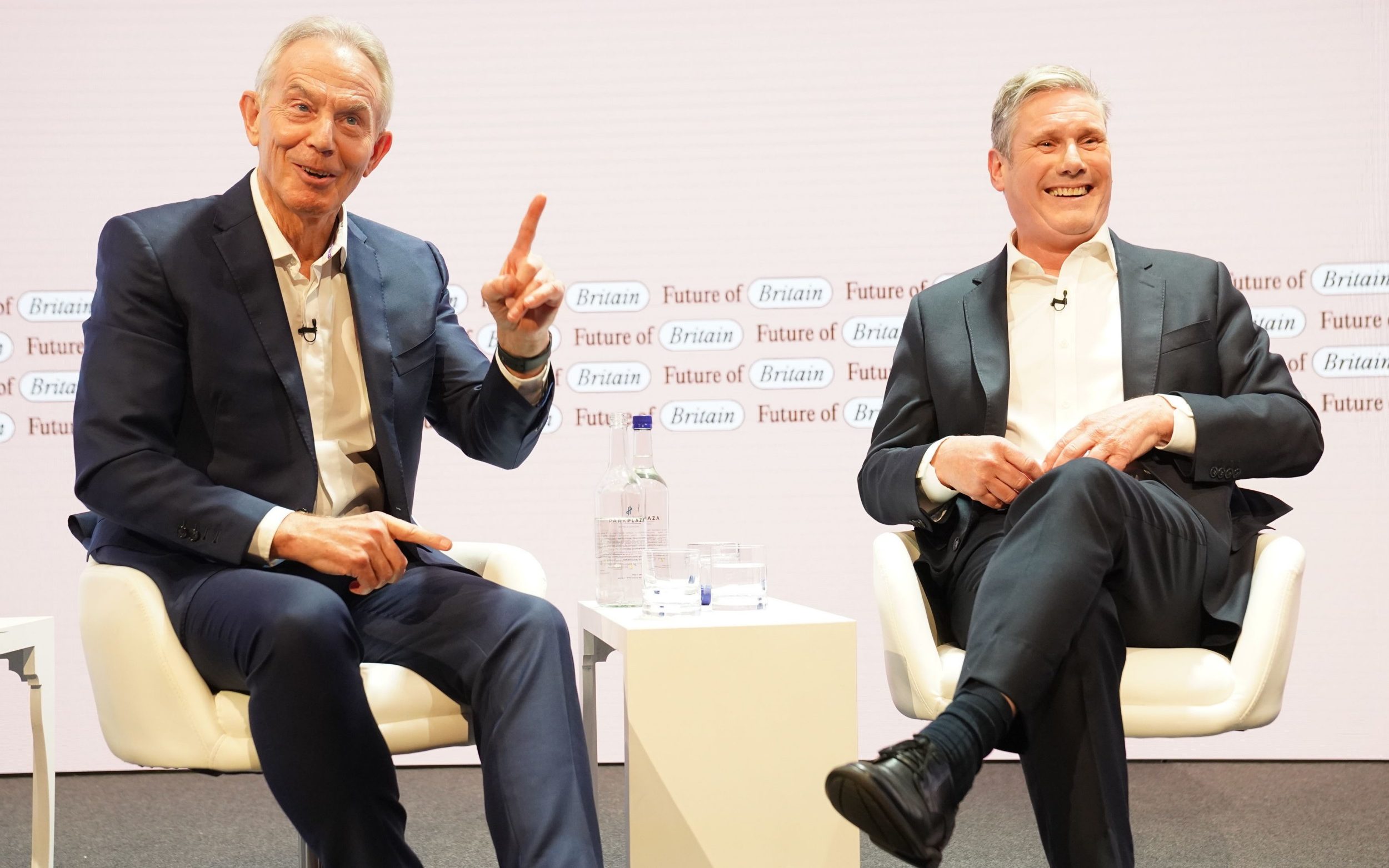
The major political event of the summer may turn out to be not the Uxbridge by-election but the public anointing of Keir Starmer by Tony Blair. This went beyond a simple laying on of hands to a very public mind-meld on the "tough decisions" that will have to be taken around public services after 2024. What was interesting in the press coverage was not simply the emphasis on ideological continuity, which won't come as a surprise to anyone, but the recognition that this public performance was also about rehabilitating Blair, or perhaps more accurately reassuring him that the party was now safe for him to approach. John Crace in the Guardian, who rarely manages to delve beyond the surperficial, made the point that "Blair needs Starmer to prove to himself that he’s still alive. That all those wilderness years were worthwhile. That he still means something. And Starmer needs Blair as a signpost to the future. That after four election defeats, there is a clear path to victory." What this does reveal, if unconsciously, is how much Labour's politics is now about personality rather than policy.

This was made clear in the aftermath of the three by-elections on the 20th of July. Having not unreasonably written off Somerset and Frome long before the count, Labour then managed to turn two excellent results, a gain in a traditionally Tory seat and a big vote improvement in one until recently seen as safe enough for an indolent Prime Minister, into a witch-hunt targeted on a slightly less right-wing Labour London Mayor. Together with the relentless briefing against the hardly-radical Andy Burnham and the blackballing of Jamie Driscoll, this emphasised how much Labour's politics have expanded from simple left-right factionalism to the personal factionalism that was a feature of the New Labour years, most obviously the division between Blairites and Brownites (predictably, Ed Miliband is still being briefed against and you can't help suspecting that the rowing back on green commitments is as much about discomfiting him as pursuing "fiscal responsiblity").

Historically, Labour leaders have tended to respect the separate democratic legitimacy of local government, even when at loggerheads. For example, Neil Kinnock's fulminations against Liverpool City Council in the mid-1980s were just that: fulminations. Though the party moved to expel Militant Tendency members, its attitude towards Labour town halls didn't go beyond chiding. This could be excused by the fact that Labour wasn't in power nationally, but the same approach was largely taken by New Labour when it had full control of central government. Blair famously blackballed Ken Livingstone, but after the latter ran and won the London Mayoralty as an independent, he was allowed back into the party and re-elected on the Labour ticket. Though the move by the Blair government to create London Underground as a public-private partnership was a clear attempt to clip the Mayor's wings, Livingstone was eventually vindicated as it was brought back under Transport for London control during the Brown years.

Under Starmer, there has already been a step-change in relations with local government that can only presage a more interventionist approach once the party is in control at Westminster. This goes beyond rigging selections and marginalising the left to actively undermining anyone who appears to be developing a personal popularity that might provide a focus for opposition to the leadership, hence the briefing against the likes of Sadiq Khan and Burnham, neither of whom has ever shown either the ambition or independence of Livingstone. The attack on the London Mayor in particular is telling given that he hails from the party right. While some assume the fuss over ULEZ and whether it had a bearing on the Uxbridge result is simply an excuse to further water down the party's climate change policy and reassure reactionary voters elsewhere that Labour is on the side of the "hard-working motorist", it shouldn't be ignored that this is also about pre-emptively telling Khan that local government policy will not be independent of central government diktat.


A sub-plot in the summer commentary was the election in Selby and Ainsty of the "briefcase child", Keir Mather: a 25-year old apparatchik from the right of the party who has reliably parroted Starmer's preferred lines on all policy matters. While this elicited complaints about a lack of real world experience and charges of ageism on the part of his critics in equal measure, the obvious message to the wider party is that loyalty to the leadership is all that matters while the message to constituency parties and local electorates is that there will be no let-up in the parachuting of preferred sons and daughters into safe or winnable seats. These three developments - personal factions, centralised control and preferment - are characteristic of the turn towards governmental absolutism. All of these features were there under New Labour, but they had to be accommodated with the other tendencies of the party, towards democracy and diversity, and reconciled with the institutional authority of the trade unions. That accommodation and reconciliation now appears to be rejected.

Blair was ultimately a product of his class: a manadarin dilettante (consider his naivety over technology) with delusions of grandeur (consider Iraq) and a messianic zeal for a shallow modernity (consider his overuse of the word "modernisation"). Starmer is different in two respects. First, despite all the quibbling about whether his dad really was a worker or a manager, his social origins are clearly more "mundane" than Blair's and this informs his innate cultural conservatism, notably his anti-intellectualism. Blair may not have fully read Anthony Giddens, let alone Jurgen Habermas, but he paid lip-service to the idea of "thought". Starmer, with his reliance on focus groups and pessimistic readings of sociology (in the Goodhart and Goodwin mould), is clearly more interested in "instinct". Second, Starmer, with his long stint as DPP and proximity to the intelligence services (notably in Northern Ireland), is a creature of the state rather than just another posh boy who thinks he might make a good Prime Minister.

What I think this all adds up to is a heightening of the absolutist approach, which ironically co-exists with a lack of fixed principles. The old argument about not being able to do good without first winning power is being replaced by the argument that winning power is all that matters and if good is eventually to be done that will be a matter for the Treasury and market sentiment. The problem is not simply that the electorate is not being offered a message of hope but that it is being reminded in no uncertain terms that hope is for the naive. The prospect is not of a genuinely reforming administration (the "reform" promised for the NHS will clearly be just a repetition of yesterday's failed policies) but of a permanent government of conservative bureaucrats whose loyalty will be first to the political cartel and then to the interests of property. Activism will be frowned on unless it takes the form of lobbying through the cartel itself (so the gender critical will get a hearing but Extinction Rebellion and even Greenpeace will be anathematised). The police and intelligence services will be further reinforced.

In many ways this is the logical conclusion of the work of both Margaret Thatcher and Tony Blair. The creation of "politically constituted property" (in Ellen Meiksens Wood's phrase) through privatisation, allied with the growing importance of industry lobbyists at the public-private interface, has created an environment of sinecures and revolving doors. Corruption has dwindled in local government and the public sector not because of any moral revolution but because so much of it has been reclassified as legitimate market transactions. The pandemic did not reveal a sudden collapse in the due diligence of central government in awarding contracts. It merely publicised an already corrupt and compromised process. The worst people in the world (e.g. former MPs such as Angela Smith, Michael Dugher and Ian Austin) are held up not as paragons of virtue (that would be silly) but as valued non-execs and rightful office-holders. The glue of absolutism is hierarchy and the key message that the next government will deliver is: Know your place. That is the thread that runs from 1979 to today.

Signal and Noise

The government has proposed to "crack down on rip-off university degrees". This means that courses with "poor outcomes" - measured in terms of dropouts, low ensuing employment rates and wages, and high initial costs and student debt - will have their enrollments capped. Inevitably exceptions will be made for strategically important courses, like medicine and engineering, and no one seriously expects the measure to affect the Russell Group. This is clearly about reducing access to higher education in the service of class prejudice as much as reducing costs to the Exchequer, hence the positive reception in the Tory press after years during which columnists who did Classics or PPE at Oxford have insisted that we must do away with "mickey mouse" degrees along with the divisive nonsense of critical theory. Whether this latest initiative will actually amount to much, or is simply another culture war spasm, only time will tell. But what I want to concentrate on here is not the all-too-obvious motivations of a Conservative government in its death-throes but rather the nature of the criticism that has been levelled at it. This has predominantly rested on a dichotomy of the instrumental and the cultural: the claim that the government know the price of everything and the value of nothing.

The state cannot help but think of university education in instrumental terms, specifically the contribution of trained graduates to the economy, just as it necessarily thinks of healthcare in terms of maximising and reproducing the labour force. That this should put it at odds with those who adopt an aesthetic defence - that education is a good in itself - is in no way surprising, but it also does not mean that the government of the day is therefore philistine, as many of its critics have suggested. Likewise it does not mean that those advocating the civilising qualities of study are not free of snobbery and prejudice. One grimly amusing aspect of the criticism has been the emphasis on the democratic nature of higher education: that it should be available to all and that in capping courses we are discriminating against students from poorer and minority backgrounds. But higher education in the UK has never been (and probably never will be) available to all and it remains (and probably will remain) a social hierarchy in which the poor and minorities are systematically disadvantaged.

The suggestion that the government should adopt a more holistic approach, committing to increase gross national happiness rather than just gross national product, sounds nice but it runs up against this very problem: that higher education in the UK is selective and exclusive (consider the regular anxiety over "grade inflation"). The traditional justification for this was that educating a minority of the population in expert roles was a positive contribution to society as whole - more doctors, teacher, engineers etc - with the implicit understanding that progressive income taxation would recyle some of the financial rewards accruing to further education into the public treasury for general benefit, including the funding of future access for the disadvantaged. As tax solidarity has declined since the 1970s, and as the introduction of tuition fees has put a very public price on higher education (albeit misleadingly as the actual cost to the public treasury of training a BSc in Engineering is not the same as a BA in French), the emphasis has shifted increasingly to the idea of societal contribution, and that has served to turn up the volume of attacks on courses whose utility is not instrumentally obvious, like critical studies. 

The irony is that if the government were truly instrumental then it would be pushing for greater state direction of education and explicit planning of courses and numbers to feed into a larger economic plan. But the contemporary state does not do that sort of planning. Consequently, the space is inevitably filled by the market - i.e. delegated, diffuse planning in which price signals (e.g. earnings post-graduation for different courses) are meant to work their magic, even though the evidence to date, for example the way that every university promptly chose to charge the maximum in tuition fees after these were raised after 2010, is that there is no actual market. That universities become businesses and students become consumers is simply the logic of this planning absence but it doesn't mean that either behave as such: the businesses don't actually compete and the consumers don't actually decline inadequate offers and take their custom elsewhere. If a student switches from one course to another, or even to another institution, that isn't taken as a judgement on the supplier but on the consumer.


One reason why the market approach doesn't work in practice is that only a small minority of students have a clear career objective, and they are the ones least likely to respond to price signals. If you're determined to be an electrical engineer and want to study at a particular college, you're not going to prefer another university simply because it is 5% cheaper, and you're certainly not going to switch to studying Russian at that first collge because it's on special offer. Not only do many 18-year olds have no idea what career they will pursue, the uncertainty of the future means that they cannot be sure whether a particular degree will still be as relevant and financially rewarding tomorrow as it is today. Beyond the class prejudice and anti-intellectualism, a lot of the contemporary chat about "low-value courses" reflects the wider anxiety over the future impact of technology on job prospects and wages - e.g. that AI will do away with writing so studying English or journalism is a dead-end. The future is unknowable so we should not expect teenagers to be clairvoyant.

The disproportionate impact of the course cap on poor and minority students is evidence of the failure of the strategy of university expansion that commenced in the 1990s. As William Davies noted, "The wider ideological problem is that, for politicians of all parties in the post-Thatcher era, the education system has carried the burden of sustaining the illusion of a classless society". This burden was always going to be insupportable because of the insistence that the state's involvement be limited to arranging the financing while the higher education market would efficiently allocate resources. Instead of directly intervening to remove the class and racial biases in the admissions process, the state allowed the university sector to continue with discriminatory selection, which has had the effect of creating a "ghetto" of courses (and institutions - i.e. the non-Russell Group polyversities) where low regard was a self-fulfilling prophecy. The government's eventual "crackdown" was baked in from the start.

The conservative antipathy towards universities, particularly in the claims that students are intolerant and academics are pushing divisive nonsense, isn't simply the seasoning of the charge that they are "ripping off" the younger generation. It is rather part of a more thoroughgoing critique that believes universities should not only be elitist institutions but that they should inculcate a particular worldview (the Western canon of literature and art, for example). But this goes against their nominal commitment to the market. If the consumers, i.e. students, want a woke education then that is what universities should provide. Likewise, there is a conflict between the idea that universities should return to a more elitist curriculum and the attacks on the metropolitan elite who were educated in it. What conservatives actually want to do is plan further education, not only in terms of numbers per subject but in the enforcement of norms of behaviour among students: it is a demand for an authoritarian education system, not a tweak in the market. That's the signal; the hysteria over free-speech is simply the noise.

Similarly, the critics of the government are not sincere in their calls for education for all, and few of them would back a genuinely meritocratic approach in which high-status institutions take the brightest and best candidates from across the country rather than disproportionately selecting from private schools. If they really believed in a democratic approach then they would support UBI, giving everyone the choice to pursue further education or training at any point in their lifetime and with any supplier but not obliging them to pursue it in a particular way or at a particular time, unlike the Liberal Democrat's  proposed "skills wallet" and similar schemes do. Likewise a commitment to a more inclusive education system would see the admissions process flipped so that ranking by schools determined access rather than selection by universities (i.e. a "bog-standard" comprehensive in Slough would get 10 places across the Russell Group each year and so would Eton College). What the government's critics actually want to do is maintain the status quo. That's the signal; the hysteria over philistinism is simply the noise.