Search

Friday, 31 May 2013

You can't come in

Facebook have agreed to tighten-up their admin regarding pages that glorify misogyny, which shows you how far Mark Zuckerberg has come since Facemash, the "hot or not" site he constructed at Harvard using online student photos. It also shows you the negligible difference that having a self-proclaimed feminist as COO makes. Sheryl Sandberg is a business-woman with political ambitions, which means she is more interested in PR exercises, such as exhorting other women to "lean in" and emulate her, than in the dirty but necessary job of initiating an ethical purge within her own organisation.

In the film based on the rise of Facebook, The Social Network, the Facemash episode provides one of the more risible moments of techno-nonsense, when the popularity of the site causes the university network to crash (OMG!). Excessive demand may cause a server to crash, but it has no impact on a network. In this case, the server was Zuckerberg's own PC, which apparently ground to a near-halt. The reason he got carpeted by the university authorities was not trashing the network but invasion of privacy, having hacked access to the photos. How times change.


The real hero of that film was Harvard itself. Despite the Winkelvoss twins accentuating the Horse Feathers-like absurdities of elite education, the university is shown in flattering terms as the gathering of the brightest minds and an incubator of talent. The slapdown of the twins by Larry Summers, the President of Harvard and later Bill Clinton's Treasury Secretary, is presented as evidence of the university's integrity and independence (Summers, by the way, was a mentor of Sandberg at Harvard and later appointed her to a role at the Treasury). This positive image doesn't extend to the female characters, most of whom are portrayed as eye-candy or bunny-boilers, with even the independently-minded girlfriend who dumps Zuckerberg due to his instrumental attitude being little more than a plot hinge, though this in turns suggests a compensatory fantasy in which Facebook is one man's revenge on womankind.

The other hero of the film is property, though this is so taken for granted that our sympathies are torn between different forms of property claim, with no real questioning of the paradigm. Even the lawyers are presented sympathetically. You can see the neoliberal arc in the transformation of stylised justice on film from 12 Angry Men and To Kill a Mockingbird to a dispute over stock dilution and intellectual property rights. What The Social Network does reflect is the degree to which the success of Facebook was based on exclusivity, initially that of Harvard, then of Ivy League universities more generally, and finally of the wider community of "cool" people. The slow collapse into uncoolness post-IPO was always inevitable. What's interesting is the role that elite education has played in this heroic trajectory. Though the Internet grew out of academia, both in terms of where it was developed and the paradigms it employs (Google's famous Page Rank algorithm is essentially peer review), few anticipated the degree to which it's social media incarnation would turbo-charge the snobbery and bullying that the geeks spent their time trying to avoid.

The online medium is thought to be inherently disruptive, but actually it reinforces existing power relationships, hence the pervasive sexism and trolling. This reinforcement is increasingly apparent in the case of MOOCs, massively open online courses, which are routinely described as revolutionary despite the evidence pointing in precisely the opposite direction, i.e. they are reactionary. After decades of expanding higher education, justified as the need to upskill labour as we "compete in the global race", we have reached an inflexion point and are starting to see college rolls decline as costs become prohibitive and state support for the disadvantaged is whittled away. The anxiety over Oxbridge admission bias in recent years is not a sign that we are democratising elite education, but that we highly value privilege. We want to make sure the worthy gain admittance, but we don't question the basis of such exclusivity.

During the period of expansion, elite colleges were able to maintain discretion over admission policies and so limit supply, which meant that increased capacity was met through marginal growth - i.e. converting polytechnics and other higher education colleges to universities. As this process reverses, MOOCs aren't going to supplant Oxbridge or Ivy League colleges that offer a positional good, they're going to erode the marginal sector. This means increasingly hard times for UK polyversities and US community colleges. In this context, the lead taken by elite institutions in developing MOOCs should be seen less as an altruistic desire to spread knowledge and more an attempt to reinforce the boundary between the best and the rest (completion rates are very low and persevering with a Harvard MOOC will not get you a Harvard degree). It is possible that elite MOOCs may become acceptable as credits for non-elite colleges, but it's equally likely they will remain as nothing more than glossy advertising for elite values. The unironic Boris Johnson's cry of "Buller, Buller, Buller!" is the emblem of our times.

The real disruption is likely to be further down the food-chain, where MOOCs become a viable substitute for non-elite higher education and professional training. If you think of education in practical terms as providing capital with skilled labour, then the medieval model of years spent studying non-vocational courses in an expensive college looks very inefficient when extended beyond a rentier elite. Online courses can provide capital with access to a larger pool of trained labour, with shorter lead times for new skills, at a fraction of the cost. As more and more work moves online and becomes highly standardised, location and wider social knowledge becomes increasingly irrelevant. British kids whose only qualification might be an online diploma will be in competition with similarly qualified kids from all over the world, which will inevitably drive down wages.

The combination of online access and the high cost of a bricks-n-mortar education will result in the university experience reducing back to a small social elite, while the majority make do with what are essentially vocational correspondence courses. The future looks very much like a reversion to the late Victorian era. One consequence of this is that access to scientific and academic careers will increasingly be reserved for the well-off who can afford the higher up-front costs required to get on the career ladder via post-graduate work, much as the way that careers in music and the arts have migrated up the class hierarchy in recent years. Art schools open to all are now as rare as working class pop groups outside of TV talent shows. The consequence of this, across science and the arts, will be a decline in innovation, because you're dependent on a smaller "gene pool" with an inbuilt establishment bias.

One thing omitted in The Social Network was Zuckerberg's background. The son of wealthy parents, he went to an elite preparatory school and was privately tutored on software development in his teens. He had a few advantages, over and above access to Harvard's campus LAN. From his earliest days, he knew the password, and it wasn't swordfish. The elite MOOC is an aspirational commodity. You can look, but you can't come in.

Monday, 27 May 2013

You Can't Live Forever

I finally got round to seeing the new Baz Luhrmann film of The Great Gatsby today, but managed to pick the 2D version with subtitles. I was happy about the former but the latter was disconcerting. It's fair to say that Luhrmann signposts too much without the additional aid of spelling out the words (which he even does for some choice phrases in the vanilla version). The subtitles also mean you get a track listing of the Jay-Z produced music, which threw up some eye-catching ephemera, such as the key role of The Bryan Ferry Orchestra. Most people seem to dislike the use of the modern stylee, as if only trad jazz should have been allowed (they don't quibble about the use of colour film), but I found it unobjectionable without being helpful. The story is a series of dramatic interiors, like a well-made play, punctuated with woozy interludes in which you're thrown off-kilter by booze or fast cars. The music doesn't really signify.


The GG (that's an in-joke for anyone familiar with the future queen's uncle) is one of my favourite American novels simply because it adds so much to the understanding of everything that came after it, and not a little to what preceded it. Gatsby has the same blood as Natty Bumpo and Ishmael, the same vital force as Augie March and Ferris Bueller. The skill of Fitzgerald is in making him both utterly unusual and yet recognisably an everyman, simultaneously superhero and mensch. He is the perfectly poised American ("poise and how to attain it" is part of his dream). He really is quite impossible. The film is carried by Leonardo Di Caprio, who in his first appearance, the famous "smile" scene, looks like a young JFK (he is surely inching towards playing the role one day). There are intriguing parallels with his portrayal of Howard Hughes in Scorcese's The Aviator: two obsessives who are humoured because of their wealth (Hughes, coincidentally, was the model for Tony Stark, aka Iron Man, who has become the role-model for the Bay Area libertarian ubermensch). Of the other main roles, Carey Mulligan lacks the icicle in the heart of Daisy, while Joel Edgerton is an echt Tom Buchanan.

The film's central weakness is Tobey Maguire, who is insufficiently suspect for the role of the unreliable narrator, Nick Carraway. They may as well have cast Tim Nice-but-Dim. On the spectrum from Philip Marlowe to Patrick Bateman, Carraway is closer to the latter. There is something callous in his makeup. For all his judgementalism about the other characters, at heart he simply doesn't care enough, hence he tolerates Gatsby's obvious deceit, Jordan Baker's dishonesty (less apparent in the film than the book), Daisy's selfishness and Tom's brutality. This is his strange honesty. He ultimately savours and celebrates Gatsby for the sincerity of his shallow beliefs. When he says "They're a rotten crowd", he's talking about himself as well. That green light represents both the possibility of advance and the perils of naivety - green for go and as green as a cabbage. It symbolises Nick's inability to believe or commit, and his fascination with those that are able to, whether sincerely like Gatsby or insincerely like Daisy. He is a modern protagonist with a classic existential dilemma, which he finally resolves by retreating to the Midwest and respectable obscurity (the film recasts this as alcohol dependency and writing therapy, implying that Carraway is Fitzgerald's alter ego).

In the novel, Nick's final cutting of Tom Buchanan in the street, and his interior eulogy at Gatbsy's funeral (attended by the hick father), do not ring quite true, which perhaps explains why these scenes are omitted from the film. They are cliched, and would probably have come across as gross melodrama in Luhrmann's hands. Yes, Nick has become sickened by the moral nullity of the rich, but he is not disillusioned. That's because he didn't start with any illusions, unlike Gatsby. The film also skips the "ellipses" after the party at Tom and Myrtle's apartment, which suggest he has secrets of his own (his attraction to Gatsby may be partly sexual).

The "society" that Gatsby aspires to is made up of shallow and stupid people, notably Daisy and Tom. The social scenes that Carraway wanders through - the parties at Gatsby's mansion, the drinking session at Tom and Myrtle's, the "business" meeting with Meyer Wolfsheim (focused on food in the book, drink in the film) - are all morally adrift. Luhrmann overplays this with the inferno-like scenes of the ash-pits between West Egg and New York, which were actually just scrubby edge-lands that in time became Flushing Meadows (home to the 1939 World's Fair and later Shea Stadium). The modern echoes, in terms of scene and  mood, if not geography, can be found in Less Than Zero and Imperial Bedrooms (for my money, Bret Easton Ellis is a more fitting inheritor of the "Fitzgerald des nos jours" accolade than the oft-cited Jay McInerney).

Perhaps the one authentic character is Myrtle, though she is conventionally despised by Fitzgerald for her lack of class and her cupidity (she buys a dog on a whim). She has the unapologetic spirit of desire that built America, even if she lacks the "capacity for wonder" of the original Dutch sailors arriving on the shore of Long Island. She is, more than Gatsby, who has managed to really live his dream for a while, the victim of the tale. If his key phrase centres on recreating the past, hers is the belief that "you can't live forever". She knows her time, her chance, is running out - that the fates are against her. Gatsby, in contrast, thinks he is inviolable. George Wilson, Myrtle's husband, is a weak man, in thrall to an idealised vision of his wife, and thus a doppelganger of Gatsby. Daisy kills Myrtle: dumb privilege trampling authentic vitality. Wilson ostensibly kills Gatsby in misdirected revenge, though the truth may be murkier - did Wolfsheim have Gatsby killed and then frame Wilson? The film invents dialogue to show Tom persuading Wilson to target and shoot Gatsby, while the novel leaves this open and doesn't show the act of murder, merely a punctured Gatsby floating suspiciously on an unpunctured lilo.

There have been a number of films of the story, though I've only previously seen the 1974 Jack Clayton version, starring Robert Redford and Mia Farrow. I remember the main impact it had was on fashion: Oxford bags, saddle shoes and tank tops. No wonder Punk happened. Like all great tales, the finest cinematic treatment is actually oblique. I give you Withnail and I: an unreliable narrator, unrealised dreams, self-delusion, drink and drugs, the perils of the city, escape to the country, cars, and portentous closing words.

Friday, 24 May 2013

The Invention of Capital

There is amusement to be had in the progress of Google from "Don't be evil" to Doctor Evil's lair, as implied by Eric Schmidt's verbal slip about being a "capitalist country", but this ignores a couple of truths. The first is that the famous motto is widely misunderstood, having nothing to do with ethics and everything to do with the search product's USP of unbiased results. "Evil" here is adrift of morality and no more than a consumption preference. It's just marketing. The second truth is that multinationals got out of state-building with the transition from mercantile to industrial capitalism 200 years ago. That shift was marked by the emerging nation states absorption of the mercantile corporations, most famously with the transformation of the East India Company into the British Empire in India.

The semi-independent nature of multinationals appears to live on in their use of offshore subsidiaries and their ability to negotiate as peers with government over tax, however this is misleading. Tax havens are extensions of the nation state. The British Virgin Islands are no different to the Channel Islands in this respect. Corporations do not operate outside the nation state, they operate inside it. Their exceptional status does not reflect any real difficulty on the part of government in taxing them, it reflects their economic power and thus ability to dictate favourable terms. It's worth bearing this mind as the clamour for tax reform builds. While governments are busy announcing "clampdowns", their policy changes are actually geared to making tax regimes more corporate-friendly.

Though there has been much talk about international cooperation to get tough with tax havens, this is unlikely to produce anything beyond the cosmetic. Tax havens are secrecy jurisdictions, which means they are concerned with personal tax avoidance as much as corporate, and it would take a global revolution to gain agreement to intrude on the financial affairs of the rich. The fact that secrecy jurisdictions have long been the primary conduit for global money-laundering has not led to their being shut down, so why should the embarrassment of Apple or Google change matters? Corporate tax avoidance is relatively small beer compared to personal tax evasion and untaxed criminal proceeds.

The key mechanism behind most high-profile corporate tax avoidance is transfer pricing (aka "fiscal dumping"), which allows a multinational to move costs to higher-tax jurisdictions, and so minimise pre-tax profits, and correspondingly shift revenue to low tax jurisdictions, and so maximise post-tax profits. The original rationale for transfer-pricing was to distribute HQ costs out to operating subsidiaries, thereby recognising the contribution of shared internal services and corporate know-how to local profitability. Over time, both transferred costs and revenues were increasingly made up of intangible assets based on intellectual property (IP), such as software copyrights, patents and the "brand". For example, HQ sells a patent to a low tax subsidiary for a nominal amount. The subsidiary then charges large royalty fees to operating companies in high tax jurisdictions, thus artificially shifting profits to the low tax regime.

There are international accounting rules on transfer-pricing and the valuation of IP, but these operate on an "arms-length" principle, i.e. prices must roughly match what would be charged in a open market by unrelated entities. The problem is that the price of something that is not publicly-traded, such as inhouse-developed software or a patent, is a largely subjective call, much like accounting "goodwill". It is also acceptable to cross-charge for advice, intellectual capital, that again has no fixed open market price. Though this should be done on a transparent cost-plus basis, this simply incentivises the corporation to over-pay executives and specialists and thus ramp up the allowable cost of these services. It also incentivises corporations to pay top-dollar for IP acquisitions (often done through stock rather than cash). A successful purchase can produce large royalties to limit tax exposure. An unsuccessful purchase can be written off against tax. This virtual capital has become a larger component of total capital over time, both as a result of technological change and stock bubbles. Capital is mobile not just in its money form, but increasingly in its constant (i.e. non-labour) form.

So what tax reform can we expect? One proposal is to tax corporate profits where those profits are generated rather than where the business is "tax-resident". If you buy a book on Amazon while sitting at a PC in London, then the profit should be taxed in the UK not Luxembourg or the US. The problem is that this doesn't address transfer-pricing, which can suppress local profits, as was demonstrated last year by Starbucks. The desire to tax the sale will inexorably lead to the tax point inching towards the point of sale, i.e. the actual cash transaction. As Larry Elliott suggested this week, "We can force [government] to introduce sales taxes to avoid profits migrating offshore".

A sales tax is regressive as it falls more heavily on those who have to spend all of their income on current consumption, in contrast to the well-off who typically divert a chunk into savings and investment, as well as non-VATable assets such as property. It is possible to implement it in a way that does not penalise the consumer immediately (the VAT amount is increased and the pre-VAT amount is decreased, with zero net change in price), however the eventual effect is inflationary. In fact, any policy that results in corporates paying their tax in full is inflationary as a subset is probably only profitable today because they currently avoid some tax. Free market theory holds that these businesses are inefficient and should exit the market, making way for new entrants, but in reality some will just put up their prices and get away with it.

Sales taxes are also problematic for government revenues due to widening inequality, which causes median incomes to stagnate, and globalisation, which leads to commodity deflation. Though the latter offsets the former to a degree, it results in a growing proportion of median incomes being spent on non-taxed goods, such as food and rent. This leads to a regular ratcheting-up of VAT and other sales taxes (or their extension to new areas). This is a vicious spiral: widening inequality and globalisation drive increased demand for public services in developed economies while simultaneously depressing tax receipts to pay for them.

Simon Jenkins had much the same thought as Larry Elliott, with a few more thrown in for good measure: "The trouble is that any company whose business is not nailed to British soil seems to treat corporation tax as voluntary. It might be better to ease it out in favour of sales tax, business property tax and, if the City bites the bullet, a financial transactions tax". Business rates tend to be reasonable because they relate to the provision of local services that are proportionate to property, such as roads and utilities. But a general tax based on business property would advantage those with a small footprint relative to profit (such as Google and Amazon), as well as companies that have offshored production. A financial transactions tax is not designed to increase tax receipts for public expenditure but to dampen down risky behaviour (high-volume trading) and to surcharge excess profits that arise (in part) from tax avoidance. In practice, the sales tax would end up doing the bulk of the work in Jenkins's scheme.

One "cunning plan" is to lower corporation tax rates uniformly to a level that stops avoidance being worthwhile - the Laffer Curve for business. The result of this would not be a change of direction, but rather the continuation of the neoliberal strategy of the last 35 years. As Robert Peston noted, the current problems arising are "part of a broad trend of multinationals paying a much smaller proportion of public sector costs in all the world's developed economies. In the US, for example, corporate tax generated 32.1% of all federal taxes in 1952. Today that proportion has fallen to a puny 8.9%". Peston rather ingenuously suggests that "hoarding cash in low-tax centres seems in some ways a bit pointless for publicly owned corporations - in that it creates enormous complications when it comes to getting the cash to its rightful owners, the shareholders". But as Apple has recently shown, these deposits can be used as collateral to raise loans that are then used to pay dividends to shareholders. Thus tax avoidance fuels private sector debt, which is already at high levels due to years of low interest rates encouraging debt financing.

Another proposal is to adopt unitary taxation. This involves rolling up a multinational's profits into a single consolidated number, which is then allocated pro-rata across all tax jurisdictions where it operates based on an agreed formula, e.g. volumes of sales or employee headcount. The ruling tax rate in each state is then applied to that state's share of the profits (it's worth noting that this is already done at a federal level in the US and Switzerland). The biggest benefit is that it makes transfer pricing pointless. However, it doesn't address the pricing of intangible assets. In other words, the consolidated profit figure is still open to manipulation by the over-valuation of IP.

So what's likely to happen? There seems little reason to expect a change in the long-term trend of tax composition in the UK or other advanced economies. This means a continuing shift from income taxes to sales taxes, and simultaneously from taxes levied on specific goods to taxes on general consumption (the standard rate of VAT rose from 8% in 1979 to 20% by 2011). Corporation tax has remained a relatively small component, and highly geared to the business cycle. Local taxes have declined due to the centralisation of government since the 80s. Income taxes have been fairly consistent over time, as a share of total revenue, however this masks a shift of the burden from the well-off to the less well-off through the increasing share of capped NICs, the conversion of income to dividends and capital gains, and the regressive impact of increased personal allowances (i.e. reduced benefit to minimum wage earners). History would therefore point to an increase in VAT as an ironic strategy to tackle corporate tax avoidance.

Unitary taxation has an obvious attraction for the EU, not least because it does not require harmonisation of corporation tax rates, though it would gradually encourage it. Multinationals would see fewer advantages in being based in low tax states like Ireland or Luxembourg, and those states would have less reason to keep rates low as an attraction for multinationals. In practice, there would not be a lot of change. Companies like Google are based in Ireland for a variety of reasons, including language, education levels and local wage rates. There would probably be fewer company secretary jobs in Luxembourg, but I suspect the local economy would cope. The key point that makes unitary taxation a good bet is that it makes no attempt to address the issue of IP valuations. That, ultimately, is what companies like Google, Apple and Amazon are most keen to protect. This would mean that a mechanism remained by which corporations could, in collusion with governments, determine their effective tax rate while burnishing their corporate social responsibility credentials.

It is the gradual transformation of capital from hardware to software that is driving corporate tax avoidance.

Tuesday, 21 May 2013

Asleep at the Wheel

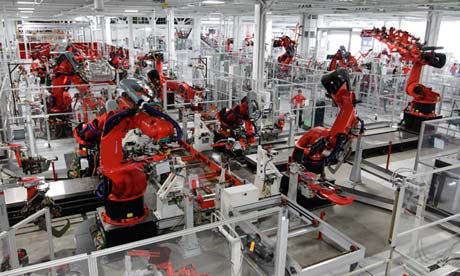
As the reality of capital-biased technological change (more robots, fewer jobs) begins to bite, the supporters of social democracy become ever more desperate to find a silver lining. Will Hutton in The Observer tells us that "Suddenly a robotised, automated economic reality is moving off the science fiction pages and into daily life". Of course, there's nothing sudden about this. His article is illustrated by a contemporary photo of robots constructing Tesla sport cars (below), which immediately recalled for me the famous Fiat Strada "Hand built by Robots" advert from 1979.


There are three features of this picture that I think are worth noting. The first is that the robots are painted blood red, as if in an attempt to indicate some residual corporeality: once were workers. The Fiat opus celebrated the absence of the human in the manufacturing process, which was satirised by the Not The Nine O'clock News's "Hand built by Roberts" sketch. The second thing that strikes me is that you cannot immediately tell what is being manufactured here. It could be anything. The Strada advert understandably foregrounded the car, but in so doing suggested that robots were a heavy industry application and no threat to whitecollar jobs. The third feature is the clean room environment, enhanced by the use of white paint and grey metal, which contrasts with the Fiat advert's classically dark and grimy industrial setting. There is a practical aspect to this, inasmuch as keeping dust and dirt out is good for equipment maintenance, but there is also an ideological resonance in the pretension to a sterile lab.

The one thing the Strada advert couldn't do was excise the test drivers of the newly built cars. The measure of the distance we've come since 1979 is that the Google driverless car is already a proven technology, though not yet commercialised (unless they're charging a fee for media appearances). You wonder why? Hutton talks up the benefits of this technology (though he omits drunk-driving) but fails to put it into a social context. Automation costs money, and there is no offsetting saving on you, the erstwhile driver, so most people will initially forgo the benefits for a cheaper, non-automated model. Many of the collective benefits, such as increased road capacity and lower (possibly non-existent) driver insurance, will only arrive when automated cars are mandatory and the non-automated outlawed. It should be obvious that automated cars can only succeed as a result of government diktat, which means they'll probably happen sooner in Europe and Japan than the US (anti-gun regulation will be augmented by anti-car regulation as a leading libertarian identifier - just think of the bumper stickers: "Defend your right to crash!").

Hutton's social naivety is also clear in this statement: "Some argue that a dystopian world is emerging in which good jobs and full-time employment will become the preserve of an educated, computer-literate elite". Doh! Despite the consistent trumpeting of the benefits of education (skill-biased technological change), there will be no correlation between "good jobs" and computer literacy. While there will obviously be a class of highly-skilled and well-paid techies (atop a pyramid of digital peons), most "good jobs" in the future will be rent-extracting and their occupants (increasingly hereditary owners) will continue to pride themselves on their lack of IT skills (a corporate lawyer using a Blackberry does not constitute "skill"), just as the bourgeois of the first industrial revolution prided themselves on their uncalloused hands. As a social democrat, Hutton believes there is still hope that the future economy may produce large numbers of well-paid, skilled jobs. He identifies four areas.

"The first is in micro-production. There is going to be a huge growth in micro-brewers, micro-bakers, micro-film-makers, micro-energy producers, micro-tailors, micro-software houses and so on who will deploy the internet and micro-production techniques to produce goods at prices as if they were mass-produced, but customised for individual tastes". If the small number of goods we produce are at mass-production prices, then our turnover and profit will be tiny. We could make a living through customisation, but that means charging a premium price. These are middle-class dilettante businesses that assume a lot of well-off buyers - i.e. our fellow artisans supporting their own lifestyles through a trust fund, share portfolio or property rents. The future looks like Mumford & Sons.

"The second is in human wellbeing. There will be vast growth in advising, coaching, caring, mentoring, doctoring, nursing, teaching and generally enhancing capabilities". While there is certainly a market for life-coaching, assisted navel-gazing and other indulgences, mass-market "human wellbeing" services are already being automated, where they aren't being de-professionalised, such as in teaching and nursing. The reality of Hutton's vision for most people will be an increase in low-paid jobs providing care for the elderly. The future for many smells of wee and boiled cabbage.

"The third is in addressing the globe's 'wicked issues'. There will be new forms of nutrition and carbon-efficient energy, along with economising with water, to meet the demands of a world population of 9 billion in 2050". These aren't new industries, merely the evolution of existing ones. For "nutrition" read agriculture and food processing. If you think this is about to produce a huge increase in employment, then you haven't been paying attention. At this point Hutton starts to spin giddily out control: "Space exploration will become crucial to find new minerals and energy sources. New forms of mining will allow exploration of the Earth's crust. The oceans will be farmed". Sweet, suffering asteroids - we're going to exploit space! I presume by farming the oceans he means harvesting those creatures, you know, fish.

"And fourthly, digital and big data management will foster whole new industries – personalised journalism, social media, cyber-security, information selection, software, computer science and digital clutter removal". This is techno-nonsense that could do with some serious "clutter removal". Personalised journalism is just a euphemism for targeted advertising. It doesn't mean you get Jon Pilger or Peter Hitchens to give you their undivided attention for a day. It will not produce any more jobs, beyond the unpaid artisan-microblogger. While it is true that techno-bollix like big data will be used to create supernumerary, rent-extracting roles, these will just displace similar roles based on older bollix, like PR. Parkinson's law operates at the aggregate as well as the individual level.

I can't be too harsh on Will Hutton. Though he is trying to keep his spirits up with the power of positive thinking, he does at least recognise the reality of the transformation we're going through, the current absence of any "double movement" to protect society from its effects, and the ideological role of neoliberalism in ruling out the possibility of resistance.

He concludes: "Britain will need the open innovation structures, financing mechanisms and social support institutions to capitalise on the opportunities quickly, rather than be overwhelmed by the risks". The problem is that these very mechanisms and institutions are currently being reengineered to preserve the interests of the few in the face of the incoming tide. Translated into plain English, education ("open innovation structures") is being forced to readopt its traditional role as a class filter rather than a talent amplifier; The City ("financing mechanisms") is determined to restore the ancien regime under which the interests of society are subservient to the interests of Money Capital; and the welfare state ("social support institutions") is being picked apart and the profitable bits handed over to Big Capital.

The historical irrelevance of social democracy stems from its belief in the necessity and desirability of full employment, and the associated use of universal income tax to redistribute wealth via a welfare state. It can cope with temporary unemployment, and may even benefit from a small, persistent underclass as a goad to keep the mass of workers "respectable", but it has no answer to a society in which a growing minority are simply surplus to requirements. Inventing fantastic jobs, from micro-tailor to ocean-farmer, simply avoids confronting this.

Monday, 20 May 2013

Arsenal Do That Thing Again

And so we finished fourth. As predicted. And we won one-nil away from home, no less. Talk about retro. I've held off writing about Arsenal since the aftermath of our home defeat by Bayern Munich. Not because of any rabbit's-foot paranoia, but simply because it looked to me like the second half of the season was going to follow a familiar trajectory, though I confess the victory away to the new "best team in Europe" in the return leg almost had me attacking the keyboard, if only to wonder why we make a habit of doing this Jekyll and Hyde thing (see AC Milan in 2012 and Barcelona in 2011).

I admit that the away defeat to Spurs, shortly after the loss to Bayern, was a downer, but not wholly unexpected. Tottenham have put together a decent squad, while ours has been poorer than usual, which is why they ran us close. What I did expect was that we would gradually erode their points advantage. Andre Villas Boas's mistake, which he probably won't make again, was to think that a 7-point gap in early March was conclusive. As many a Spurs fan pointed out, they enjoyed the same gap after their 5-2 defeat at the Emirates at roughly the same point last season. Arsenal fans could feel confident because we usually out-point Tottenham over the closing straight. In the event, Spurs didn't implode in classic style. Over the last 12 games, they've been 3rd best in the form league. Unfortunately for them, Arsenal have been the top form team.

This last point highlights a frustration for many Gooners, namely that we could have made a decent tilt at the title had we been as effective earlier in the season. Of course, this ignores the salient fact that we had a lot of new players to integrate into the team, not to mention the need to re-engineer an attack previously reliant on Robin. As I suspected back in January, the increasing familiarity of the team produced a solid groove of decent results - i.e. getting points even when the performance was below par. It was also noticeable that we improved away from home, scoring more but crucially conceding very few - only 1 over the last 5 away games since White Hart Lane. Our home form was decent but not spectacular. Since defeat by Man City in mid-January, the only blemishes in the league were draws against Liverpool, Everton and Man Utd. Had we been in pole position, this would probably have been tolerable.

Attention now shifts to the summer. Given the amount of managerial change among the top four, I suspect we'll see a spike in "making a statement" signings (that rules out Loic Remy, unless the statement in question is being made to the police). In today's Football Focus fag-end, the main topic of debate was whether Gareth Bale will now sign for Manure (along with Baines, Fellaini and Jagielka, no doubt). I really wanted Martin Keown (who loyally insisted that Arsenal now have real money to spend, not just the legendary "war-chest") to innocently suggest that Wenger might make a bid, but his current schtick is the conventional "obdurate defenders make thoughtful pundits" one, so sarky humour must be suppressed until you've served your time and ascended to the 70s light entertainment nether-world of Hansen and Lawrenson. Keown is actually an intelligent observer (though alongside Garth Crooks and Robbie Savage the cast of Made in Chelsea would appear incisive), but much too diplomatic. His future at the BBC is assured (I suspect Lee Dixon parted ways because he could not always suppress his engagingly derisive laugh).

We obviously need another striker. Podolski has proven a useful specialist. If he can get over the injury he's been carrying, he could even hit 20 goals a season, but I doubt he'll ever be the main man. Giroud has been a lot better than his critics have generally allowed, but for all his good link-up play he remains too slow to be the pivot-cum-poacher that the modern game demands. This is why players like David Villa keep popping into the frame. Of course, this implies a possible reconfiguration of Arsenal's game-plan, assuming Wenger keeps Giroud in the starting eleven. Perhaps the most interesting development will be Wenger's decision on Rosicky, who is the closest we have to a central number 10 (Wiltshere and Cazorla tend to drift out towards the sides of the penalty area) and often the catalyst for upping our tempo. I suspect Le Prof will try to resolve this by acquiring a a mobile striker who can play wide, central or deep. Luis Suarez would appear to be tailor-made, despite the houndstooth.

The midfield has improved with every game. Arteta got the recognition he deserved early on, and has been consistently reliable since, while Ramsey has gone from the new Jon Sammels to the new Ray Parlour. Oxlade-Chamberlain looks ready to step up, while no one can deny that Walcott has matured, even if he remains a player of fits and starts. Cazorla has been the player of the season for me, if only because he has never been less than good in what is usually a variable first campaign (cf Giroud). I suspect he'll miss out on the usual "EPL team of the season" polls due to the eye-catching performances of Mata and Michu (and idiots voting for Giggs), but he's been a joy to watch and that promises much for next season.

The defence has been the key to recent results, hence the unwillingness of Wenger to let Vermaelen loose when Koscielny and Mertersacker have been so effective as a partnership. The Belgian has been unfortunate, perhaps suffering from being promoted captain, and I wouldn't be surprised if a move to Barca (who need recruits) isn't on his mind. With Squillaci and Djourou likely to move on, a new centre-back or two is presumably on the shopping list. The same may be true for goalkeepers. Fabianski must have figured by now that he's inherited Dan Lewis's 1927 jersey. As soon as he puts in a few decent performances, calamity (injury or a freak goal) strikes. While Szcsesny probably still has the manager's faith, an experienced backup looks like a prudent investment.

All in all, a bit of a "transition" season. We've got RvP out of our system, and even the (admittedly unlikely) Fabregas rebound is prompting more concern about Wilshere than anticipation about the return of the prodigal. The danger is that if Vermaelen, Rosicky and Sagna all move on, we could be faced with a further extension of that transition as we integrate more new players with insufficient seniors, even though the squad unquestionably needs to be augmented. Our success, as ever, may therefore be down to who doesn't leave as much as who comes in. In 1970-71, we used only 16 players over 64 games (42 in the league). That was unusually parsimonious even then. In the modern era of rotation and injury caution, a winning squad tends to have plenty of competition. Our squad is probably 3 or 4 quality players short of the ideal. More out of hope than expectation, I'm looking forward to a busy summer.