Len McCluskey's comments about using the Olympics as a focal point for anti-cuts protests predictably resulted in condemnation by both Conservatives and Labour this week. It should hardly be necessary to point out that McCluskey's actual comments were perfectly reasonable and probably just a ploy in respect of current negotiations over pay for Unite's bus workers.
The hysterical reaction could be attributed to the way in which everyone seems to take leave of their senses where the Olympics are concerned. It coincided with the latest PR push on the security preparations, with RAF planes scrambling over London to intercept a notional terrorist threat. Apparently, there are surface-to-air missiles somewhere about the place as well, possibly in a lock-up in Catford. There is an element of "fighting the last war" about this, but that is understandable when the purpose is reassurance as much as deterrence.
What is more interesting is the tone of the reaction. Both Milliband and Cameron talked about McCluskey's words as being "unacceptable", which implies they think he has committed a grievous faux pas. Milliband went on to say: "This is a celebration for the whole country and must not be disrupted". Cameron topped that with: "The Olympics are a great opportunity for this country to show everything that is great about the United Kingdom and advertise ourselves to the world".
At this point you begin to sense that the party leaders see the event in essentially PR terms - putting the UK in the shop window. Milliband then took leave of his senses with the following: "We all need to be rallying behind the Olympics – it's going to be an important opportunity for Britain and it's going to affect our jobs, our economic growth in the future and the prosperity of this country". The contribution of the Olympics to future growth will be negligible: most of the economic stimulus has already passed and the legacy is biased towards consumption (e.g. Westfields) rather than production, so don't hold your breath on prosperity.
McCluskey's key point was to contrast the Olympics love-in with the reality of cuts and the slow privatisation of the NHS. He said: "I believe the unions, and the general community, have got every right to be out protesting. If the Olympics provide us with an opportunity, then that's exactly one that we should be looking at". This actually reads as a rather defensive statement, insisting on the right to protest, and perhaps reflects the prevailing assumption that for 3 weeks we'll all forget about the real world.
Perhaps McCluskey's real offence is to have threatened embarrassment in front of our guests. This embarrassment ultimately comes down to revealing the truth about who we are. The recently broadcast documentary series on the anti-apartheid movement, Have You Heard From Johannesburg, made the point that the purpose of protest is often to stimulate a reaction that reveals the truth about a situation. The South African government dismissed the anti-apartheid movement as a tiny number of communists and insisted that the majority of the population were happy with separate development.
The success of the recent campaign against penalising unpaid work experience refuseniks is an echo of this. The government dismissed the campaigners as "Trotskyists" and insisted that employers, the public and the young unemployed themselves all loved the scheme. Protest appears to have brought a different truth to the surface.
What truth do we fear would be revealed if we have a protest at the Olympics?

Thursday, 1 March 2012

Monday, 27 February 2012
Give me five

The above photo was taken just before Muhammad Ali (Cassius Clay then) met Henry Cooper for the first time at Wembley in 1963. This was the occasion on which 'Enry's 'Ammer floored the young American but the fight ended in Clay's favour due to a cut over Cooper's eye. They met for a second time in 1966, the venue this time being Highbury. As a lifelong Arsenal supporter, Cooper was no doubt inspired by the setting but ended up losing again, despite being ahead on the scorecard, due to another cut over the eye.
This season looks like it will have a few more twists and turns. The eventual outcome will probably hinge on the effectiveness of our defence, which in turn means we need to start getting more luck with injuries, or at least avoid any further calamities. We looked disorganised in the opening few minutes against Spurs but tightened up considerably thereafter. The pressing in midfield was excellent and the pace exemplary. Tottenham couldn't live with us in the second half.
Meeting Liverpool after their Carling Cup win is no bad thing. Teams unconsciously ease up a little after winning silverware. If we can show more desire, I think we can nick three points, though a draw would be acceptable in the circumstances.
While many consider the return leg against Milan to be a dead rubber, I think it could turn out to be pivotal for the rest of the season. We know we can score big, and while the Rossoneri should be too cute, they're vulnerable to pace as a number of British teams have shown in the past. Even if we don't score enough to progress, a good win (and clean sheet) could be the launchpad for a strong run at third place. That, not fourth, has to be the target now.
Cooper was a popular boxer because he forced the pace, opening up his opponent's defence before landing his trademark left hook. Robin van Persie's goal yesterday was particularly reminiscent of this. Ali tried to counter Cooper in their second bout by clinching him tight when he got close and otherwise keeping his distance. Arsenal need to press hard in every game now and up the tempo. And slap a tub of vaseline over everyone's eyebrows.
Saturday, 25 February 2012
I am gonner
Why do people watch the Oscars? You know, other people. I don't watch it myself because it's past my bedtime and, well, boring. But lots of other people get terribly excited by it, a bit like general election night, which has also become a sofa party theme in recent years. I'd like to say I never see it at all, but every year I am unable to avoid the highlights spattered across the wider media.
I sort of watched it once, in an alcoholic stupor. That was one of the years when Billy Crystal was compere, a man for whom the word "schtick" might have been invented. I think I fell asleep, tired out waiting for a car-crash that never came.
Is it simply anticipatory schadenfreude? There's usually either a host who dies under the weight of the lame jokes, or an irruption of delicious bad form as a Vanessa Redgrave or a Marlon Brando sub (no, not a sandwich) takes the mike. The entertainment interludes are usually chicken-in-a-basket fare, while there is a whole media sub-genre devoted to wardrobe faux-pas on the red carpet.
Given the amount of money spent, you'd expect a slicker operation. The interpolation of clips from the films, displaying their evident excellence, appears to be an almost cruel contrast, but I suspect this serves to emphasise the authenticity of the gibbering creatives presenting or accepting.
You don't have to be a cynic to suspect that Janet Jackson's nipple and MIA's finger at the US Super Bowl were unconscious attempts to introduce a frisson of danger into an event (half-time filler, after all) that lacks the Oscar's unpredictability. More successfully, the Brit awards have graduated from national embarrassment to international embarrassment with the aid of Adele's finger - presumably a gesture towards the US market, which has never got the hang of the two-fingered salute.
The tension around time is interesting. The stars are normally seen as people who are under pressure to give more of themselves to their public; they have no time to themselves; they're always on show (yeah, right). The awards ceremony is conversely an opportunity to publicly ration the limelight, to box them into a 45 second slot. "That's quite enough of you". Given Adele's recent ubiquity in terms of awards, James Corden was perhaps subliminally doing us all a favour.
A study has shown that Hollywood films between 1935 and 2005 have tended to gradually standardise shot lengths and rhythm to match the optimal human attention span. The end result might appear to be a case of the bleedin' obvious, as it's humans who edit films, but the gradual shift from longer to shorter probably owes more to the dominance of theatrical conventions, together with the technical limitations (and cost) of complex editing, at the beginning of the period. What's particularly satisfying is that the lead author of the study is Professor Cutting.
The point of citing this work is that there is an optimum time and an optimum rhythm. We can have too much of a good thing, and when the rhythm breaks down, it can be difficult to get it going again. All fairly trite, but given an extra poignance by the news that Andrei Arshavin is off home to Zenit St. Petersburg, probably for good.
The little Russian produced some fine cameos in his early days at Arsenal in 2009, echoing his form in the 2008 European Championship, but he lost his way during the latter part of the 2010-11 season and never managed to get back into a rhythmn. He was a player of moments, most notably his fine winning goal against Barcelona in February 2011. That unfortunately marked the beginning of the end.
In sport you really don't need the winner to step into the limelight. Post-match interviews are rarely entertaining, let alone enlightening, if the interviewee has just won or scored. The best interviews are usually with the losers. Similarly sports award ceremonies are risible because the attempts at explanation, or even mundane thanks, look so flimsy in contrast with the action that led to the gong.
At the Oscars, you get the feeling that some recipients want to top out their winning performance in front of the lectern. Many of them are instinctively acting, though obviously trying hard not to go full retard. The fun for the audience is the palpable risk of hubris.
One of the more endearing features of Arshavin was his reluctance to do post-match interviews. Some will put this down to poor English, or laziness, but I think he was intelligent enough to realise that he had nothing to add. I am gooner. That was your catchphrase. I am gonner would be appropriate now. But not forgotten.
I sort of watched it once, in an alcoholic stupor. That was one of the years when Billy Crystal was compere, a man for whom the word "schtick" might have been invented. I think I fell asleep, tired out waiting for a car-crash that never came.
Is it simply anticipatory schadenfreude? There's usually either a host who dies under the weight of the lame jokes, or an irruption of delicious bad form as a Vanessa Redgrave or a Marlon Brando sub (no, not a sandwich) takes the mike. The entertainment interludes are usually chicken-in-a-basket fare, while there is a whole media sub-genre devoted to wardrobe faux-pas on the red carpet.
Given the amount of money spent, you'd expect a slicker operation. The interpolation of clips from the films, displaying their evident excellence, appears to be an almost cruel contrast, but I suspect this serves to emphasise the authenticity of the gibbering creatives presenting or accepting.
You don't have to be a cynic to suspect that Janet Jackson's nipple and MIA's finger at the US Super Bowl were unconscious attempts to introduce a frisson of danger into an event (half-time filler, after all) that lacks the Oscar's unpredictability. More successfully, the Brit awards have graduated from national embarrassment to international embarrassment with the aid of Adele's finger - presumably a gesture towards the US market, which has never got the hang of the two-fingered salute.
The tension around time is interesting. The stars are normally seen as people who are under pressure to give more of themselves to their public; they have no time to themselves; they're always on show (yeah, right). The awards ceremony is conversely an opportunity to publicly ration the limelight, to box them into a 45 second slot. "That's quite enough of you". Given Adele's recent ubiquity in terms of awards, James Corden was perhaps subliminally doing us all a favour.
A study has shown that Hollywood films between 1935 and 2005 have tended to gradually standardise shot lengths and rhythm to match the optimal human attention span. The end result might appear to be a case of the bleedin' obvious, as it's humans who edit films, but the gradual shift from longer to shorter probably owes more to the dominance of theatrical conventions, together with the technical limitations (and cost) of complex editing, at the beginning of the period. What's particularly satisfying is that the lead author of the study is Professor Cutting.
The point of citing this work is that there is an optimum time and an optimum rhythm. We can have too much of a good thing, and when the rhythm breaks down, it can be difficult to get it going again. All fairly trite, but given an extra poignance by the news that Andrei Arshavin is off home to Zenit St. Petersburg, probably for good.
The little Russian produced some fine cameos in his early days at Arsenal in 2009, echoing his form in the 2008 European Championship, but he lost his way during the latter part of the 2010-11 season and never managed to get back into a rhythmn. He was a player of moments, most notably his fine winning goal against Barcelona in February 2011. That unfortunately marked the beginning of the end.
In sport you really don't need the winner to step into the limelight. Post-match interviews are rarely entertaining, let alone enlightening, if the interviewee has just won or scored. The best interviews are usually with the losers. Similarly sports award ceremonies are risible because the attempts at explanation, or even mundane thanks, look so flimsy in contrast with the action that led to the gong.
At the Oscars, you get the feeling that some recipients want to top out their winning performance in front of the lectern. Many of them are instinctively acting, though obviously trying hard not to go full retard. The fun for the audience is the palpable risk of hubris.
One of the more endearing features of Arshavin was his reluctance to do post-match interviews. Some will put this down to poor English, or laziness, but I think he was intelligent enough to realise that he had nothing to add. I am gooner. That was your catchphrase. I am gonner would be appropriate now. But not forgotten.
Tuesday, 21 February 2012
A hecatomb of oxymorons
| We seem to be living in an era of oxymorons. In addition to George Osborne's already discredited expansionary austerity (eat less and pile on the pounds), we recently had Sayeeda Warsi lecturing us about intolerant secularism. This gave me an idea for a new Viz-style cartoon, the Ungrateful Brats. Picture the scene: three scowling children find themselves in a park, faced by the kindly park-keeper.
Kids: What games can we play? Parky: You can play any game you like, and so can anyone else who uses the park. Of course, you don't have to play a game if you don't want to. You can sit on a bench or feed the ducks. Kids: You intolerant bastard! I may have to work on it a bit more, but you get the general idea. | 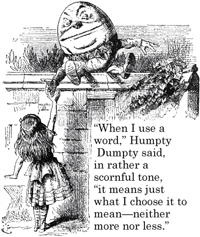 |
George Orwell's dystopian Newspeak deprecated adjectives and relied on nouns and verbs for its doublethink: war is peace, ignorance is strength etc. Lewis Carroll was perhaps more realistic when he has Humpty Dumpty say:
They’ve a temper, some of them—particularly verbs, they’re the proudest—adjectives you can do anything with, but not verbs—however, I can manage the whole lot!It's the adjectives that you have to watch out for. Slippery buggers. Rather than change a word's meaning, just encourage it to keep the wrong sort of company. Of course we shouldn't be surprised that politicians can convince themselves that words mean just what they want them to mean. The question is whether they actually believe what they are saying.
Language abuse has become a matter of house style for the right in recent years. What started as cynical tactics by the tobacco industry leeched out into wider industry lobbies and neoliberal think tanks, and then washed over the levees into creationism. In recent years, the booming sector has been climate change. The key features are well known: equating scientific uncertainty with doubt, calling denial scepticism, misrepresenting "theory" as unproven, and defining beliefs (e.g. intelligent design) as competing theories.
David Frum, a rational American conservative, wrote a great piece a few months ago on the shift of the Republican party to the wilder shores of barmy. He describes this as the development of a market segment, the target for Fox News, talk radio and Tea Party merchandise. The nurturing of this segment depends on a beleaguered, paranoid worldview and the explicit rejection of alternative views as not just wrong but intentionally evil.
Backed by their own wing of the book-publishing industry and supported by think tanks that increasingly function as public-relations agencies, conservatives have built a whole alternative knowledge system, with its own facts, its own history, its own laws of economics.He makes the point that the funding for this worldview comes from a small number of the super-rich, but that these aren't cynics manipulating the credulous, rather these shadowy billionaires actually believe the nonsense themselves.
For over sixty years we have assumed that Big Brother would arrive, if at all, via party and state. In the event, the proponents of 2+2=5 have arisen among, and been nurtured by, the freedom-loving entrepreneurs of the business world. How we all laughed about Steve Jobs's reality distortion field.
Sunday, 19 February 2012
Cranking the crisis klaxon
And so the "defining week" of Arsenal's season draws to a close. We have one of these every year. It's a tradition, like wearing a used keeper's jersey for a cup final. The press are predictably hyper-ventilating, with some now openly imploring RvP to quit at the end of the season to save his career. These are the same commentators who criticised Arsenal for not signing more players of van Persie's calibre last summer.
The defining week has a time-honoured plot, like a medieval mystery play, in which Arsenal crumple on multiple fronts and find themselves staring at another potless season. I'm only surprised it doesn't feature a dragon. The fact that in most seasons only 3 English clubs win anything is ignored. The narrative is about the shame of Arsenal not being one of them. Again.
As a long-standing fan, this isn't as irksome as many think, indeed the disappointment when you respond to enquiries like "you must be gutted" with "not really" is mildly amusing. It's as if you hadn't read the script. In truth, it's simply about knowing your history and having been round long enough to see much worse teams, with much worse records.
If you had told me at the beginning of the week that we'd only win one of three, but said I could choose which one, I'd have plumped for the league game. The 3 points are in the bank. Progressing a further round in a cup is fun, but the success is unlikely to be lasting. That's the nature of knockout competitions. All clubs recognise this, hence the relative downgrading of the cups. The days of the "cup team", willing to sacrifice league points for a good run, are gone. TV's position money has put paid to that.
The doom-mongering over the defeats has ignored some salient facts. First, that Arsenal won well away from home against Sunderland, coming from behind and snatching a late winner (the sign of a good team, we're normally told). Second, that we lost 4 defenders to injury over 3 games, one of whom is now out for the rest of the season. (I doubt even Barcelona could have shrugged off the rate of attrition we have suffered across the back line in 6 months). Third, that we were on the receiving end of a lot of bad luck: an offside goal build-up by Milan, Vermaelen's slip for their third, and two goals for Sunderland from shots that weren't on target. That's not to mention Ibrahimovic's penalty dive (the old knee to thigh trick).
We didn't deserve to beat Milan, but on most days we'd have lost 2-0 (had we nicked a goal, 2-1 would have felt like a victory of sorts). They're not that good, and we're not that bad. I suspect the flat, slow performance owed something to the exertions against Sunderland on a heavy pitch in the first game. Playing 3 games in 8 days on cut-up surfaces not only hampers our passing style, but it exacerbates the physical toll. That's not to say that we weren't poor, but we haven't suddenly turned into the worst team in living memory.
I'm sure we're all glad that another "defining week" is behind us. So what, objectively, did we achieve? We got through to the last 16 in Europe, and the last 16 in the FA Cup. Neither Manchester club could manage either, but they have different narratives. For Arsenal's detractors, being a top European team is not enough. It's victory or ignominy - nothing in between. This has been key to the narrative since 2006. We clearly flew too close to the sun then.
What I think this shows generally is that as league placings have become more and more a straight reflection of money spent, and as the amount of money needed to move up a place has grown so much, small relative movements have taken on a greater significance. Today's "surprise package" is a promoted team that doesn't get relegated immediately.
A team like Spurs is lauded for "cracking the top four" (and Harry Redknapp will no doubt get Manager of the Year for it, in addition to the England job), though no one really expects them to emulate an Everton or a Leeds and win the title. It's worth noting that plucky Spurs have been the fourth highest gross and net spenders in terms of transfers over the last 6 years. In terms of return on investment, their record is quite poor.
This attitude has become so entrenched that when a team punches above it's presumed weight, the positive delight for them is quickly drowned by the noisy inquest into the relative failure of others that this must entail. Winning has become a grind, an expectation, not an eagerly sought bonus.
The media pander to this, as noisy intemperance is a more compelling spectacle than reasonable judgement. This resulted in the strange sight of ITV's pundits lauding Zlatan Ibrahimovic midweek. This is a player that English commentators have taken great pleasure in denigrating over the years ("he doesn't do it in the big games"). For one night only (or two, if you count the 2-2 draw with Barcelona at the Emirates in 2010), Ibra was a giant among men.
It would take something to top that for cheek, but ITV managed it with Roy Keane yesterday. He was on the panel not because he is an astute and interesting pundit (he isn't) but because he could stick the knife into either team, depending on the result.
Adrian Childs seemed determined to provoke him, and remind us of the key narrative, by asking him if he'd got over the 2005 cup final (he hasn't). Keane obliged by claiming at half-time that Arsenal weren't in the game at all, despite out-passing Sunderland at the beginning, getting knocked back when Coquelin went off and the defence was rejigged, and then falling behind to a deflected shot.
He dismissed the current Arsenal team as the worst he'd ever seen, which means he must have been abducted by aliens and replaced with a robot when we finished 12th in 1995. His insight amounted to the claim that wearing gloves signalled a lack of fight. This is the sort of thing that passes for wisdom in a pub or a playground. It is absurd that such a managerial nonentity should be asked to comment on the likes of Arsene Wenger and Martin O'Neill. You'd get more sense out of Gok Wan.
The defining week has a time-honoured plot, like a medieval mystery play, in which Arsenal crumple on multiple fronts and find themselves staring at another potless season. I'm only surprised it doesn't feature a dragon. The fact that in most seasons only 3 English clubs win anything is ignored. The narrative is about the shame of Arsenal not being one of them. Again.
As a long-standing fan, this isn't as irksome as many think, indeed the disappointment when you respond to enquiries like "you must be gutted" with "not really" is mildly amusing. It's as if you hadn't read the script. In truth, it's simply about knowing your history and having been round long enough to see much worse teams, with much worse records.
If you had told me at the beginning of the week that we'd only win one of three, but said I could choose which one, I'd have plumped for the league game. The 3 points are in the bank. Progressing a further round in a cup is fun, but the success is unlikely to be lasting. That's the nature of knockout competitions. All clubs recognise this, hence the relative downgrading of the cups. The days of the "cup team", willing to sacrifice league points for a good run, are gone. TV's position money has put paid to that.
The doom-mongering over the defeats has ignored some salient facts. First, that Arsenal won well away from home against Sunderland, coming from behind and snatching a late winner (the sign of a good team, we're normally told). Second, that we lost 4 defenders to injury over 3 games, one of whom is now out for the rest of the season. (I doubt even Barcelona could have shrugged off the rate of attrition we have suffered across the back line in 6 months). Third, that we were on the receiving end of a lot of bad luck: an offside goal build-up by Milan, Vermaelen's slip for their third, and two goals for Sunderland from shots that weren't on target. That's not to mention Ibrahimovic's penalty dive (the old knee to thigh trick).
We didn't deserve to beat Milan, but on most days we'd have lost 2-0 (had we nicked a goal, 2-1 would have felt like a victory of sorts). They're not that good, and we're not that bad. I suspect the flat, slow performance owed something to the exertions against Sunderland on a heavy pitch in the first game. Playing 3 games in 8 days on cut-up surfaces not only hampers our passing style, but it exacerbates the physical toll. That's not to say that we weren't poor, but we haven't suddenly turned into the worst team in living memory.
I'm sure we're all glad that another "defining week" is behind us. So what, objectively, did we achieve? We got through to the last 16 in Europe, and the last 16 in the FA Cup. Neither Manchester club could manage either, but they have different narratives. For Arsenal's detractors, being a top European team is not enough. It's victory or ignominy - nothing in between. This has been key to the narrative since 2006. We clearly flew too close to the sun then.
What I think this shows generally is that as league placings have become more and more a straight reflection of money spent, and as the amount of money needed to move up a place has grown so much, small relative movements have taken on a greater significance. Today's "surprise package" is a promoted team that doesn't get relegated immediately.
A team like Spurs is lauded for "cracking the top four" (and Harry Redknapp will no doubt get Manager of the Year for it, in addition to the England job), though no one really expects them to emulate an Everton or a Leeds and win the title. It's worth noting that plucky Spurs have been the fourth highest gross and net spenders in terms of transfers over the last 6 years. In terms of return on investment, their record is quite poor.
This attitude has become so entrenched that when a team punches above it's presumed weight, the positive delight for them is quickly drowned by the noisy inquest into the relative failure of others that this must entail. Winning has become a grind, an expectation, not an eagerly sought bonus.
The media pander to this, as noisy intemperance is a more compelling spectacle than reasonable judgement. This resulted in the strange sight of ITV's pundits lauding Zlatan Ibrahimovic midweek. This is a player that English commentators have taken great pleasure in denigrating over the years ("he doesn't do it in the big games"). For one night only (or two, if you count the 2-2 draw with Barcelona at the Emirates in 2010), Ibra was a giant among men.
It would take something to top that for cheek, but ITV managed it with Roy Keane yesterday. He was on the panel not because he is an astute and interesting pundit (he isn't) but because he could stick the knife into either team, depending on the result.
Adrian Childs seemed determined to provoke him, and remind us of the key narrative, by asking him if he'd got over the 2005 cup final (he hasn't). Keane obliged by claiming at half-time that Arsenal weren't in the game at all, despite out-passing Sunderland at the beginning, getting knocked back when Coquelin went off and the defence was rejigged, and then falling behind to a deflected shot.
He dismissed the current Arsenal team as the worst he'd ever seen, which means he must have been abducted by aliens and replaced with a robot when we finished 12th in 1995. His insight amounted to the claim that wearing gloves signalled a lack of fight. This is the sort of thing that passes for wisdom in a pub or a playground. It is absurd that such a managerial nonentity should be asked to comment on the likes of Arsene Wenger and Martin O'Neill. You'd get more sense out of Gok Wan.
Subscribe to:
Posts (Atom)