Search

Sunday, 13 July 2014

The Coming Terror

The "Westminster Paedophile Scandal" appears to be galloping through the traditional narrative arc of "conspiracy in high places" in record time. As with the "Red Scare" of Joseph McCarthy, the classic modern template, there are three notable features: the suggestion that Westminster is riddled with the guilty; that some parts of government are dodgier than others (McCarthy had it in for the US State Department, his British successors for the Home Office); and that official inquiries are likely to be compromised, if not part of an active cover-up by "the establishment" (a word enjoying a mini-revival). You'll know the scandal is mid-flight over the shark when someone mentions the Freemasons or the Bilderberg Group.

This is not to say that there aren't paedophiles at Westminster or in the Civil Service (statistical probability suggests otherwise and convictions have already occurred), but there is clearly more at issue here than individual crimes, just as Watergate wasn't "about" a break-in. The question is whether the institution can be held responsible for the behaviour of its members, but it is doubtful that culpability goes beyond the willed obliviousness that the BBC exhibited in respect of Savile et al. It seems unlikely that there is anything on a par with the connivance of Richard Nixon, let alone that party whips at Westminster were routinely hushing-up criminal acts in order to strongarm MPs.

A legacy of the 1960s "sexual revolution" is the increased public salience of child abuse in the "doings of the mighty". Unconventional forms of consensual sex (adultery, homosexuality) have lost their power to embarrass or provide political leverage (McCarthy also pursued homosexuals, in what became known as the "Lavendare Scare"), while at the same time popular therapy has advanced the idea of childhood as a time of unique vulnerability. The structural origin of the "paedo threat" can be found in the increased tabloidisation of the media in the 1980s (the arrival of Today, the start of breakfast television and the evolution of the "sleb"), which recycled historic cases such as The Moors Murders and provided ample exposure for flimsy claims of "satanic ritual abuse". As these modern witch-hunts collapsed under the weight of their own hyperbole, focus shifted to institutional abuse.

Institutions are sites of power, so abuse of all sorts will always be found there. What I'm interested in is the selectivity of the media: sexual abuse is having a moment, but not in its most prevalent form, which is abuse and coercion in the workplace. Just as satanic ritual abuse was an all-to-obvious opportunity to berate social workers (first for incompetence, then for over-reaction), and by extension local councils, so the current focus on claims of a "ring" involving MPs, civil servants and local authority care homes corrals what might be termed "the usual suspects" in the eyes of the anti-state brigade. But this linkage is tenuous at best. The fact that Cyril Smith was an abuser does not implicate Parliament as a whole, nor should it excuse the media's eliding of child sexual abuse with a wider "loss of trust" in politicians and the establishment. Expenses-fiddling does not segue into kiddy-fiddling.

Andrew Rawnsley in The Observer today bemoans the loss of public trust, but manages to exhibit the commentariat's conflicted instincts within a single paragraph: "I like to think I am always on my guard against hysteria ...  but I wouldn't be at all surprised if it is shown that there were cases of offenders among MPs whose criminal depredations were hushed up by whips and other party managers for the usual self-serving reasons". This is prurience masquerading as cynicism, which further fuels the nonsensical idea that whips are omniscient and omnipotent. Francis Urquhart is a work of fiction.

Rawnsley attempts perspective: "What is often called the decline of trust is really an evaporation of deference. Where once there was a reflexive respect for authority and a willingness to give it the benefit of the doubt, there is now a default to distrust". Deference was never about giving the benefit of the doubt, i.e. suppressing scepticism, but about the unquestioning acceptance of authority, often in flat contradiction of the facts. It is the reactionary frame of mind. The 60s are meant to have ushered in an era marked by the "healthy distrust of authority", though the roots of this can be traced back to World War One. In practice, the scepticism of the age soon became the motor of modern capitalism: the "me generation", those "crazy individualists", "because you're worth it" etc.

Rawnsley appears oblivious to the role of capitalism, in its anti-state and pro-market form, in the creation of what David Brooks in The New York Times admiringly refers to as a "personalistic culture". According to Rawnsley, who cites Brooks as an expert on modern manners, "It seems we'd now rather trust an individual we don't know than a big institution that we have come to know much too well". Really? You might like to help me with a small problem I have transferring a billion Dollars out of Nigeria.


In an amusing juxtaposition, Rawnsley's piece in the print edition appears opposite an editorial on BBC funding, which promotes an impeccably neoliberal position on the benefits of commodistisation: "The more various and often frankly free market ways of raising money the corporation develops, the more free from sticky political fingers it will become". In other words, only the market can save institutions from the further erosion of trust consequent on their association with the state. The ideological logic of modern capitalism, of rational utility maximisers and transactional calculation, is for trust to become a commodity that can be secured or exchanged for money. Filthy lucre becomes a disinfectant, an idea that would have fascinated Sigmund Freud, who first popularised the psychological trinity of childhood, sex and money.

Wednesday, 9 July 2014

The Disambiguation of Belo Horizonte

Last night's demolition of Brazil by Germany in Belo Horizonte was predictable, even if the scoreline was not. For all the wailing and gnashing of teeth, I doubt this will be as traumatic as the famous Maracanazo of 1950, when Brazil narrowly lost the final to an unfancied Uruguay in Rio de Janeiro. There will be plenty of media fuss over the coming days, including predictions of social disorder just short of civil war, but the simple truth is that Brazil looked no better than a last-eight team and were fortunate to have got that far, owing not a little to QPR's second-choice goalkeeper. Germany were excellent, and are now deservedly favourites for the title, but the comprehensive nature of their victory owed much to Brazil's psychological collapse midway through the first half.


The warning signs were obvious earlier in the tournament, from the over-reliance on Neymar The Redeemer through the limitations of Fred (who played like Karl Power), but perhaps the biggest pointer to impending disaster was the sheer weight of emotional anxiety that marked the narrow victories over Chile and Colombia. This went beyond the desire to do well on home turf to a desperation to maintain the ideal of Brazil as the ultimate in footballing art, which translated on the night into suicidal play by the likes of Marcelo and David Luiz. The crowd's booing of Fred was less personal antipathy (he's actually a local boy who played for both Belo Horizonte's main teams) than frustration with the domestic game. It's not producing a lot of talent, and the best players disappear to Europe by the time they're 20.

The great era of Brazilian football, inaugurated by Garrincha and Pele in Sweden in 1958, ended with the team of Socrates, Zico and Falcao, who adorned the 1982 and 1986 tournaments but came away empty-handed. The teams of the last twenty years managed to marry the functional and the (occasionally) elegant, winning in 1994 and 2002, but there was a sense that they were trading on past glories, literally so as the Brazilian FA avoided playing at home to indulge in lucrative overseas friendlies and "Jogo Bonito" became just another piece of royalty-earning IP.

Though the contrast of a freewheeling past and a pragmatic present was a simplification, it did hint at the underlying tensions around class and politics. Jogo Bonito was organic and nativist, but also strongly egalitarian and anti-establishment (during the period of military rule), linked to the 60s Tropicalia movement in culture and exemplified by Socrates' twin roles as imperious midfielder and pro-social doctor. The era bookended by Dunga, as player in 1990 and coach in 2010, saw the adoption of a supposedly more European style in terms of organisation and tactics, however the emphasis on preparation and "risk management" was part of a much wider neoliberal turn towards the technocratic and commercialised.

The class stratification of sport, embodied in the prawn sandwich meme, has effected both developed and developing nations simultaneously. Globalisation means that positional goods, like iPhones or FIFA match tickets, can be made available to the "new middle class" everywhere. TV reports in the build-up to the current tournament gave the impression that ordinary folk had been priced out of attendance only recently, but this has been going on for years. Brazilian football has become an increasingly middle-class preserve, much as cricket has in India and both sports have in the UK.

This, rather than a sudden discovery of the joys of goalless draws, is why football is growing in popularity in the USA. Twenty years after Brazil won the World Cup in Pasadena, and after twenty years of Soccer Moms, the sport may now be sufficiently middle-class to avoid the charge of being foreign and socialist. The sporting and social gap between the semi-pros and immigrants who made up the USA team in their shock victory over England at Belo Horizonte in 1950 and the Brazil team of 1982 is tiny in comparison to the gap between the latter and any tournament team today. One silver lining for England is that the 1950 "disaster" has now been superseded. If only they could get over 1966 as well.

Sunday, 6 July 2014

By Any Means Necessary

One of the most resonant texts of twentieth century economic speculation is J M Keynes's 1930 essay The Economic Possibilities for our Grandchildren, in which he predicted a 15-hour week within 100 years. The reason for the continuing fascination is the idea that technology and growth can deliver Utopia; that a life of easeful pleasure is within our grasp, even some way short of a post-scarcity economy. The essay got a further mention the other day in a conventional (though witty) column by Andrew Martin advocating a 4-day working week. What was poignant was to see this staring across the fold in The Guardian at an investigation into the growth of food banks.

Following a gradual reduction in working hours over the nineteenth and twentieth centuries, there was a bifurcation in developed economies after 1980. For unskilled labour, average work hours have shrunk, while low-wages have required many to extend their total work hours over multiple jobs. This is the root cause of the growth of food banks: there just aren't enough adequately-paid unskilled jobs to go round and social security is increasingly threadbare. For the skilled, there has been a twin movement of increased time off (paid holidays, parental leave, part-time working etc) and presenteeism (i.e. hanging around for reasons of status rather than productivity).

The high-profile of the latter gives rise to middle class angst summed up by The New Yorker recently as: How did we get so busy? The answer is that work time is increasingly a positional good, i.e. a "fictitious commodity" distinct from labour power. The emblematic forms of this appear first at the margins, in feminised job-shares and nepotistic interns, dissolving the relationship between labour and status. For high-status (and predominantly male) roles, the "always on" joys of corporate email have partially replaced the traditional arenas of performative loyalty and politicking down the pub, club or golf course. A parallel change has been the increasing professionalisation of management - i.e. the construction of a pseudo-scientific discipline through MBAs and rule-books - which means that footloose executives often lack an understanding of a business and value their ignorance of operational detail ("it's about strategic vision"). Rent-seeking remains a growth area of the economy.


Conventional economics sees no mystery in the failure of the 15 hour week to arrive, though it remains fascinated by Keynes's idea. A 2010 MIT collection of essays, Keynes Revisited, quoted in the New Yorker article, explained this failure variously: human inventiveness creates ever more new products, so we keep working to acquire more new stuff; we also work to achieve self-actualisation, which may just mean avoiding our families and meeting new sexual partners; and how much we work is conditioned by social norms as much as practical need, hence the sensual French have more holidays than puritanical Americans. These are essentially sociological explanations, which might seem odd coming from economists, until you consider the influence of rational choice theory (Gary Becker was a key contributor) and that the essays were written in the immediate aftermath of 2008, when conventional economics was trying to avoid catching our eye.

The influence of Becker leads to the assumption that the hours we work are a matter of personal choice, a trade-off necessitated by the inescapable scarcity of time. This might be dismissed as just a determination to keep the concept of scarcity at the heart of orthodox economics at a time of growing capital abundance, however I think it also relates to the ideological importance of competition, present in the idea that we have many demands competing for our attention. A key feature of the digital economy is its dependence on our time as both a scarce resource and a tradable commodity: we spend time with apps as much as we spend money; we pay for free services with our time and our liminal attention; we seek to turbo-boost our social connections, replacing inefficient face-time with instant messages and broadcasts. The boundary between work and leisure has been blurred by social media. This presents a challenge to both Keynes and his critics: where does work stop and non-work start?

This is part of a wider cultural turn since the 1970s centred on the idea of competition: not just with each other in an economic or quasi-economic context, but with ourselves in the internalisation of biopower (diets, gym, lifelogging), or through fetish objects (from Tamagochi to smartphones) and the status competition of social media. As Will Davies notes: "At  key moment in the history of neoliberal thought, its advocates shifted from defending markets as competitive arenas amongst many, to viewing society-as-a-whole as one big competitive arena. Under the latter model, there is no distinction between arenas of politics, economics and society. To convert money into political power, or into legal muscle, or into media influence, or into educational advantage, is justifiable, within this more brutal, capitalist model of neoliberalism".


Inequality is then the rightful product of competition. However, this is not the same justification as the "superior rewards to talent" deployed in response to Thomas Piketty, but a more brutal acceptance that winning "by any means necessary" is its own justification. This can be thought of as the oligarch's defence, and has obvious implications for the effectiveness of democracy. It also has implications for the working day. If you believe you are engaged in a competition at all levels of activity - from the absurd "global race" through commercial rivalry to empire-building and jockeying within a company - and that this competition has no rules or constraints, not only will corporate malfeasance be normalised and "gamification" accepted as routine, but you will be constantly working the angles to preserve or improve your own position as "the entrepreneur of yourself". In such circumstances, taking time off is tantamount to conceding the game.

But there is a problem here, an incipient crisis. If automation continues to replace labour with abundant capital, if we reach "peak jobs", working time will inevitably become scarcer, even if we engineer more supernumerary roles. The current ideological valorisation of "hard-working" may be nothing more than the anxiety of musical chairs. What do we do once the music stops? A job guarantee scheme cannot work beyond a stop-gap, unless we want to commit to the creation of a new helot class in perpetuity, alongside an employment elite who are constantly at work in the same sense that the aristocracy once was. A guaranteed basic income might be a more palatable solution for capital, as it does not necessarily compromise ownership or power, but this means it would probably be framed as a subsidy to labour (i.e. a dole), rather than a social dividend (i.e. the individual's share of technological progress), so the tendency towards the parsimonious is likely to lead to social conflict.

If we think of a basic income as "buying off" labour (i.e. a market intervention, akin to a set-aside scheme), the principle of social equality will, ironically, lead to that time being priced at a minimum level - we won't buy back the time of the skilled at a higher price. This means we will buy off the time of the poor (the un- and under-employed) first, so retaining high work hours will be entrenched as a sign of status ("scarce" workers, aka "talent", will be exempted altogether). Buying back time on a pro-rata basis across all jobs would actually be better in the long run (it's a transitional measure that would gradually disappear), but it's a non-starter politically in the short run: why should a lawyer's free time be worth more than a binman's?


Another option is to revive popular capitalism by giving workers shares in the robots as their hours decline ("Workers can earn more of their income from capital than from working - by owning part of the robots that replace them ... rather than rely on government income redistribution policies"), but this looks about as credible as previous attempts at popular share-ownership under Thatcher and Yeltsin, which were clearly never intended to dilute actual capital accumulations. Unless the purchasing power of declining wages increases, shares will soon migrate to cash and ownership will once more be concentrated in the hands of the rich.

The point to remember about Keynes's 1930 essay, and the reason its still resonates, is that it was a defence of capitalism, in the form of technological innovation and the wonders of compound interest, at a time when many were questioning it in light of the 1929 crash. Keynes believed that if it were "managed" (through population control, technocracy and the avoidance of war - i.e. Edwardian liberal shibboleths), then it would surely deliver the "bliss" of a 15-hour week. This ignores the fact that all changes in working hours, from the Victorian Factory Acts to the EU Working Time Directive, have depended on legislation and enforcement by the state. Working time is a social construct, and thus a political choice.

That choice is between a competitive, market-based solution, which cannot but immiserate the majority to preserve the privileges of a minority, or a cooperative solution, which cannot avoid the same outcomes unless it is applied equally across all jobs, which means socialism. Given the ideological investment in our flexible labour market by all political parties since the 1980s, and the continuing obeisance to the interests of "business", it is likely that the former path will be the one taken, with the politics reduced to quibbling over the degree of immiseration. In that sense "austerity", at a point in history when we are collectively richer than ever and perfectly capable of spending our way to both higher growth and greater equality, is looking like a fixture of the century rather than a temporary aberration.

Friday, 4 July 2014

Match of the Day

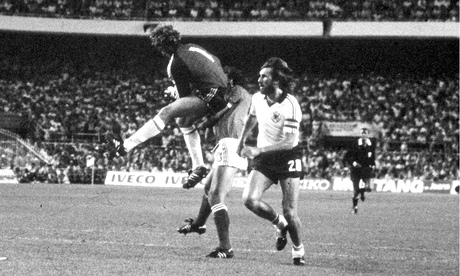
The 1982 World Cup in Spain was the first that enthralled me as a tournament (1974 and 1978 were both a bit grim), largely because of the fascinating contrast in styles, nowhere better exemplified than in the semi-final between France and Germany, though the subsequent final between the Germans and a victorious Italy was also compelling (Marco's Tardelli's manic goal celebration etc). Today's France-Germany clash will do well to stand comparison with a match that finished 3-3 after extra time, featured Schumacher's infamous "bumming" of Battiston, and was the first World Cup match to be settled by a penalty shootout.


France were pretty ordinary at the start of the tournament, beginning with a defeat to England and Bryan Robson's first minute goal. The unusual format, with two group stages before the semis, allowed them time to get their increasingly fluid game together, based around the midfield of Platini, Giresse and Tigana. Though they lost the semi-final, they would go on to deservedly win the European Championship in 1984. Germany had also been unconvincing, losing to Algeria in the first group stage and drawing with England in the second, but would go on to to reach a further two finals in succession, winning in 1990. Though the flowering of the game after Italia 90 owed much to economic and social change, the 1982 tournament in Spain, and that semi-final in particular, was a key step in the aesthetic rehabilitation of football that occurred during the 80s.

If form is any guide, this could be a corker (so assume I've put the mockers on it). For the Arsenal fan, Germany must be favourites (3 squad players versus 2 - Sagna having left the building), but the romantic in me will be just as happy if the French win it after an epic struggle. Today's other quarter-final, Brazil versus Colombia, looks difficult to call, largely because it will probably depend on how well Neymar and Rodriguez play on the night. This highlights a difference between the American and European teams, namely that the former are heavily-dependant on a single player (Argentina without Messi would be distinctly average), while the latter each have a handful of game-changers, some on the bench. For this reason, I suspect we may see a European team win a tournament in the Americas for the first time.

Though only one of France and Germany can go through, both squads, and those of Belgium and Holland, looks to have greater depth and flexibility than Brazil, Colombia, Argentina and Costa Rica. My hunch is that Germany have the edge, mainly because they have more "square pegs" who can spring a surprise, such as Muller, Ozil and Gotze, which is interesting in itself given the national stereotype of precision engineered components. Germany look endearingly shambolic, from their makeshift full-backs, through Mertesacker's lack of a third-gear, to Thomas Muller's socks. Up against Jurgen Klinsmann's Californicated chinos and teeth in the last 16 round, Joachim's Low's impression of an anxious metrosexual restrauteur was a hoot.

In contrast, the French look like they mean business, closer to Les Paras than the Musketeers of 1982. Didier Deschamps is the embodiment of "obdurate", but the team's success owes much to the rapid forward movement from midfield of Matuidi, Valbuena and Pogba. They have a determination that echoes Platini & co. I suspect Germany will sit deep this time, rather than risk a high line and reliance on Neuer's eccentric sweeping, though this will allow France to bring on Giroud later to exploit crosses and produce layoffs. Germany will need some hard running in the middle of the park, so how they use Khedira and Schweinsteiger could prove crucial to the result. It's a fascinating prospect.

Tuesday, 1 July 2014

Monkey Tennis

The victims of Stuart Hall, Max Clifford and Rolf Harris have talked about the mesmeric nature of fame, and how it can make you unable to resist abuse while simultaneously grateful for the attention. The same mechanism was exploited by Jimmy Savile, but his is a more important case because his career of abuse depended on connivance and willed ignorance by others in authority. In this sense, he has more in common with Rebekah Brooks, despite her innocence of phone-hacking, in terms of modus operandi.

Hall and Harris are examples of the petty abuse of power - the corruption common to minor functionaries and bullies - opportunistically taking advantage of the impressionable and vulnerable who crossed their paths. Clifford was more parasitical, exploiting his proximity to celebrities while exhibiting loathing of himself (the obsession with his knob) and many of his erstwhile clients. The common theme is opportunity and a lack of moral scruple where temptation was concerned. In contrast, Savile and Brooks saw power in instrumental and transactional terms and set out to amass it, the one through a strategy of self-promotion and the other through relentless networking. The distinction is between the idea of celebrity as an intrinsic quality - personal talent or prestige - and a form of capital that is accumulated.

As the media for projecting a personality have increased in scope and number over time, celebrity has not concentrated but proliferated. Instead of Big Brother we have the Z-list. Celebrity has become a profuse commodity. In their different ways, both Savile and Brooks appreciated that the growth in bandwidth meant an increasing demand for content. Savile was a hustler and a "self-punter", for ever making grandiose claims and pushing self-interested schemes. It was like Alan Partridge and Monkey Tennis but without the humour. Brooks was ultimately the product of changing economics, as falling paper sales led to a turn away from expensive hard news towards celebrity gossip and synthetic anger. An irony of the phone-hacking trial is the extent to which the tabloids came to rely on premium-rate phonelines, from inhouse competitions to sex-chat adverts. That, rather than the vulnerability of voice-mail, was the significant impact of mobile phone technology on newspapers: it changed the revenue dynamic.

Jeremy Hunt recently insinuated that Savile's long history of abuse in NHS hospitals was the product of institutional failure and personal negligence, and thus consistent with the government's critique of the organisation. He was predictably coy about the evidence that hospitals turned a blind eye because of the fund-raising and publicity that Savile's involvement brought. Suggesting that dependence on external finance might be corrupting is not politically helpful when you're trying to open up the NHS to private providers. Savile wasn't indulged because he was "just Jimmy", but because he was important to revenue. This was transactional.

Savile's abuse was not the product of his actual celebrity. Rather he parlayed his limited celebrity as a third-rate DJ and charmless laughing-stock into a career as a charity fund-raiser. It was this that provided the opportunity to gain privileged access to vulnerable victims, and also access to other power networks that could advance and protect him (Christmas with Thatcher etc). His appetite for public service campaigns (Clunk-Click, The Age of the Train) was mirrored in his walking from Lands End to John O'Groats three times: literally national coverage. Jim'll Fix It was an inspired idea, from his perspective. Initially, the BBC did have concerns about what was being "fixed", but in terms of the risks of product placement by conniving businesses. Throughout his life, Savile was a fixer and influence-peddler, and someone who instinctively understood the commodity nature of celebrity.

Rebekah Brooks's defence in the phone-hacking trial boiled down to persistent ignorance in her role as editor. She had to construct a personality for the jury that was both incompetent (she knew nothing) and sympathetic (she was distracted by fertility treatment, the breakup of her first marriage, her anti-paedophile campaign etc). What this left was the reality of a relentless operator who cultivated relationships for instrumental ends and was incapable of distinguishing between sentimentality and ethical principles. The post-verdict speech - "I've learnt some valuable lessons and hopefully I'm the wiser for it" - was straight out of the embarrassed politician's playbook.

Brooks's rise and subsequent fall has fascinated the broadsheets, who despise her for not being a "real" journalist and for being too much the schmoozer (and Blair's mate). The flame-haired witch trope and the many testaments to her flirtatious charm are the sort of jejune sexism you can expect from ex-public schoolboys who go weak at the knees when a woman touches their arm. Some of the contempt is self-deluding romanticism: an affront to the ideal of the principled, campaigning editor from CP Snow to Lou Grant. Some of it is class contempt: the conflation of the tabloid readership's presumed gullibility and prurience with the amorality of the journos and their seedy sub-contractors. Some of it is unease because her career reveals that running a newspaper is just a branch of PR, which perhaps gives an insight into the empathy that Cameron had for both her and Coulson.

Being a propaganda organ is hardly novel for a newspaper, but this is now pursued on an "industrial scale" by a global corporation like News Corp / Fox News, rather than being simply the byproduct of institutional prejudice. It is noticeable how many "campaigns" in the popular press these days are confected: an over-promoted combination of the unobjectionable and the marginal. We have moved from resonant social issues, such as Rachmanism and Thalidomide, to the hyperbolic sentimentality of Sarah's Law and Our Brave Boys. This is partly economics again: the tabloids are averse to funding major investigations while the broadsheets find it easier and cheaper to operate closer to home, hence the bias towards government scandals (cash for questions, MPs' expenses etc) and the incestuous relationship with The Met, who artlessly provide both investigatory legwork and their own dirty linen. Corporate power has never had it so easy, despite the periodic chuntering about tax avoidance.

David Cameron's apology in respect of Andy Coulson suggests both a man who didn't trouble to enquire too closely into his appointee's past (which feeds the stereotype of the PM as a lazy chancer), but a better interpretation would be that his willed ignorance was simply the product of being at ease with a man he understood. Coulson's attraction was not his empathy for the common man (feeding the stereotype of the cabinet as out-of-touch elitists), which is hardly a rare gift, but his connections with News International and his proven media-management skills. This was transactional. Rupert Murdoch has emerged from the scandal commercially stronger, largely because of the defensive separation of newsprint from TV. The money spent on defending Brooks, Coulson et al is chicken-feed if it provides an effective firebreak against a prosecution under the US Foreign and Corrupt Practises Act.

The different verdicts for Coulson and Brooks reflect their different operational involvement in "editing": the one a hack, the other a networker. Brooks's wilful ignorance about what was going on in her own newspaper would be amusing if it weren't typical of executive behaviour: covering her arse through "empowerment" and plausible deniability. Whereas Coulson was interested in celebrity purely as a commodity, something he could transform into stories and circulation, Brooks was seduced by a belief in her own intrinsic power. She was a user as well as a dealer, trading up through the celeb hierarchy from Piers Morgan via Ross Kemp to Blair and the Chipping Norton set.

There is a contrast to be made here with George Entwhistle, a BBC lifer who was technically well-qualified for the Director General role but completely at sea when trying to handle the politics outside the walls of Broadcasting House: the exact opposite of Brooks. In his case, empowerment was his undoing. An experienced arse-coverer would have issued an email to all staff on day one stating that in light of the Savile allegations any stories concerning sexual abuse would have to be cleared with the DG's office before broadcast. This would have been contrary to his instincts and experience, but exactly the sort of thing that an astute politician would have done.

When confronted with the crimes of Savile, some contemporaries, like Esther Rantzen, have excused their blindness by claiming that it was a more innocent era with different standards of behaviour. This is self-serving nonsense. Sexual abuse is not a recent invention but a common aspect of power relations. What has changed since the 1970s is that authority has shrunk in some institutional areas, such as teaching and medicine, while it has grown in other marketised areas, such as management and celebrity. This is a product of neoliberalism, which has delivered enhanced power to executives while imposing greater inspection on workers. This shift in authority is reflected in changes in opportunity and temptation: more cocaine in the boardroom, less petty pilfering. The result is that there are fewer cases of teachers abusing pupils (though these few get blanket media exposure), but more cases of headteachers abusing funds (routinely hushed-up outside the public sector).

The growth in cases of historic and contemporary sexual abuse by celebrities reflects a growth in the quantum of newsworthy "slebs" and a parallel growth in the demand for salacious content by both bored consumers and cash-strapped media. There has not been a shift in morality. What has happened is the arrival of multi-channel TV, the Internet, and the symbiotic recycling of these two by newspapers. We live in the age of Monkey Tennis.