The big news in the world of wacky baccy this week was the decision of Uruguay to partially legalise marijuana, which has resulted in apparently sober calls for the nation to be awarded the Nobel peace prize (I love you too, man). Ultimately this is a sideshow. Perhaps of more significance is the suggestion that the UK government may look to regulate rather than ban synthetic drugs, though I suspect they'll pass up this opportunity in the short term. The emblematic role of drugs in the tabloid press (see Nigella Lawson) means that we'll probably be a late adopter as far as liberalisation or decriminalisation is concerned, but the fact that it is being considered indicates that a shift in attitude is under way. The key word is "regulate".
Perhaps the most overt sign of this change in popular culture has been Breaking Bad. Because of their length, TV drama series tend to require a lot of supporting comment - the auxiliary of constant blather intended to make you watch the programme and thus the adverts. Drama provides more grist for this than comedy, which suggests that the rise of social media has been decisive in creating the current "golden age of TV". With the exception of those aimed at knowing niche audiences (The IT Crowd, The Big Bang Theory), sitcom has been on the slide since 2006 and the birth of Twitter. If we'd imagined microblogging in the 90s, we'd probably have thought that the dissemination of jokes would be a killer app, but it turns out that the TV cheese for this particular wine is the traditional water-cooler guff of dramatic reveals and shouting at talent shows and politicians. It's reassuringly like Drury Lane in the eighteenth century.
Though much ink and many bytes are spent explicating the "narrative arc" and the moral quandaries of the central characters, the key meaning of these dramas can be found in the mise en scene, which doesn't tend to change much from beginning to end. Thus The Sopranos was a study of an SME in self-destructive and terminal decline, while The Wire looked more widely at institutional failure. Breaking Bad suggests that drugs might be a domestic manufacturing industry of the future, with a bit of luck. Despite the thick icing of morality and symbolic violence, all of these series are worrying away at industrial decline in the US and its social consequences. In Walter White's fall from grace as a chemistry teacher, there is a recognition that recreational drugs are the misapplication of a noble calling. The implication is that a small shift in the law (remember prohibition) could make this a respectable business.
The background to this spectacle is international economic negotiations, both the global efforts coordinated by the World Trade Organisation and regional initiatives such as the Transatlantic Trade and Investment Partnership and the Trans-Pacific Partnership. The WTO was created in 1995 as an institutional upgrade on GATT, the General Agreement on Tariffs and Trade, a rolling series of negotiations that was started in 1947 with the aim of avoiding the protectionism and autarky that had scarred the 1930s. Though GATT remains active, in the form of the outstanding Doha round, the global focus has long since shifted from the reduction of tariffs towards the harmonisation of regulations, notably in the areas of commercial services, intellectual copyright and foreign investment. The last GATT agreement before the creation of the WTO was, coincidentally, the Uruguay round, which ran from 1986 to 1994 (the duration, longer than the Congress of Vienna, is indicative of the scope and detail of these negotiations as much as the difficulty in securing agreement).
Despite the regular use of the words "trade" and "tariffs", and the implicit valorisation of "free trade", international agreements since the Uruguay round have had less and less to do with the traditional exchange of raw materials, agricultural produce and manufactured commodities. The objective in the neoliberal age has been to extend the rights of multinational corporations in the areas of intellectual property, investor-state dispute settlement (ISDS, i.e. the rights of foreign investors to trump domestic legislation), and the regulation of regulation (i.e. ensuring that domestic laws are harmonised to the satisfaction of global capital). As Dean Baker says, "the dirty secret about most trade negotiations today is that they aren’t really about 'conventional barriers to trade' any more. 'Non-tariff barriers', which get most of the attention in trade talks these days are a euphemism for differing national approaches to regulation".
While a lot of the criticism directed at these negotiations focuses on the anti-democratic implications of ISDS, the really big issue is intellectual property. The Trans-Pacific Partnership (TTP) is in large part targeted at extending US IP rights in South East Asia, where a large proportion of the world's "knock-offs" currently originate. But the scope of this goes beyond bootleg copies of The Hobbit. As Walter White has shown, we now have the technology to create knock-off drugs. As well as crystal meth, we can safely produce mildly psychoactive agents with minimal harmful effects (certainly less harmful than alcohol). If Big Pharma doesn't do this, then the market will be left to "unregulated" and "unscrupulous" producers in Vietnam and Mexico. It should be obvious that the gradual extension of IP rights is preparation for the decriminalisation of drugs, not to mention the ubiquity of high-profit GM.
There are many who cheer the Uruguay decision because it proposes nationalisation, rather than the regulation of a free market, and thus the adoption of a more socially-embedded response to the collateral damage of the drugs trade, but what they fail to appreciate is that this is only possible because there is no patent on cannabis or THC. In the future, the rights of nation states to manage their drug policy and direct their drug industries will be constrained by the rights of Big Pharma, who will own the "good stuff".
Search
Friday, 13 December 2013
Monday, 9 December 2013
Counting Peanuts in the Monkey House
How much should we pay MPs, given that there is no objective criteria to determine their salaries? There isn't a market that can provide a "clearing price", and the suggestion that candidates should make salary bids part of their election manifesto would institutionalise corruption. Nor is there any obvious measure of productivity, unless you want to encourage a greater output of poorly-scrutinised bills. Even international benchmarks are unhelpful as there are widely differing approaches to pay, expenses and outside earnings. The popular answer is that their pay should reflect our subjective opinion of their relative worth, which is a social judgement, not a market evaluation - i.e. closer to a form of barter than monetary exchange, so one MP equals three estate agents, or 0.75 of a brain surgeon.
This belief is founded on an assumption about class and rank, hence the tendency to use roles with traditional social standing, such as lawyers, doctors and headteachers, as the peer group. The problem is that 30 years of neoliberalism has seen these roles transformed in two ways. First, they have benefited from widening income inequality as part of the upper half of the middle class. As the earnings of the top 1% have accelerated away, this has helped drag the earnings of the next 9% up. Second, they have become more internally polarised due to the increased rewards to "leadership" and the mainstreaming of bonuses. Are MPs now to be compared to corporate lawyers, heads of commissioning GP consortia and academy "superheads", or are they to be compared to legal aid solicitors, locum doctors and the heads of comprehensive community schools?
Fearful of drawing too much attention to the growth in inequality before 2008, all of the parties acquiesced in an informal stitch-up that saw headline pay restrained while incomes were boosted through liberal office allowances, nod-and-a-wink expenses and generous pension contributions. Meanwhile, in the spirit of the age, MPs continued to pursue their outside commercial interests, and in some cases decided to combine the two domains through lucrative lobbying and "cash for questions".
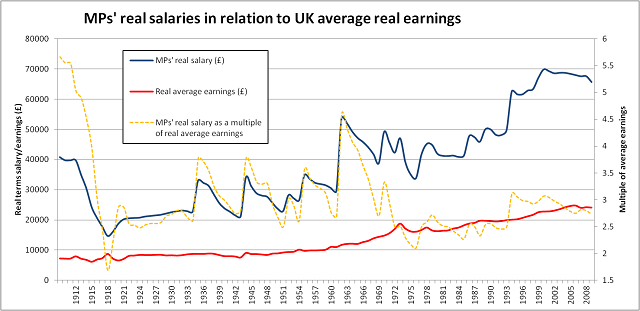
The current thinking of the Independent Parliamentary Standards Authority, which now sets MPs pay, appears to be that it should be linked to average earnings, with a multiple of around 3. This contrasts with a multiple of 5.7 when pay was first introduced in 1911, though this was soon corrected by inflation during WW1. The multiple was around 2.5 during the 1920s, and then wobbled around 3.25 between the mid-30s and the oil shock of 1973. It dropped to 2.5 during the era of high inflation and public pay policies (and after expenses were separated-out in 1971), jumped up to 3 during the Major years, and has gradually declined since then to around 2.7 now (see chart below). On the face of it, they have a reasonable argument for an uprating now to a multiple of 3.
The problem is that "average earnings" in this model is the statistical mean, not the median. In other words, the aggregate of everyone's earnings divided by everyone who works, rather than the point at which 50% of the population earn more and 50% earn less. As the FT noted when this pay rise was first mooted in July, "Mean earnings have grown faster than median earnings since 1980, largely because of higher pay at the top of the income scale. In other words, Ipsa has made its measurement more sensitive to the rise in income inequality". Hooking their pay to median earnings might be fairer in terms of relative worth, but it would condemn MPs to an ongoing decline relative to the top-end of the income scale if inequality continues to rise. The choice of the mean is therefore a vote of no confidence in the prospect of inequality narrowing any time soon.
There are many drivers of unequal earnings growth: technology has increasingly automated median-skill roles, leading to job polarisation; globalisation has created competitive downward pressure on unskilled wages while raising the premium for high-skill roles; and politicians have lightened the tax burden on the wealthy. But perhaps the most emotionally significant for MPs has been the exemplary role of bankers since the 1980s. This has not only set the bar high in London, it has had a cascade effect through related employment sectors such as law and business services, from which MPs are disproportionately drawn. "Why shouldn't we have some of that?" isn't an edifying motive, but it's perfectly understandable.
One of the features of neoliberal corporate practice has been its apparently schizoid attitude towards rank and status. First names are used, ties may be dispensed with, and a flatter organisation chart appears (as mid-tier roles evaporate). Yet at the same time there is greater reliance on independent salary benchmarking (you're no longer just competing with the firm up the road) and executive remuneration committees (whose wisdom is little more than an old saw about peanuts and monkeys). Though this is justified by reference to "paying the going rate", it is clear that the primary driver is status, a social currency, rather than market pricing.
The reported distaste of politicians for the proposed 11% pay increase is not mere hypocrisy; it also reflects embarrassment at the growth in income inequality during the neoliberal era, and a realisation that after the 2008 "setback", this unequal growth has returned and that the chief beneficiaries are many of the same bankers, corporate lawyers and executive chancers who filled their boots the first time round. Galloping price inflation at the top end of the London property market is not just the result of Chinese investors buying up Battersea Power Station for its excellent Feng Shui. The flats there will be very handy for Westminster.
This belief is founded on an assumption about class and rank, hence the tendency to use roles with traditional social standing, such as lawyers, doctors and headteachers, as the peer group. The problem is that 30 years of neoliberalism has seen these roles transformed in two ways. First, they have benefited from widening income inequality as part of the upper half of the middle class. As the earnings of the top 1% have accelerated away, this has helped drag the earnings of the next 9% up. Second, they have become more internally polarised due to the increased rewards to "leadership" and the mainstreaming of bonuses. Are MPs now to be compared to corporate lawyers, heads of commissioning GP consortia and academy "superheads", or are they to be compared to legal aid solicitors, locum doctors and the heads of comprehensive community schools?
Fearful of drawing too much attention to the growth in inequality before 2008, all of the parties acquiesced in an informal stitch-up that saw headline pay restrained while incomes were boosted through liberal office allowances, nod-and-a-wink expenses and generous pension contributions. Meanwhile, in the spirit of the age, MPs continued to pursue their outside commercial interests, and in some cases decided to combine the two domains through lucrative lobbying and "cash for questions".
The current thinking of the Independent Parliamentary Standards Authority, which now sets MPs pay, appears to be that it should be linked to average earnings, with a multiple of around 3. This contrasts with a multiple of 5.7 when pay was first introduced in 1911, though this was soon corrected by inflation during WW1. The multiple was around 2.5 during the 1920s, and then wobbled around 3.25 between the mid-30s and the oil shock of 1973. It dropped to 2.5 during the era of high inflation and public pay policies (and after expenses were separated-out in 1971), jumped up to 3 during the Major years, and has gradually declined since then to around 2.7 now (see chart below). On the face of it, they have a reasonable argument for an uprating now to a multiple of 3.
The problem is that "average earnings" in this model is the statistical mean, not the median. In other words, the aggregate of everyone's earnings divided by everyone who works, rather than the point at which 50% of the population earn more and 50% earn less. As the FT noted when this pay rise was first mooted in July, "Mean earnings have grown faster than median earnings since 1980, largely because of higher pay at the top of the income scale. In other words, Ipsa has made its measurement more sensitive to the rise in income inequality". Hooking their pay to median earnings might be fairer in terms of relative worth, but it would condemn MPs to an ongoing decline relative to the top-end of the income scale if inequality continues to rise. The choice of the mean is therefore a vote of no confidence in the prospect of inequality narrowing any time soon.
There are many drivers of unequal earnings growth: technology has increasingly automated median-skill roles, leading to job polarisation; globalisation has created competitive downward pressure on unskilled wages while raising the premium for high-skill roles; and politicians have lightened the tax burden on the wealthy. But perhaps the most emotionally significant for MPs has been the exemplary role of bankers since the 1980s. This has not only set the bar high in London, it has had a cascade effect through related employment sectors such as law and business services, from which MPs are disproportionately drawn. "Why shouldn't we have some of that?" isn't an edifying motive, but it's perfectly understandable.
One of the features of neoliberal corporate practice has been its apparently schizoid attitude towards rank and status. First names are used, ties may be dispensed with, and a flatter organisation chart appears (as mid-tier roles evaporate). Yet at the same time there is greater reliance on independent salary benchmarking (you're no longer just competing with the firm up the road) and executive remuneration committees (whose wisdom is little more than an old saw about peanuts and monkeys). Though this is justified by reference to "paying the going rate", it is clear that the primary driver is status, a social currency, rather than market pricing.
The reported distaste of politicians for the proposed 11% pay increase is not mere hypocrisy; it also reflects embarrassment at the growth in income inequality during the neoliberal era, and a realisation that after the 2008 "setback", this unequal growth has returned and that the chief beneficiaries are many of the same bankers, corporate lawyers and executive chancers who filled their boots the first time round. Galloping price inflation at the top end of the London property market is not just the result of Chinese investors buying up Battersea Power Station for its excellent Feng Shui. The flats there will be very handy for Westminster.
Saturday, 7 December 2013
An Inspiration to Lawyers Everywhere
The first time I came across the word Apartheid may have been in Arthur C Clarke's 1953 novel, Childhood's End, which I think I read around 11 or 12, so about 1972. Superior aliens, the Overlords, turn up out of the blue to stop the Cold War and save humanity from extinction. They insist that this will only be a watching brief (their shyness is eventually explained by their resemblance to traditional European images of the devil), and that they will keep their interventions to a minimum. The two notable exceptions are to stop the bloody killing of the whites in South Africa, following the collapse of Apartheid a few years earlier, and the bloody killing of bulls in Spain, which Clarke obviously felt had gone on long enough.
South Africa also featured in another SF classic, Michael Moorcock's The Land Leviathan of 1974. In an alternate early twentieth century, the republic is an enlightened outpost of democracy and racial harmony, whose president is the former lawyer, Mohandas K Gandhi. Moorcock's Oswald Bastable books are now seen through the prism of what would subsequently be pigeon-holed as Steampunk, and consequently works of techno-whimsy, but they were actually a satire on colonialism and the compromises that liberalism makes with it. Though set in an Edwardian world of imperial self-confidence and Fabian social progress, the critique had a sharp, contemporary resonance in the 70s when the reactionary right still urged that we should sympathise with the predicament of a white minority faced by communist encirclement without and the "immaturity" of blacks within.
The transformation of the ANC from part of the problem to the basis of the solution is now attributed to the dignity and forbearance of Mandela and his imprisoned colleagues, aided and abetted by the wider anti-apartheid movement, but this was actually the product of more profound forces, notably the global triumph of neoliberalism. I recall meeting a South African businessman in the early 80s who assured me that change was inevitable, partly because disinvestment and sanctions were hurting, but more because the inefficiencies of the system were holding back capital. Apartheid prevented the growth of a larger consumer society, and it stopped industry making full use of the available talent. It just wasn't good business. While the Afrikaaner small capitalists, farmers and state functionaries were in two or three minds, symbolised by the lunacy of the Bantustan strategy and the AWB, the predominantly "anglo" big capitalists were largely reconciled to the inevitability of majority rule after the Soweto Uprising in 1976. It was a matter of cutting a deal that would keep the country open to international capital and marginalise the SACP.
In 1982 Mandela was moved from Robben Island to Pollsmoor Prison, which (it subsequently transpired) was the first fruit of the unofficial negotiations opened between the Apartheid regime and the ANC that would culminate in his release in 1990. Exploratory discussions between "people of goodwill", whether through deniable back channels or semi-official "Track II" NGOs, is a key modus operandi of neoliberalism. Where the 50s and 60s had been marked by a reluctance to talk except under duress, symbolised by the absurd "hot line" (and parodied by the Batphone), the era since the 70s has been one of promiscuous chat on the back of increased trade and travel, improved communications technology and globalisation. The strong commercial slant has fed back into the language of politics and diplomacy, thus "conferences" and "treaties" have been updated to "talks" and "deals", and the official products of negotiation are often aspirational and hazy: words like "openness", "reconciliation" and "commitment" feature a lot. The real promise is always more talks, more chat, more sidebar business opportunities.
From our vantage point today, it is clear that big capital was the winner in South Africa in the 90s and 00s. An inefficient and debilitating racial divide was replaced by a more efficient but equally debilitating class divide. In some respects, the fate of the ANC was the result of its leaders being lawyers, very much in the tradition of the Edwardian Gandhi, if not exclusively committed to non-violence. At the same time that Algeria was undergoing a bloody war of independence, the ANC was fighting the long drawn out treason trial of 1956-61. It is little remembered now, but the founding of the Pan-African Congress in 1959, and the Sharpeville massacre in 1960, were seen by many contemporaries as reproaches to the strategy of the ANC. Paradoxically, the jailing of Mandela and other ANC leaders after the Rivonia trial in 1963 reinforced their pre-eminent role in the struggle. Had they been released, they might have been marginalised by more militant elements in the townships.
As the needs of capital increasingly pointed towards the dismantling of Apartheid, Mandela increasingly became a symbol of hope and his eventual release a promissory note of change, but with the specifics left suitably vague. The deferred gratification of "hope" was a leitmotif of the times, from Berlin in 1989, through New Labour in 1997, to Obama in 2008. Since then, we have realised the extent to which neoliberal society was based on illusory hope: that incomes and house prices would keep on rising, that education would pay, that ability would determine success. One of the best films of the immediate post-crash era was 2009's District 9. Though most people interpreted it as a specific parable of Apartheid, it was actually a universal parable of class and its fragility, with the white protagonist's accidental infection, and the instrumental attitude of his employer and family, forcing him into the underclass as he transforms into an alien "prawn". Hope had turned to fear.
When I first saw the film, I recalled Childhood's End because of the South African connection and the hovering mother ship, though the aliens are quite different. Whereas the "prawns" of District 9 are troublesome proles, the Overlords can be read as a prescient metaphor of neoliberal interventionism (the image of Tony Blair as a horned devil will obviously please some). Michael Moorcock's vision of an alternate South Africa was obviously ironic, but in one respect he too was prescient in imagining a society whose figurehead and moral compass was a crusading lawyer. What he perhaps didn't anticipate is that it would be the corporate lawyers who would ultimately be the power behind the throne.
South Africa also featured in another SF classic, Michael Moorcock's The Land Leviathan of 1974. In an alternate early twentieth century, the republic is an enlightened outpost of democracy and racial harmony, whose president is the former lawyer, Mohandas K Gandhi. Moorcock's Oswald Bastable books are now seen through the prism of what would subsequently be pigeon-holed as Steampunk, and consequently works of techno-whimsy, but they were actually a satire on colonialism and the compromises that liberalism makes with it. Though set in an Edwardian world of imperial self-confidence and Fabian social progress, the critique had a sharp, contemporary resonance in the 70s when the reactionary right still urged that we should sympathise with the predicament of a white minority faced by communist encirclement without and the "immaturity" of blacks within.
The transformation of the ANC from part of the problem to the basis of the solution is now attributed to the dignity and forbearance of Mandela and his imprisoned colleagues, aided and abetted by the wider anti-apartheid movement, but this was actually the product of more profound forces, notably the global triumph of neoliberalism. I recall meeting a South African businessman in the early 80s who assured me that change was inevitable, partly because disinvestment and sanctions were hurting, but more because the inefficiencies of the system were holding back capital. Apartheid prevented the growth of a larger consumer society, and it stopped industry making full use of the available talent. It just wasn't good business. While the Afrikaaner small capitalists, farmers and state functionaries were in two or three minds, symbolised by the lunacy of the Bantustan strategy and the AWB, the predominantly "anglo" big capitalists were largely reconciled to the inevitability of majority rule after the Soweto Uprising in 1976. It was a matter of cutting a deal that would keep the country open to international capital and marginalise the SACP.
In 1982 Mandela was moved from Robben Island to Pollsmoor Prison, which (it subsequently transpired) was the first fruit of the unofficial negotiations opened between the Apartheid regime and the ANC that would culminate in his release in 1990. Exploratory discussions between "people of goodwill", whether through deniable back channels or semi-official "Track II" NGOs, is a key modus operandi of neoliberalism. Where the 50s and 60s had been marked by a reluctance to talk except under duress, symbolised by the absurd "hot line" (and parodied by the Batphone), the era since the 70s has been one of promiscuous chat on the back of increased trade and travel, improved communications technology and globalisation. The strong commercial slant has fed back into the language of politics and diplomacy, thus "conferences" and "treaties" have been updated to "talks" and "deals", and the official products of negotiation are often aspirational and hazy: words like "openness", "reconciliation" and "commitment" feature a lot. The real promise is always more talks, more chat, more sidebar business opportunities.
From our vantage point today, it is clear that big capital was the winner in South Africa in the 90s and 00s. An inefficient and debilitating racial divide was replaced by a more efficient but equally debilitating class divide. In some respects, the fate of the ANC was the result of its leaders being lawyers, very much in the tradition of the Edwardian Gandhi, if not exclusively committed to non-violence. At the same time that Algeria was undergoing a bloody war of independence, the ANC was fighting the long drawn out treason trial of 1956-61. It is little remembered now, but the founding of the Pan-African Congress in 1959, and the Sharpeville massacre in 1960, were seen by many contemporaries as reproaches to the strategy of the ANC. Paradoxically, the jailing of Mandela and other ANC leaders after the Rivonia trial in 1963 reinforced their pre-eminent role in the struggle. Had they been released, they might have been marginalised by more militant elements in the townships.
As the needs of capital increasingly pointed towards the dismantling of Apartheid, Mandela increasingly became a symbol of hope and his eventual release a promissory note of change, but with the specifics left suitably vague. The deferred gratification of "hope" was a leitmotif of the times, from Berlin in 1989, through New Labour in 1997, to Obama in 2008. Since then, we have realised the extent to which neoliberal society was based on illusory hope: that incomes and house prices would keep on rising, that education would pay, that ability would determine success. One of the best films of the immediate post-crash era was 2009's District 9. Though most people interpreted it as a specific parable of Apartheid, it was actually a universal parable of class and its fragility, with the white protagonist's accidental infection, and the instrumental attitude of his employer and family, forcing him into the underclass as he transforms into an alien "prawn". Hope had turned to fear.
When I first saw the film, I recalled Childhood's End because of the South African connection and the hovering mother ship, though the aliens are quite different. Whereas the "prawns" of District 9 are troublesome proles, the Overlords can be read as a prescient metaphor of neoliberal interventionism (the image of Tony Blair as a horned devil will obviously please some). Michael Moorcock's vision of an alternate South Africa was obviously ironic, but in one respect he too was prescient in imagining a society whose figurehead and moral compass was a crusading lawyer. What he perhaps didn't anticipate is that it would be the corporate lawyers who would ultimately be the power behind the throne.
Wednesday, 4 December 2013
Drone Alone for Christmas
The announcement that Amazon are thinking about using light-weight drones for deliveries has been variously dismissed as a stunt to boost pre-Christmas sales, a distraction from their dodgy record on employee conditions and tax avoidance, and a rather laboured geek joke. Predictably, various "business commentators" and "legal experts" have taken the proposal seriously and started to opine about its feasibility and impact. Equally predictably, the Interwebs have had a field-day pointing out the many and various problems, from Americans shooting them out of the sky in defence of their constitutional rights, to over-eager family pets colliding with rotor blades. First prize goes to this little beauty:
The Amazon announcement is just a bit of nonsense at this stage, but the response to it indicates the extent to which we have already become reconciled to the idea that drones will be whizzing rounds our skies in the near future. In practice, their main non-military use will be as mobile CCTV. They're not well-suited to delivering bottles of wine, or getting close to humans, but they're excellent for surveillance.
The drone is also emblematic of Amazon's intention to automate as much of their operation as possible. The shitty terms and conditions of their distribution staff is simply a reflection of that staff's planned obsolescence. Amazon are not a "value-add" business, in the sense that they can charge an increment on costs for a better service. Despite all the paeans to their convenience, online shoppers want their goods cheaper than they would find in bricks-n-mortar shops. Consequently, Amazon must leverage their size to drive down wholesale prices, pare overheads (mainly distribution) to the bone, and encourage volume purchases (the marginal profit on the second or third item in a delivery is greater than the first).
Given this business model, drones are a poor investment. While they appear to reduce the need for a delivery guy, this will simply shift the cost for labour elsewhere, i.e. to more expensive drone operators or mechanics. The systems could be designed to be wholly autonomous, which is feasible in terms of avoiding other drones and reaching a GPS-guided location, but this would present major issues on arrival where all possible obstacles could not be planned for (e.g. getting in to a block of flats, avoiding that yapping dog etc). Drones also lack the carrying capacity required to reduce overheads, unless they are scaled up to a level where fuel costs would make them more expensive than a road vehicle. The truth is that a van and a driver will remain a better choice for a long time to come.
If you abstract the Amazon model to purchase-pick-delivery, then they have automated purchase (through a website) and are well on the way to automating picking (i.e. what happens in their distribution centres). The stage least viable for automation, because it contains the point where unpredictable interaction with the buyer is inescapable, is delivery. The logical approach here would be to outsource as much of this to the buyer as possible. For that reason, Amazon's use of pick-up points and low-tech lockers is probably more significant than their championing of drones.
The Amazon announcement is just a bit of nonsense at this stage, but the response to it indicates the extent to which we have already become reconciled to the idea that drones will be whizzing rounds our skies in the near future. In practice, their main non-military use will be as mobile CCTV. They're not well-suited to delivering bottles of wine, or getting close to humans, but they're excellent for surveillance.
The drone is also emblematic of Amazon's intention to automate as much of their operation as possible. The shitty terms and conditions of their distribution staff is simply a reflection of that staff's planned obsolescence. Amazon are not a "value-add" business, in the sense that they can charge an increment on costs for a better service. Despite all the paeans to their convenience, online shoppers want their goods cheaper than they would find in bricks-n-mortar shops. Consequently, Amazon must leverage their size to drive down wholesale prices, pare overheads (mainly distribution) to the bone, and encourage volume purchases (the marginal profit on the second or third item in a delivery is greater than the first).
Given this business model, drones are a poor investment. While they appear to reduce the need for a delivery guy, this will simply shift the cost for labour elsewhere, i.e. to more expensive drone operators or mechanics. The systems could be designed to be wholly autonomous, which is feasible in terms of avoiding other drones and reaching a GPS-guided location, but this would present major issues on arrival where all possible obstacles could not be planned for (e.g. getting in to a block of flats, avoiding that yapping dog etc). Drones also lack the carrying capacity required to reduce overheads, unless they are scaled up to a level where fuel costs would make them more expensive than a road vehicle. The truth is that a van and a driver will remain a better choice for a long time to come.
If you abstract the Amazon model to purchase-pick-delivery, then they have automated purchase (through a website) and are well on the way to automating picking (i.e. what happens in their distribution centres). The stage least viable for automation, because it contains the point where unpredictable interaction with the buyer is inescapable, is delivery. The logical approach here would be to outsource as much of this to the buyer as possible. For that reason, Amazon's use of pick-up points and low-tech lockers is probably more significant than their championing of drones.
Sunday, 1 December 2013
Secular Stagnation as a Software Glitch
The big noise in the econoblogosphere over the last fortnight has been the reaction to Larry Summers' reintroduction of the concept of "secular stagnation", the idea that all is not well with capitalism and that we may need to get used to low growth and persistent unemployment (or underemployment). Summers first notes a dog-that-didn't-bark oddity of the economy prior to the 2008 crisis: "Too easy money, too much borrowing, too much wealth. Was there a great boom? Capacity utilization wasn't under any great pressure. Unemployment wasn't under any remarkably low level. Inflation was entirely quiescent. So somehow, even a great bubble wasn't enough to produce any excess in aggregate demand". In other words, the new economy was a bit pants.
One could arguably extend Summers' description across the entire period of the "Great Moderation", back to the mid-80s. Though there was volatility in specific assets and interest rates, due to well-known local conditions (e.g. UK house prices and interest rates in the early 90s, the US dotcom boom in the late 90s etc), volatility at the macroeconomic level, i.e. GDP and inflation, was low. The industrial restructuring of the early 80s did not lead to a step-up in GDP growth across the developed world (let alone wealth "trickle-down"), but rather a regression to the postwar mean (2.6% in the UK), while unemployment stayed high. If we manage to hit that rate of growth in the UK by 2018, ten years after the crash, it will be hailed as a triumph.
Summers then turns to another puzzle, the aftermath of the successful attempts in 2009 to "normalise" the financial system: "You'd kind of expect that there'd be a lot of catch-up: that all the stuff where inventories got run down would get produced much faster, so you'd actually kind of expect that once things normalized, you'd get more GDP than you otherwise would have had -- not that four years later, you'd still be having substantially less than you had before. So there's something odd about financial normalization, if that was what the whole problem was, and then continued slow growth". In other words, where was the bounce back once Gordon & co saved the world?
The concept of secular stagnation was originally popularised by the US economist Alvin Hansen in the 1930s as "sick recoveries which die in their infancy and depressions which feed on themselves and leave a hard and seemingly immovable core of unemployment" (he was observing the petering-out of the New Deal recovery in 1937 and couldn't anticipate the impact that the coming war would have). The assumption behind this was that the motors of economic expansion, such as rapid population growth, the development of new territory and new resources, and rapid technological progress, had played out. Consequently, the upswing of the business cycle lacked momentum. This finds an echo in modern "stagnationist" theories like those of Tyler Cowen ("no more low-hanging fruit") and Robert Gordon ("modern technology is rubbish" - I paraphrase).
The origin of Hansen's thinking lay in Keynes's observation that net saving at full employment tends to grow, whereas net investment at full employment tends to fall. This is Keynes's justification for government to act as the investor of last resort, thereby maintaining aggregate demand and full employment. The socialisation of investment is back on the agenda, even if the S-word is to be avoided and pro-middle class projects (like HS2 and Help to Buy) preferred.
An implication of Summers' analysis, spelled out by Paul Krugman, is that "we may be an economy that needs bubbles just to achieve something near full employment", however the track record since the 80s suggests that these bubbles have actually been relatively poor at the job of providing a stimulus, just as QE has been in recent years, hence the persistent unemployment and absence of high inflation. This in turn suggests that there is a very powerful secular trend at work driving stagnation, and that bubbles and monetary policy have been able to do little more than ameliorate its effects. As Krugman says, "we have become an economy whose normal state is one of mild depression, whose brief episodes of prosperity occur only thanks to bubbles and unsustainable borrowing". So what causes this underlying mild depression?
The cause of stagnation in the Keynes/Hansen model is a combination of supply-side deficiencies (an ageing population, declining returns from education, not enough new monetisable technologies) and demand-side deficiencies (not enough consumption and/or productive investment). Supply-siders like Tyler Cowen naturally emphasise the former, with the accent on demography, moral decline and the non-appearance of jet-packs, while demand-siders like Duncan Weldon emphasise the latter, with the accent on inequality and wage stagnation. Some demand-siders, like Yves Smith, also point to the pernicious effects of modern finance: "Companies are not reinvesting at a rate sufficient rate to sustain growth, let alone reduce unemployment ... managers and investors have short term incentives, and financial reform has done nothing to reverse them".
Other commentators have sought moralistic explanations. FlipChartRick suggests that the growth of superstar executive pay has led to the decline in investment, but I think this is confusing cause and effect. Declining investment, along with weakened trades unions, has grown profits at the expense of wages and thus created a larger pot of winnings for distribution among shareholders and executives. Rising inequality certainly has a dampening effect on aggregate investment, because of the greater marginal propensity of the rich to save rather than consume, and save in non-productive forms like property, but it doesn't follow that investment is deliberately curtailed (in concert, across thousands of companies) in order to advance inequality. There must be a structural cause - i.e. something that isn't the result of policy but the unplanned product of changes in the material base.
Investment as a share of retained income has been trending down since the late 80s, yet profits have held up. One perspective on this, put forward by Ben Bernanke in 2005, is that the "dearth of domestic investment opportunities" produces an increase in lending abroad, the so-called "global savings glut", reflecting higher rates of return for capital in emerging economies. A second perspective is an "investment strike", i.e. capitalists are choosing to depress capital expenditure, despite growing profits in emerging economies, leading to an aggregate fall in global investment levels. But how can declining investment be sustained beyond the short-term? Surely lower levels of investment will lead to lower profits in future, and thus a "crisis in capital accumulation"?
A possible answer, according to L Randall Wray, is that the problem is neither a savings glut nor an investment dearth, but rather an excess of capacity due to "the productivity of capitalist investment in plant and equipment. To put it in simple terms, the problem is that investment is just too damned productive. The supply side effect of investment (capacity creation) is much larger than the demand side effect (the multiplier), and the outcome is demand-depressing excess capacity. We call that a demand gap". The importance of Wray's analysis is the focus on the material base, i.e. technological productivity.
Paul Krugman appears to be receptive to the idea that we may be living through a technological revolution, despite the naysayers: "What Bob Gordon (pdf) is predicting is disappointment on the supply side; what Larry Summers and I have been suggesting is that we may face a persistent shortfall on the demand side". He is also sceptical (as a good SciFi fan) about the assumed triviality of modern technology: "I know it doesn’t show in the productivity numbers yet, but anyone who tracks technology has a strong sense that something big has been happening the past few years, that seemingly intractable problems - like speech recognition, adequate translation, self-driving cars, etc. - are suddenly becoming tractable. Basically, smart machines are getting much better at interacting with the natural environment in all its complexity." Krugman's list of wonders is significant because what he is talking about is essentially software, the machine "smarts".
A paradox of eras of rapid growth is that they are also periods of great waste. This is the core truth of Schumpeter's "creative destruction": for every successful idea there must be a long tail of failures. But this is not a problem in macroeconomic terms as any spending helps boost aggregate demand, regardless of the return on investment, hence Keynes's suggestion to bury old banknotes in mines and let the private sector dig them out. The peculiar feature of the dotcom boom of the 90s was that it was insufficiently wasteful, despite the best efforts of venture capitalists, stock-boosters and a seemingly infinite supply of bonkers business plans. The reason for this, I think, was the shift in investment from hardware to software.
The 120 years from 1870 to 1990 can be thought of as the era of hardware. Technological advance accelerated because of three institutional features (this is a key premise of innovation economics). The first was the expansion of state-funded universities and technical institutes in the late nineteenth century, which provided the foundation for systematic R&D. The second was the growth of private-sector labs in large industrial companies in the early twentieth century (e.g. IBM and Xerox), which boosted the returns to applied research. The third was the growth of international standards bodies, particularly after WW2 (e.g. ISO, IEEE and IETF), which encouraged the widespread adoption of new technologies. You can see the ideological legacy of this institutional approach to innovation in endogenous growth theory, the lionisation of instrumental education, the fashion for "innovation clusters", and in the search for "synergies" between business, academia and the public sector.

An area that benefited from this approach was logistics, which is the unsung hero of the modern economy. In the century before 1960, there had been few major changes to the technology beyond the growth of road haulage (i.e. lorries) at the expense of rail. International trade was still dependent on cargo ships and predominantly manual docks. Containerisation (based on ISO standards) was the revolutionary change, leading to the closure of the old city docks, a vast increase in trade volumes, and a consequent fall in commodity prices. But there was a second efficiency gain in the 80s, as a result of the impact of ICT (mainframes, mini-computers, private datacoms networks) on inventory management, which led to the development of just-in-time inventories and lean manufacturing. These improvements in logistics appear to have been a major factor in the reduced volatility of GDP and the chief cause of the "labour supply shock" that we call globalisation.
This points to the increasingly transformative impact of software over the last 30 years. While the early phases of the ICT revolution were hardware-heavy, by the mid-80s software was becoming the dominant element in business productivity growth. From episodic capital-labour substitution (e.g. machine installations), industry moved towards continuous improvement and optimisation, hence the growing importance of process management and statistical control, and latterly data analysis. This didn't just improve productivity, it also made production more modular and portable (necessary to be measurable), which was an important factor in facilitating offshoring and outsourcing. Software also has a high "spillover" value, i.e. its adoption by one business can also benefit others (e.g. improved inventory management by suppliers reduced inventory costs for retailers as well).
Though LANs and email had arrived by the early 90s, the mass adoption of ICT only came in the late 90s with the second wave of Internet technologies, notably the Web and SMTP email, and the deployment of Windows 95/98 PCs on every desk. Parallel to this, the corporate data centre was transformed by the replacement of expensive mainframes and minis with commodity Wintel and Unix servers, the development of application-independent RDBMSs (which allowed you to build custom applications cheaply), and the growth of off-the-shelf ERP and CRM systems (boosted by Y2K) that centralised corporate data.
The result of all this was a simultaneous explosion in the utility of software and a fall in the price of hardware. This was masked initially because total budgets remained high during the 90s - i.e. what was once spent on a single mainframe was now spent on hundreds of PCs - but it became apparent that this was a one-time bonanza, even before the dotcom bubble burst. Though some technology providers sought to move their profit margins from hardware to software and ancillary services, the impact of freeware and opensource (whose roots go back to the 70s), plus the democratisation of software development, meant that the days of huge, year-on-year capex budgets were over. The more recent arrival of SaaS (software as a service) and the "cloud" is merely confirmation that the technology is now pervasive and practically abundant (i.e. very cheap if not yet free). In the 80s, only the biggest companies could afford programmers. Now, many SMEs can afford their own "Web guy", and a tech startup is by definition a business with minimal capital. The cost of entry for high-tech innovation has not been lower since the evolution of insitutional R&D.
According to the US Information Technology & Innovation Foundation: "Between 1980 and 1989, business investment in equipment, software and structures grew by 2.7 percent per year on average and 5.2 percent per year between 1990 and 1999. But between 2000 and 2011 it grew by just 0.5 percent per year... Moreover, as a share of GDP, business investment has declined by more than three percentage points since 1980". They attribute this decline to two main factors, a loss of US competitiveness and increasing market short-termism (the primacy of shareholder value). I think both of these play a part, but I also think a crucial factor is software, which has become the dominant element in business technology since 2000. Costly high-tech hardware is still central to the manufacturing sector (e.g. robots), but as that has declined in the US and UK from 25% of GDP in 1980 to around 12% now, it is clearly not the dominant element in the wider economy. Software, on the other hand, is extensively used by every industry sector.
Technology is cumulative in nature, i.e. it builds on prior knowledge and seeks to constantly improve its operation, but software is particularly efficient in this regard because it can be augmented and edited, rather than requiring complete redesign and replacement, and because a lot of the knowledge is publicly shared, notably through the incorporation of opensource, so patents are less of a restriction on the spread of techniques. While a machine might only be replaced every 3 or 4 years, software can be upgraded weekly. This means that software tends to improve at a quicker (and smoother) rate than hardware. We are distracted by Moore's Law to think ICT productivity growth is all about faster processors, when in reality it is about better exploitation of increasingly cheaper hardware resources.
This two-way movement, accelerating utility and commodity deflation, is not historically unknown, but it has traditionally relied on economies of scale. What is unprecedented is that this dynamic can now apply at very small scale levels. An SME can exploit ICT and logistics to create a new market with minimal capital outlay. It should hardly be a surprise then that the demand for capital is falling at a time of widespread innovation. The madness of the dotcom boom, both the desperate search for something to throw capital at, and the promiscuity of VCs who realised you could afford to back an entire field of losing horses, was telling us something profound.
For some, like Frances Coppola, the coming abundance is problematic: "As the productivity of both labour and capital increases, the need for them diminishes. This is why the economy is creating bubbles. Those with assets are desperately looking for yield, and governments are desperately trying to generate jobs. Like animals in a drought, investors and governments crowd into the last remaining waterholes, as the water in them gradually evaporates". The modern economy is generating a lot of profit but insufficient employment (i.e. well-paid jobs) because it has become very efficient. The problem then is one of transmission, i.e. the distribution of this profit, not a malfunctioning engine. It is a matter of political economy.
It is a commonplace that banking by 2008 was no longer fit for its social purpose, but the implication of secular stagnation may be that the traditional model of industry - based on capital accumulation, high employment and the leverage of institutional innovation - may have already run its course as well. The solution may not just require the socialisation of investment, and the corollary of a job guarantee, but the socialisation of capital and its remittance as funded free time (i.e. a basic income). If you think that throwing money at a crowd of people in the hope that it may produce an aggregate return sounds mad, I would suggest you need to take a closer look at how software development is already funded.
One could arguably extend Summers' description across the entire period of the "Great Moderation", back to the mid-80s. Though there was volatility in specific assets and interest rates, due to well-known local conditions (e.g. UK house prices and interest rates in the early 90s, the US dotcom boom in the late 90s etc), volatility at the macroeconomic level, i.e. GDP and inflation, was low. The industrial restructuring of the early 80s did not lead to a step-up in GDP growth across the developed world (let alone wealth "trickle-down"), but rather a regression to the postwar mean (2.6% in the UK), while unemployment stayed high. If we manage to hit that rate of growth in the UK by 2018, ten years after the crash, it will be hailed as a triumph.
Summers then turns to another puzzle, the aftermath of the successful attempts in 2009 to "normalise" the financial system: "You'd kind of expect that there'd be a lot of catch-up: that all the stuff where inventories got run down would get produced much faster, so you'd actually kind of expect that once things normalized, you'd get more GDP than you otherwise would have had -- not that four years later, you'd still be having substantially less than you had before. So there's something odd about financial normalization, if that was what the whole problem was, and then continued slow growth". In other words, where was the bounce back once Gordon & co saved the world?
The concept of secular stagnation was originally popularised by the US economist Alvin Hansen in the 1930s as "sick recoveries which die in their infancy and depressions which feed on themselves and leave a hard and seemingly immovable core of unemployment" (he was observing the petering-out of the New Deal recovery in 1937 and couldn't anticipate the impact that the coming war would have). The assumption behind this was that the motors of economic expansion, such as rapid population growth, the development of new territory and new resources, and rapid technological progress, had played out. Consequently, the upswing of the business cycle lacked momentum. This finds an echo in modern "stagnationist" theories like those of Tyler Cowen ("no more low-hanging fruit") and Robert Gordon ("modern technology is rubbish" - I paraphrase).
The origin of Hansen's thinking lay in Keynes's observation that net saving at full employment tends to grow, whereas net investment at full employment tends to fall. This is Keynes's justification for government to act as the investor of last resort, thereby maintaining aggregate demand and full employment. The socialisation of investment is back on the agenda, even if the S-word is to be avoided and pro-middle class projects (like HS2 and Help to Buy) preferred.
An implication of Summers' analysis, spelled out by Paul Krugman, is that "we may be an economy that needs bubbles just to achieve something near full employment", however the track record since the 80s suggests that these bubbles have actually been relatively poor at the job of providing a stimulus, just as QE has been in recent years, hence the persistent unemployment and absence of high inflation. This in turn suggests that there is a very powerful secular trend at work driving stagnation, and that bubbles and monetary policy have been able to do little more than ameliorate its effects. As Krugman says, "we have become an economy whose normal state is one of mild depression, whose brief episodes of prosperity occur only thanks to bubbles and unsustainable borrowing". So what causes this underlying mild depression?
The cause of stagnation in the Keynes/Hansen model is a combination of supply-side deficiencies (an ageing population, declining returns from education, not enough new monetisable technologies) and demand-side deficiencies (not enough consumption and/or productive investment). Supply-siders like Tyler Cowen naturally emphasise the former, with the accent on demography, moral decline and the non-appearance of jet-packs, while demand-siders like Duncan Weldon emphasise the latter, with the accent on inequality and wage stagnation. Some demand-siders, like Yves Smith, also point to the pernicious effects of modern finance: "Companies are not reinvesting at a rate sufficient rate to sustain growth, let alone reduce unemployment ... managers and investors have short term incentives, and financial reform has done nothing to reverse them".
Other commentators have sought moralistic explanations. FlipChartRick suggests that the growth of superstar executive pay has led to the decline in investment, but I think this is confusing cause and effect. Declining investment, along with weakened trades unions, has grown profits at the expense of wages and thus created a larger pot of winnings for distribution among shareholders and executives. Rising inequality certainly has a dampening effect on aggregate investment, because of the greater marginal propensity of the rich to save rather than consume, and save in non-productive forms like property, but it doesn't follow that investment is deliberately curtailed (in concert, across thousands of companies) in order to advance inequality. There must be a structural cause - i.e. something that isn't the result of policy but the unplanned product of changes in the material base.
Investment as a share of retained income has been trending down since the late 80s, yet profits have held up. One perspective on this, put forward by Ben Bernanke in 2005, is that the "dearth of domestic investment opportunities" produces an increase in lending abroad, the so-called "global savings glut", reflecting higher rates of return for capital in emerging economies. A second perspective is an "investment strike", i.e. capitalists are choosing to depress capital expenditure, despite growing profits in emerging economies, leading to an aggregate fall in global investment levels. But how can declining investment be sustained beyond the short-term? Surely lower levels of investment will lead to lower profits in future, and thus a "crisis in capital accumulation"?
A possible answer, according to L Randall Wray, is that the problem is neither a savings glut nor an investment dearth, but rather an excess of capacity due to "the productivity of capitalist investment in plant and equipment. To put it in simple terms, the problem is that investment is just too damned productive. The supply side effect of investment (capacity creation) is much larger than the demand side effect (the multiplier), and the outcome is demand-depressing excess capacity. We call that a demand gap". The importance of Wray's analysis is the focus on the material base, i.e. technological productivity.
Paul Krugman appears to be receptive to the idea that we may be living through a technological revolution, despite the naysayers: "What Bob Gordon (pdf) is predicting is disappointment on the supply side; what Larry Summers and I have been suggesting is that we may face a persistent shortfall on the demand side". He is also sceptical (as a good SciFi fan) about the assumed triviality of modern technology: "I know it doesn’t show in the productivity numbers yet, but anyone who tracks technology has a strong sense that something big has been happening the past few years, that seemingly intractable problems - like speech recognition, adequate translation, self-driving cars, etc. - are suddenly becoming tractable. Basically, smart machines are getting much better at interacting with the natural environment in all its complexity." Krugman's list of wonders is significant because what he is talking about is essentially software, the machine "smarts".
A paradox of eras of rapid growth is that they are also periods of great waste. This is the core truth of Schumpeter's "creative destruction": for every successful idea there must be a long tail of failures. But this is not a problem in macroeconomic terms as any spending helps boost aggregate demand, regardless of the return on investment, hence Keynes's suggestion to bury old banknotes in mines and let the private sector dig them out. The peculiar feature of the dotcom boom of the 90s was that it was insufficiently wasteful, despite the best efforts of venture capitalists, stock-boosters and a seemingly infinite supply of bonkers business plans. The reason for this, I think, was the shift in investment from hardware to software.
The 120 years from 1870 to 1990 can be thought of as the era of hardware. Technological advance accelerated because of three institutional features (this is a key premise of innovation economics). The first was the expansion of state-funded universities and technical institutes in the late nineteenth century, which provided the foundation for systematic R&D. The second was the growth of private-sector labs in large industrial companies in the early twentieth century (e.g. IBM and Xerox), which boosted the returns to applied research. The third was the growth of international standards bodies, particularly after WW2 (e.g. ISO, IEEE and IETF), which encouraged the widespread adoption of new technologies. You can see the ideological legacy of this institutional approach to innovation in endogenous growth theory, the lionisation of instrumental education, the fashion for "innovation clusters", and in the search for "synergies" between business, academia and the public sector.
An area that benefited from this approach was logistics, which is the unsung hero of the modern economy. In the century before 1960, there had been few major changes to the technology beyond the growth of road haulage (i.e. lorries) at the expense of rail. International trade was still dependent on cargo ships and predominantly manual docks. Containerisation (based on ISO standards) was the revolutionary change, leading to the closure of the old city docks, a vast increase in trade volumes, and a consequent fall in commodity prices. But there was a second efficiency gain in the 80s, as a result of the impact of ICT (mainframes, mini-computers, private datacoms networks) on inventory management, which led to the development of just-in-time inventories and lean manufacturing. These improvements in logistics appear to have been a major factor in the reduced volatility of GDP and the chief cause of the "labour supply shock" that we call globalisation.
This points to the increasingly transformative impact of software over the last 30 years. While the early phases of the ICT revolution were hardware-heavy, by the mid-80s software was becoming the dominant element in business productivity growth. From episodic capital-labour substitution (e.g. machine installations), industry moved towards continuous improvement and optimisation, hence the growing importance of process management and statistical control, and latterly data analysis. This didn't just improve productivity, it also made production more modular and portable (necessary to be measurable), which was an important factor in facilitating offshoring and outsourcing. Software also has a high "spillover" value, i.e. its adoption by one business can also benefit others (e.g. improved inventory management by suppliers reduced inventory costs for retailers as well).
Though LANs and email had arrived by the early 90s, the mass adoption of ICT only came in the late 90s with the second wave of Internet technologies, notably the Web and SMTP email, and the deployment of Windows 95/98 PCs on every desk. Parallel to this, the corporate data centre was transformed by the replacement of expensive mainframes and minis with commodity Wintel and Unix servers, the development of application-independent RDBMSs (which allowed you to build custom applications cheaply), and the growth of off-the-shelf ERP and CRM systems (boosted by Y2K) that centralised corporate data.
The result of all this was a simultaneous explosion in the utility of software and a fall in the price of hardware. This was masked initially because total budgets remained high during the 90s - i.e. what was once spent on a single mainframe was now spent on hundreds of PCs - but it became apparent that this was a one-time bonanza, even before the dotcom bubble burst. Though some technology providers sought to move their profit margins from hardware to software and ancillary services, the impact of freeware and opensource (whose roots go back to the 70s), plus the democratisation of software development, meant that the days of huge, year-on-year capex budgets were over. The more recent arrival of SaaS (software as a service) and the "cloud" is merely confirmation that the technology is now pervasive and practically abundant (i.e. very cheap if not yet free). In the 80s, only the biggest companies could afford programmers. Now, many SMEs can afford their own "Web guy", and a tech startup is by definition a business with minimal capital. The cost of entry for high-tech innovation has not been lower since the evolution of insitutional R&D.
According to the US Information Technology & Innovation Foundation: "Between 1980 and 1989, business investment in equipment, software and structures grew by 2.7 percent per year on average and 5.2 percent per year between 1990 and 1999. But between 2000 and 2011 it grew by just 0.5 percent per year... Moreover, as a share of GDP, business investment has declined by more than three percentage points since 1980". They attribute this decline to two main factors, a loss of US competitiveness and increasing market short-termism (the primacy of shareholder value). I think both of these play a part, but I also think a crucial factor is software, which has become the dominant element in business technology since 2000. Costly high-tech hardware is still central to the manufacturing sector (e.g. robots), but as that has declined in the US and UK from 25% of GDP in 1980 to around 12% now, it is clearly not the dominant element in the wider economy. Software, on the other hand, is extensively used by every industry sector.
Technology is cumulative in nature, i.e. it builds on prior knowledge and seeks to constantly improve its operation, but software is particularly efficient in this regard because it can be augmented and edited, rather than requiring complete redesign and replacement, and because a lot of the knowledge is publicly shared, notably through the incorporation of opensource, so patents are less of a restriction on the spread of techniques. While a machine might only be replaced every 3 or 4 years, software can be upgraded weekly. This means that software tends to improve at a quicker (and smoother) rate than hardware. We are distracted by Moore's Law to think ICT productivity growth is all about faster processors, when in reality it is about better exploitation of increasingly cheaper hardware resources.
This two-way movement, accelerating utility and commodity deflation, is not historically unknown, but it has traditionally relied on economies of scale. What is unprecedented is that this dynamic can now apply at very small scale levels. An SME can exploit ICT and logistics to create a new market with minimal capital outlay. It should hardly be a surprise then that the demand for capital is falling at a time of widespread innovation. The madness of the dotcom boom, both the desperate search for something to throw capital at, and the promiscuity of VCs who realised you could afford to back an entire field of losing horses, was telling us something profound.
For some, like Frances Coppola, the coming abundance is problematic: "As the productivity of both labour and capital increases, the need for them diminishes. This is why the economy is creating bubbles. Those with assets are desperately looking for yield, and governments are desperately trying to generate jobs. Like animals in a drought, investors and governments crowd into the last remaining waterholes, as the water in them gradually evaporates". The modern economy is generating a lot of profit but insufficient employment (i.e. well-paid jobs) because it has become very efficient. The problem then is one of transmission, i.e. the distribution of this profit, not a malfunctioning engine. It is a matter of political economy.
It is a commonplace that banking by 2008 was no longer fit for its social purpose, but the implication of secular stagnation may be that the traditional model of industry - based on capital accumulation, high employment and the leverage of institutional innovation - may have already run its course as well. The solution may not just require the socialisation of investment, and the corollary of a job guarantee, but the socialisation of capital and its remittance as funded free time (i.e. a basic income). If you think that throwing money at a crowd of people in the hope that it may produce an aggregate return sounds mad, I would suggest you need to take a closer look at how software development is already funded.
Subscribe to:
Posts (Atom)