The reports of the death of Neil Armstrong have read at times like an obituary for the United States, or at least a lament for the passing of the "American century". In retrospect, the brief window between the first moon landing in 1969 and the last in 1972 can be seen as the highpoint of American power, straddling the end of the Bretton Woods post-war economic order in 1971 (when the US ended the convertibility of the dollar to gold) and preceding the oil crisis of 1973. Many of our current woes appear to stem from this point and the consequent neoliberal revolution of the 1980s. The fall of the Berlin Wall did not mark an inexorable American triumph, driven by free markets, defence spending and Reagan's "morning in America" schtick, so much as the inevitable death rattle of Stalinism. It's already a cliche that China will overtake the USA in GDP as well as Olympic medals within a decade or so.
But the Apollo programme itself should give us pause for thought. The Saturn rockets it relied on were developed under the guidance of Wernher von Braun, who had masterminded Germany's rocket research under the Nazis and the development of the V2 during WW2. One could argue that the 20th was the German century, in terms of that country's pivotal role and impact on others. Had it not been for two calamitous wars, the USA's ascent to hegemony might not have happened.
That may appear an overly Eurocentric view today, but there was no doubting the centrality of Europe in the middle years of the last century, if only because of the psychic focus of the Iron Curtain. Simple geography has always meant that the broad area of the Mediterranean and the Middle East, the Pillars of Hercules to the Straits of Hormuz, has been at the centre of world affairs, acting as a hinge between Eurasia and Africa. China and India may be growing powers, but they remain relatively disadvantaged by their peripheral position, and their flanking move to buy up land in Africa won't fundamentally change that.
In time, we may look back on the 20th century and see the dominant story as the growth of the global South, which is perhaps best throught of as everything below the Tropic of Cancer. In 1973, Arno Peters produced a new map of the world that adjusted Mercator's projection to give greater prominence to the southern land masses. Though he also proposed a new meridian, to provide a more symmetrical view, it's notable that this still went through Europe, specifically Florence.
Returning to rockets, it's worth remembering that the Americans didn't just inherit the technology from the Germans, they also inherited an ambition for (extra-)territorial expansion and even colonisation, which lives on today among some politicians. Though the Moon was claimed for "all mankind", it was the Stars and Stripes that was planted in the Sea of Tranquility. There are some who claim that the Apollo mission was primarily about developing better ICBMs and military satellites than the USSR, and that no one seriously envisaged colonisation of a dead rock whose mineral wealth is of dubious value, however the technology of manned spaceflights is so divorced from missiles that this was never any more credible than the whole "it was faked!" theory. The Americans simply thought going to the Moon would be cool. You'd think they might have learnt from Britain's suicidal obsession with planting a flag at the South Pole. The Chinese and Indians now seem determined to make the same chauvinistic mistake.
And that perhaps is why the 20th won't be remembered as the American century. Between 1945 and 1975, they had a glorious window of opportunity to genuinely benefit mankind (and thus themselves), but they blew it on anti-communist paranoia, a stupid and expensive war in Vietnam (which led in part to the convertibility watershed in 1971), and a self-indulgent spectacle that ate billions. Imagine if all that money and talent had been diverted to something really useful, like clean power or public health.
Armstrong's passing has naturally featured his most famous utterance, and the debate about whether he did omit the indefinite article before "man". Perhaps the semantic discussion should focus on whether he actually got the nouns the right way round.

Tuesday, 28 August 2012

Sunday, 26 August 2012
What would Wonder Woman do?
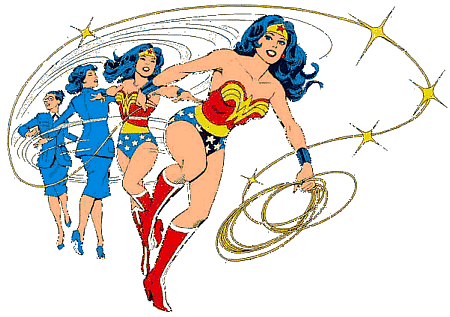
The news that Wonder Woman will get to do the jiggy-jiggy with Superman has coincided neatly with US senatorial candidate Todd Akin's "legitimate rape" gaffe. While the former is simple plot evolution, driven both by commercial need and social change, the latter has shone a light on the ingrained misogyny of US conservatives and the limits of their philosophy. But there is a connection between the two.

Chris Dillow at Stumbling and Mumbling has noted the apparent paradox of the right's championing of self-ownership (I own me, I cannot be enslaved) on the one hand, and their readiness to qualify this when dealing with a crime that directly offends female self-ownership (I have rights over your body if we've previously had sex, you don't own your own foetus). Of course the paradox dissolves once you remember that modern libertarian rights, like the classical liberal rights they derive from, are in practice reserved for white men of a particular class, which is why George Galloway has made such a twat of himself.
The reliably funny Stonekettle Station's Jim Wright (an ex-US military dude in Alaska who isn't a right-wing nut-job) asks if Akin's belief that "the female body has ways to try to shut that whole thing down" is evidence that women have superpowers. This got me to thinking about the whole superhero thing and why it developed in America. I'll come back, like a salmon to its spawning ground, to why this matters in the context of modern politics, but for now, bear with me ...
The other major influence, which overlaps with democracy and the American dream, is the myth of the West. Natty Bumppo (The Last of the Mohicans) was the archetypal frontiersman, followed by The Virginian and The Lone Ranger. They were built in the heroic mould: brave, nostalgic, ever-questing, supremely skilled, and ultimately alone (Tonto didn't count as a person). This heritage means that the superhero character contains strands of misanthropy, nativism and hyper-individualism, all of which feed the tendency towards the fascist (the unelected vigilante who just knows what's best), which surfaces as far apart as the modern Batman (The Dark Knight) and Ayn Rand's John Galt (Atlas Shrugged). See? I was always going to return to right-wing loopiness eventually.
The idea of self-ownership, which underpins classical liberal thought, largely derives from John Locke's Second Treatise of Government:
Writing in the late 17th century, his theories on self-ownership assume we're talking about white men only. The "slavery" that he cared about was subjection to an arbitrary (and possibly Catholic) monarchy that trampled on the property and religious rights of Protestant gentlemen. Real existing slavery in the Carolinas, like the dispossession of native Americans, fell outside his philosophical worldview, as, I suspect, would the notion of female self-ownership. An unborn foetus would have been the property of a man who had "mixed his labour" with that "inferior creature", woman.
Despite the ideology of the melting pot, America has always been more concerned with preserving group distinctions than Europe. In the latter, one's origins could (and can) be laundered within a generation, something that Americans heiresses famously took advantage of in the late 19th century (Winston Churchill's mum was one). Money was always more important than breeding or race, despite the claims to the contrary. In the USA, the racial segregation of the Confederacy was just the extreme manifestation of a general belief in rigid community rights; apartheid avant la lettre.
Superheroes are exemplars of the destiny of genetics, of inescapable fate (avenging dead parents etc), of group identities beyond negotiation. They are the antithesis of freely-chosen membership, of democratic practice. When a civilian aspires to don the mask, this either ends in tragedy and/or comedy (e.g. Kick Ass). The evil villain who parodies the superhero's methods and accoutrements is a visible corruption of the ideal, evidence that you cannot cross the line, no matter how talented or rich you are. His fundamental crime is Prometheus's hubris, Lucifer's pride, a refusal to accept the order of the universe. He's uppity.
Chris Dillow at Stumbling and Mumbling has noted the apparent paradox of the right's championing of self-ownership (I own me, I cannot be enslaved) on the one hand, and their readiness to qualify this when dealing with a crime that directly offends female self-ownership (I have rights over your body if we've previously had sex, you don't own your own foetus). Of course the paradox dissolves once you remember that modern libertarian rights, like the classical liberal rights they derive from, are in practice reserved for white men of a particular class, which is why George Galloway has made such a twat of himself.
The reliably funny Stonekettle Station's Jim Wright (an ex-US military dude in Alaska who isn't a right-wing nut-job) asks if Akin's belief that "the female body has ways to try to shut that whole thing down" is evidence that women have superpowers. This got me to thinking about the whole superhero thing and why it developed in America. I'll come back, like a salmon to its spawning ground, to why this matters in the context of modern politics, but for now, bear with me ...
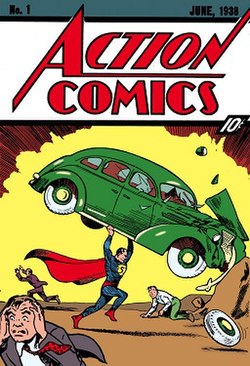
| The classic interpretation is that superheroes evolved during the Great Depression as a form of escapism and vicarious empowerment in a time of great stress. Initially, they weren't so superhuman, being like Dick Tracy (launched 1931), who relied on intelligence and fancy gadgets. During WW2 they became more super, none more so than illegal immigrant Superman who started life in 1938 as the creation of Jews fleeing pogroms and Hitler (excellently fictionalised in Michael Chabon's The Amazing Adventures of Kavalier & Clay). Thereafter the superheroes reflected American geopolitical concerns and social change, from conformity and anti-communism in the 50s, through the questioning of authority (government and family) in the 60s and 70s, to modern concerns about gender and sexuality. It's a commonplace that the roots of the superhero can be traced via Beowulf to Gilgamesh and Hercules, but what is of more modern provenance is the idea of superheroes as a class or breed apart. The post-war evolution of the superhero "team", from the Justice League of America and the Avengers to the X-Men and the Brotherhood of Mutants, sees a gradual shift from a group of individuals that deliberately pool their resources for the common good (echoing the Allies and the UN) to a group defined (sometimes unwillingly) by their genetic destiny. The Watchmen eventually turns this on its head with a group that has few actual super powers and is considered an antisocial subculture of weirdos who dress in capes. The Incredibles combined both themes to comic effect. |
 |
 | The explanation for why superheroes did not successfully evolve in Europe often points to democracy and the American dream. The idea that ordinary people can do great things, can reinvent themselves, meant that the acquisition of superpowers was (sort of) credible and aspirational. The "vulgar" exploitation of talent and wealth (Batman and Iron Man) was admired. In Britain, our heroes were gentlemen of independent (and invisible) means, from the intellectual (Sherlock Holmes), through the jingoistic (Richard Hannay, James Bond) to the downright stolid (Bulldog Drummond, Biggles). Alf Tupper, The Tough of the Track, remains the only notable working-class hero who wasn't an outright joke, and his particular talent was running fast on a diet of fish and chips (he'd never have made Team GB). |
The other major influence, which overlaps with democracy and the American dream, is the myth of the West. Natty Bumppo (The Last of the Mohicans) was the archetypal frontiersman, followed by The Virginian and The Lone Ranger. They were built in the heroic mould: brave, nostalgic, ever-questing, supremely skilled, and ultimately alone (Tonto didn't count as a person). This heritage means that the superhero character contains strands of misanthropy, nativism and hyper-individualism, all of which feed the tendency towards the fascist (the unelected vigilante who just knows what's best), which surfaces as far apart as the modern Batman (The Dark Knight) and Ayn Rand's John Galt (Atlas Shrugged). See? I was always going to return to right-wing loopiness eventually.
The idea of self-ownership, which underpins classical liberal thought, largely derives from John Locke's Second Treatise of Government:
Though the earth, and all inferior creatures, be common to all men, yet every man has a property in his own person: this no body has any right to but himself. The labour of his body, and the work of his hands, we may say, are properly his. Whatsoever then he removes out of the state that nature hath provided, and left it in, he hath mixed his labour with, and joined to it something that is his own, and thereby makes it his property.
| This combines both the idea of self-ownership, which by definition denies slavery (you cannot cede ownership of yourself to another), together with the idea that when a man mixes his labour with nature, e.g. working the land, the product becomes his property. At one level this is entirely consistent with Marx's notion of labour value, the idea that the worker's own labour-power is hers by right and that the surplus value of her labour should be inalienable. However, Locke cheerfully invested in the Africa-America slave trade and was involved in the drafting of Carolina's essentially feudal and slavery-friendly Constitution; and his theories on property conveniently denied rights to the land to Native Americans, on the erroneous basis that they did not cultivate or enclose it, and thus did not mix their labour, in his narrow definition. What was "common to all men" became the property of a few. | 
|
Writing in the late 17th century, his theories on self-ownership assume we're talking about white men only. The "slavery" that he cared about was subjection to an arbitrary (and possibly Catholic) monarchy that trampled on the property and religious rights of Protestant gentlemen. Real existing slavery in the Carolinas, like the dispossession of native Americans, fell outside his philosophical worldview, as, I suspect, would the notion of female self-ownership. An unborn foetus would have been the property of a man who had "mixed his labour" with that "inferior creature", woman.
Despite the ideology of the melting pot, America has always been more concerned with preserving group distinctions than Europe. In the latter, one's origins could (and can) be laundered within a generation, something that Americans heiresses famously took advantage of in the late 19th century (Winston Churchill's mum was one). Money was always more important than breeding or race, despite the claims to the contrary. In the USA, the racial segregation of the Confederacy was just the extreme manifestation of a general belief in rigid community rights; apartheid avant la lettre.
Superheroes are exemplars of the destiny of genetics, of inescapable fate (avenging dead parents etc), of group identities beyond negotiation. They are the antithesis of freely-chosen membership, of democratic practice. When a civilian aspires to don the mask, this either ends in tragedy and/or comedy (e.g. Kick Ass). The evil villain who parodies the superhero's methods and accoutrements is a visible corruption of the ideal, evidence that you cannot cross the line, no matter how talented or rich you are. His fundamental crime is Prometheus's hubris, Lucifer's pride, a refusal to accept the order of the universe. He's uppity.
| The mad insistence by many right-wingers in the US that Obama cannot be American is part of this. For some of them, a black president just breaches too many unstated rules. In Britain, "breeding" does not actually refer to your genetic stock but to your education and upbringing, which is simply a matter of money. David Cameron may well be a misogynist ("calm down, dear" etc), but he isn't crass enough to treat women as a breed apart, any more than he'd claim that blacks have natural rhythm (it's the Notting Hill Carnival this weekend, so there's still time). In the US, Todd Akin is regarded as a fool and an embarrassment by many, but there seems every chance he will cling on to his candidacy as his views appear to be shared or condoned by many others. By a delicious irony, his opponent in the senatorial race in Missouri is a woman, the pro-choice Claire McCaskill. C'mon Wonder Woman, save the day! |  |
Friday, 24 August 2012
Distant Voices, Still Lives
A fascinating set of old police mugshots, Newcastle-upon-Tyne criminals of the 1930s, has been published on Flickr by Tyne & Wear Archives & Museums. I was pointed to this by a centre-spread treatment in the Guardian today. One of the many burglars, William Jones, had a hand-written note across the index card that accompanied the photo: "Dead. Died in action. Benwell Hotel".

This caught my eye as I used to live, between the ages of 9 and 14, on Bentinck Road, just off the Elswick Road. The latter morphs into Adelaide Terrace where the aforementioned pub stood (I believe it's boarded-up today). I used to pass it on the bus to and from my primary school, St. Bede's, out by Denton Burn. I don't recall it being more notorious for its "action" than any other pub, of which there were many on a long road that runs along the top of the north bank of the Tyne, parallel to the Scotswood Road along the river's edge.
I can only speculate on the choice of words. Perhaps an ironic reference to Jones being fatally clobbered by the landlord when he tried to break in, or maybe the police caught him red-handed and he "resisted" (there's a suggestive comment on Flickr to this effect). It might just mean he drank himself insensible and then choked on his vomit. Rock 'n roll. Seen en masse, it's not difficult to imagine that many of those featured in the series might have had a difficult relationship with the booze. Though the photos are arresting, it's the incidental detail on the index cards that is most thought-provoking, such as their average height being around 5'6". The tallest is only just over 5'10" and quite a few were barely over 5 foot. These were mainly men in their 20s and 30s. The comparable cohort today would be 5'10", though I believe the statistical average is 5'9", due to lots of little old men. It's easy to forget the dramatic impact that an improved diet and better housing had on the health of the young from the 40s onwards.
The flat we lived in (from 1969) on Bentinck Road was in an old Victorian house that had been converted, with a housing association office on the ground floor, where we went to pay the rent, and another flat above. It was knocked down and replaced by a BT building in 1974, at which point we were decanted to Washington New Town and the joys of central heating. In the old flat we still had coal fires and one of my occasional jobs on getting in from school was to haul a fresh bucket up from the coal shed in the back yard, which meant clambering up and down a cast-iron fire escape in the rain (it usually rained). The flat above was occupied by a couple who I imagined were as old as the building but were probably in their 50s, with working daughters in their 20s (one got married while we were there and we kids were invited up to look at her trying on the white dress). Both of the parents were tiny, she dark and pinched, like a field vole, he round and gleaming, like a Christmas bauble. I think he liked a drop or two, which also prompted him into lusty renditions of Blaydon Races (yes, Geordies really do sing this at the drop of a hat).
Many of the featured criminals have Irish, Scottish or Welsh names, reflecting the continuing itinerant stream from the periphery to the industrial regions: Gallagher, Lavery, Kelly, Casey, Quinn, Muir, Finlay, Murray, and Jones. There was one exotic, a Jew, James Isadore Epstine (sic), whose trade was recorded as "billiard marker" (the graduate of a misspent youth). Most had their trade recorded as labourer (a casual trade which usually meant unemployed), with a couple of miners and a miscellany of hawkers, carpenters and news vendors. According to the police notes, most thieving was done from pubs, shops and warehouses, with remarkably little house burglary, though this probably just reflects poor pickings in the days before DVD players. Quite a few are marked subsequently as dead. Alexander Murray bears the inscription "RIP London Blitz, 1940". Perhaps he was an innocent bystander, perhaps he'd become a fireman, or perhaps he was still a burglar, employing his favoured method: "enters by means of skylight in roof".

I can only speculate on the choice of words. Perhaps an ironic reference to Jones being fatally clobbered by the landlord when he tried to break in, or maybe the police caught him red-handed and he "resisted" (there's a suggestive comment on Flickr to this effect). It might just mean he drank himself insensible and then choked on his vomit. Rock 'n roll. Seen en masse, it's not difficult to imagine that many of those featured in the series might have had a difficult relationship with the booze. Though the photos are arresting, it's the incidental detail on the index cards that is most thought-provoking, such as their average height being around 5'6". The tallest is only just over 5'10" and quite a few were barely over 5 foot. These were mainly men in their 20s and 30s. The comparable cohort today would be 5'10", though I believe the statistical average is 5'9", due to lots of little old men. It's easy to forget the dramatic impact that an improved diet and better housing had on the health of the young from the 40s onwards.
The flat we lived in (from 1969) on Bentinck Road was in an old Victorian house that had been converted, with a housing association office on the ground floor, where we went to pay the rent, and another flat above. It was knocked down and replaced by a BT building in 1974, at which point we were decanted to Washington New Town and the joys of central heating. In the old flat we still had coal fires and one of my occasional jobs on getting in from school was to haul a fresh bucket up from the coal shed in the back yard, which meant clambering up and down a cast-iron fire escape in the rain (it usually rained). The flat above was occupied by a couple who I imagined were as old as the building but were probably in their 50s, with working daughters in their 20s (one got married while we were there and we kids were invited up to look at her trying on the white dress). Both of the parents were tiny, she dark and pinched, like a field vole, he round and gleaming, like a Christmas bauble. I think he liked a drop or two, which also prompted him into lusty renditions of Blaydon Races (yes, Geordies really do sing this at the drop of a hat).
Many of the featured criminals have Irish, Scottish or Welsh names, reflecting the continuing itinerant stream from the periphery to the industrial regions: Gallagher, Lavery, Kelly, Casey, Quinn, Muir, Finlay, Murray, and Jones. There was one exotic, a Jew, James Isadore Epstine (sic), whose trade was recorded as "billiard marker" (the graduate of a misspent youth). Most had their trade recorded as labourer (a casual trade which usually meant unemployed), with a couple of miners and a miscellany of hawkers, carpenters and news vendors. According to the police notes, most thieving was done from pubs, shops and warehouses, with remarkably little house burglary, though this probably just reflects poor pickings in the days before DVD players. Quite a few are marked subsequently as dead. Alexander Murray bears the inscription "RIP London Blitz, 1940". Perhaps he was an innocent bystander, perhaps he'd become a fireman, or perhaps he was still a burglar, employing his favoured method: "enters by means of skylight in roof".
Thursday, 23 August 2012
McEwan's Export
Hard on the heels of China Mieville's challenge to the parochialism of English literary fiction, Ian McEwan, in an interview with Alex Salmond in Edinburgh, has put the case for the defence, claiming loyally that he is an English not a British writer. McEwan sees national identity, at least in the case of writers, as an act of will, a choice of team colours, and believes that such identification is only possible at the provincial level. Thus "when TS Eliot wanted to become poet in these lands, it wasn't as an English poet, it was an Anglian poet he wanted to be" The unintended irony is that the American-born Eliot eventually became an Anglican, a very public form of choosing sides (the quoted sentence is so clumsy, I'm wondering if "Anglian" might be a typo). While no one would doubt the geographical rootedness of Eliot's later work, notably Four Quartets, his earlier work was international in style and scope. No one would call The Wasteland quintessentially English. Many see Eliot's life as the restless search for a satisfactory home, in terms of relationships, culture, spirituality and artistic style. He kept on choosing sides.
Despite his name, McEwan is resolute in his belief that the cultural stock of these islands shall not mix: "It struck me this is where poetry and football coalesce; Olympics apart, we've kept our football traditions separate, too". Not quite. The borders of football have tended to reflect the constraints of physical geography rather than culture or politics. For example, in 1872 Glasgow's Queens Park played in the first (English) FA Challenge Cup. The Scottish FA was subsequently formed to sponsor a separate competition largely because of the prohibitive travel costs. This same logistical imperative explains the regionalisation (North and South) of the English Third Division between 1921 and 1958, and the involvement of relatively accessible Welsh teams, such as Cardiff City and Swansea City, in the English leagues. McEwan confuses the anachronistic oddity of the "home nations" with football generally. Many British football fans happily put club before country because they don't identify with "Ingerlund", or are swayed by loyalty to family heritage (Irish, Scottish, Welsh etc). I don't think Ian is a footy fan himself.
Moving on to an area he knows something about, McEwan emphasises the specificity of great novels in time and space, quoting Madame Bovary and Anna Karenina as examples (though not the somewhat less specific War and Peace, which ranges over decades and huge areas). He even insists that James Joyce's Ulysses should be seen in this way: "what could be more local and provincial as it were and specific to a place and time than that, but it's the modernist bible, the central text". Saying that the book is about two blokes wandering around Dublin on the 16th of June, 1904, is monumentally missing the point. Joyce merely uses this solid grounding as the launchpad for a mental journey through time and space. Just as with Eliot, Joyce's writing life traces a clear trajectory. You may not find the ultimate destination congenial (Finnegans's Wake should be sampled sparingly), but the direction of travel is thrilling. In contrast, McEwan has proven a child of his time, a baby-boomer who published a genuinely arresting (even fantastic) collection of short stories and first novel in the late 70s (First Love, Last Rites and The Cement Garden), but then proceeded to carve a niche writing elegant novels about anguished middle-class Southerners.
McEwan's problem is not that he assumes his "parish" alone represents England, but that he doesn't recognise how others, like Salmond, can see Britishness as a component in a multi-layered identity. It is this lack of multiplicity that gives rise to the narrow perspectives of modern English "litfic" writers, in Mieville's estimation. Specificity looks like a search for depth among the shallows.
Despite his name, McEwan is resolute in his belief that the cultural stock of these islands shall not mix: "It struck me this is where poetry and football coalesce; Olympics apart, we've kept our football traditions separate, too". Not quite. The borders of football have tended to reflect the constraints of physical geography rather than culture or politics. For example, in 1872 Glasgow's Queens Park played in the first (English) FA Challenge Cup. The Scottish FA was subsequently formed to sponsor a separate competition largely because of the prohibitive travel costs. This same logistical imperative explains the regionalisation (North and South) of the English Third Division between 1921 and 1958, and the involvement of relatively accessible Welsh teams, such as Cardiff City and Swansea City, in the English leagues. McEwan confuses the anachronistic oddity of the "home nations" with football generally. Many British football fans happily put club before country because they don't identify with "Ingerlund", or are swayed by loyalty to family heritage (Irish, Scottish, Welsh etc). I don't think Ian is a footy fan himself.
Moving on to an area he knows something about, McEwan emphasises the specificity of great novels in time and space, quoting Madame Bovary and Anna Karenina as examples (though not the somewhat less specific War and Peace, which ranges over decades and huge areas). He even insists that James Joyce's Ulysses should be seen in this way: "what could be more local and provincial as it were and specific to a place and time than that, but it's the modernist bible, the central text". Saying that the book is about two blokes wandering around Dublin on the 16th of June, 1904, is monumentally missing the point. Joyce merely uses this solid grounding as the launchpad for a mental journey through time and space. Just as with Eliot, Joyce's writing life traces a clear trajectory. You may not find the ultimate destination congenial (Finnegans's Wake should be sampled sparingly), but the direction of travel is thrilling. In contrast, McEwan has proven a child of his time, a baby-boomer who published a genuinely arresting (even fantastic) collection of short stories and first novel in the late 70s (First Love, Last Rites and The Cement Garden), but then proceeded to carve a niche writing elegant novels about anguished middle-class Southerners.
McEwan's problem is not that he assumes his "parish" alone represents England, but that he doesn't recognise how others, like Salmond, can see Britishness as a component in a multi-layered identity. It is this lack of multiplicity that gives rise to the narrow perspectives of modern English "litfic" writers, in Mieville's estimation. Specificity looks like a search for depth among the shallows.
Wednesday, 22 August 2012
Me old China
I recently finished reading China Mieville's Embassytown, which roughly coincided with his appearance at the Edinburgh World Writers' conference. His speech on the "future of the novel" (as trite a phrase as "the shock of the new") has been cherry-picked for suitably controversial gobbets, which is the normal way with a PR event whose purpose is to remind people that books still exist. As a marketing exercise, this is fundamentally no different to the recent eye-catching announcement that 50 Shades of Grey has sold more copies than the Highway Code. Given that many buyers appear to view the former as a user manual, this juxtaposition is less surprising than might appear at first sight.
The Mievillian prediction that appears to have done most to epater les bourgeois ecrivains appears to be the suggestion that the future novel may be crowd-sourced, thus finally dethroning the author, some 50 years after Roland Barthes called for his death. T'internet means that anyone can "shove their hands into a book and grub about in its innards, add to and subtract from it, and pass it on". Novelists will be "guerrilla editors", and novels will appears in multiple mixes. This is actually pretty old hat, particularly from an SF writer, and I can't help thinking his use of slightly last-decade terms such as "mashup" is a deliberate pisstake. Mieville's own style has a crowd-sourced feel to it: three adjectives where two would do; a cornucopia of ideas, many leading nowhere; wonderful incidental details and Dickensian characters. Of the two other books of his that I've read (a third of his adult oeuvre), The City and the City is the most completely thought-through. A resonant and engrossing vision of a social multiverse, it deserves comparison with Kafka and Dick. The Kraken, on the other hand, is an enormous McGuffin, a plot (and bland protagonist) that J K Rowling would have found serviceable, sprinkled with hilarious caricatures and farcical scenes that just about make it worthwhile.
In his wide-ranging speech Mielville makes a number of valuable points: that anti-piracy is hypocritical and ineffectual; that crowd-sourcing and the Internet serves translations and out-of-print well; that professional publishing houses output as much crap as self-publishing. His rudeboy challenge is to the parochialism and narrow perspectives of English literary fiction, and the attendant "Olympian simpering at the specialness of writers". The literary novel, and it's natural habitat in fogeyish bookshops, is a defence against modernity. But this charge is hardly new, nor is the underlying materialist critique: that the solitary author is a specific type (a subtype of the romantic artist) who evolved as part of the superstructure of classical liberalism and capitalism between the 17th and 20th centuries. While the superficial commentariat worry about changes in media, Mieville addresses the means of production, predicting a return to older, more collaborative forms of authorship, "the scrivener's edit, the monk's mashup". This has the whiff of steampunk nostalgia about it, as does his preference for estrangement over recognition (fantasy is older than realism), but at least it shows a degree of historical awareness.
Where he weakens his case is in suggesting that writers should get a salary, specifically the wage of a skilled worker, to counter the "de-monetisation" of crowd-sourcing. As proposed, this would be significantly higher than the average writer's income today. The reason this is objectionable is because it perpetuates the idea of specialness. A flowering of literature (i.e. a lot more crap but some more gems) would best be achieved through a guaranteed basic income for all. This would avoid the need for the bureaucracy of deciding who was or was not a valid writer, and would allow writers to write when they wanted to (give them a salary and they'd be obliged to produce quota). It would also help to break down the barriers between "litfic" and genre, which are, in the final analysis, nothing more than marketing categories, the "like that, like this" brutality of commodification.
The Mievillian prediction that appears to have done most to epater les bourgeois ecrivains appears to be the suggestion that the future novel may be crowd-sourced, thus finally dethroning the author, some 50 years after Roland Barthes called for his death. T'internet means that anyone can "shove their hands into a book and grub about in its innards, add to and subtract from it, and pass it on". Novelists will be "guerrilla editors", and novels will appears in multiple mixes. This is actually pretty old hat, particularly from an SF writer, and I can't help thinking his use of slightly last-decade terms such as "mashup" is a deliberate pisstake. Mieville's own style has a crowd-sourced feel to it: three adjectives where two would do; a cornucopia of ideas, many leading nowhere; wonderful incidental details and Dickensian characters. Of the two other books of his that I've read (a third of his adult oeuvre), The City and the City is the most completely thought-through. A resonant and engrossing vision of a social multiverse, it deserves comparison with Kafka and Dick. The Kraken, on the other hand, is an enormous McGuffin, a plot (and bland protagonist) that J K Rowling would have found serviceable, sprinkled with hilarious caricatures and farcical scenes that just about make it worthwhile.
In his wide-ranging speech Mielville makes a number of valuable points: that anti-piracy is hypocritical and ineffectual; that crowd-sourcing and the Internet serves translations and out-of-print well; that professional publishing houses output as much crap as self-publishing. His rudeboy challenge is to the parochialism and narrow perspectives of English literary fiction, and the attendant "Olympian simpering at the specialness of writers". The literary novel, and it's natural habitat in fogeyish bookshops, is a defence against modernity. But this charge is hardly new, nor is the underlying materialist critique: that the solitary author is a specific type (a subtype of the romantic artist) who evolved as part of the superstructure of classical liberalism and capitalism between the 17th and 20th centuries. While the superficial commentariat worry about changes in media, Mieville addresses the means of production, predicting a return to older, more collaborative forms of authorship, "the scrivener's edit, the monk's mashup". This has the whiff of steampunk nostalgia about it, as does his preference for estrangement over recognition (fantasy is older than realism), but at least it shows a degree of historical awareness.
Where he weakens his case is in suggesting that writers should get a salary, specifically the wage of a skilled worker, to counter the "de-monetisation" of crowd-sourcing. As proposed, this would be significantly higher than the average writer's income today. The reason this is objectionable is because it perpetuates the idea of specialness. A flowering of literature (i.e. a lot more crap but some more gems) would best be achieved through a guaranteed basic income for all. This would avoid the need for the bureaucracy of deciding who was or was not a valid writer, and would allow writers to write when they wanted to (give them a salary and they'd be obliged to produce quota). It would also help to break down the barriers between "litfic" and genre, which are, in the final analysis, nothing more than marketing categories, the "like that, like this" brutality of commodification.
Subscribe to:
Posts (Atom)