Brian Leveson has given some early indications of his thinking on press regulation. This includes independent oversight, pre-notification (so factual errors can be challenged by subjects), group complaints (which the PCC didn't address), and a "mechanism for swift resolution of privacy and small libel-type issues". There should be no surprise that a lawyer sees the issue in terms of legal recompense, i.e. specific wrongs can be righted, and that such recourse should fit within the existing legal regime, thus pre-notification will co-exist with injunctions and "large" libel claims will still be the preserve of the rich.
In respect of giving an independent regulator more teeth, specifically financial sanctions, he noted: "I recognise entirely the parlous financial position of much of the press but it's important that sanctions are taken seriously". This is an interesting statement as it may show that he has accepted at face value the claims of various press people that newspapers don't make money (some do, some don't), and that only a fine would be an effective sanction (as opposed to a correction of equal prominence, approved by the victim).
The non-barking dog is ownership. Both this and the more nebulous concept of plurality are within Leveson's terms of reference. His reluctance to comment on either at this stage may indicate that he is keeping his powder dry. That is to be hoped for, because ownership is ultimately the key to abusive press behaviour and therefore the only effective route by which it can be tackled.
Media tycoons aren't in it for the money alone, if at all. It should hardly need saying that the true value of a newspaper is the platform it provides to pursue the owner's political as well as economic agenda. Despite the competing charms of TV and the Internet, the combination of greater freedom (no need to provide balance) and a guaranteed audience means that a newspaper still counts. It can still provide an entree to polite society for ambitious men, such as Alexander Lebedev, in much the way that it once did for Beaverbrook and Murdoch (still trading as an anti-establishment larrikin in his 80s). It can also offer the rejected a means to take revenge on that same social elite, a la Maxwell and Desmond.
The British press has long attracted unsavoury characters such as Alfred Harmsworth (Lord Northcliffe), Harold Harmsworth (Lord Rothermere), Max Aitken (Lord Beaverbrook), Conrad Black (that's enough lords), Tiny Rowland, Robert Maxwell and Rupert Murdoch. However, a "fit and proper person" test would be as ineffective as it has been in football. The only credential ever demanded is money, and the source of that money will not be examined too closely.
The only sure way of limiting the ability of a single media mogul from exercising excessive influence is by limiting the number of media he owns. The real danger that Murdoch posed was his concentration of power, first within the newspaper sector with the addition of the Times and Sunday Times to the Sun and News of the World, and then across sectors with the launch of Sky and the aborted absorption of BSkyB. His so far inept attempts to build an online presence (MySpace, The Daily) are equally driven by a desire to grab as large a slice of the cake as possible.
Where an individual has a dominant share of the media, that dominance inevitably corrupts some politicians who come within its orbit. The "war criminal" interjection as Tony Blair was giving his evidence yesterday rather detracted from the frank admission he made. He may not have finagled us into supporting the invasion of Iraq in return for a sack of cash, but he was quite up-front about admitting that he decided to schmooze Murdoch as confronting the press was too big a task. Excusing this as a matter of priorities was an example of spin (he had ten years to do something), as was his claim that he frequently took action against Murdoch's interests (blocking the takeover of Man Utd and increasing the BBC licence fee were not major challenges to the Dirty Digger). Basically, Blair was arrogant enough to believe he could ride the tiger, and, to be fair, he proved he could do so for the first half of his premiership.
Without the quid pro quo of favourable (or the absence of unfavourable) coverage, politicians will be less tempted to trim or fawn. Having half a dozen megalomaniacs to deal with is better than having just one as it allows an astute politician to play them off against each other. Where a newspaper owner believes he is king-maker, he will tend to act as such, and some politicians will treat him so.
Such restrictions should apply not only within each medium but across multiple media as well. For example, no more than one national daily newspaper and one national TV channel, and no more than n% of total readers/viewers. If media plurality means anything, then it is that no single person or company should own so much as to be considered a king-maker by anyone. Blair didn't jet off to the other side of the world for every national newspaper owner, just the one.
A policy also needs to be devised for the Web. Leveson said: "I am struck by the fact that what the BBC does is covered by quite different rules to what the Guardian or News International does, and yet you could look at their websites and on the face of it they're doing similar things". Well, that's because they are. Their Web presence is intended to advertise and augment their paper or TV presence. The issue online is less the ownership of individual outlets, as anyone can setup a website, and more the online extension of existing brands (there's a reason why the BBC site gets more hits that this blog). An online presence should be treated as part-and-parcel of the "paper" or the "channel".
It will be argued that this may lead to fewer media outlets, as many are only viable today through cross-subsidy, however even loss-making titles will find a buyer as a vanity project if the brand has value (e.g. the Times), and those that do end up folding (perhaps the Star) are presumably unloved by both readers and potential owners, so we shouldn't shed a tear.
Limits on intra and cross-media ownership will not fix all problems. The ideological spectrum of the British press will remain narrow, so true plurality will be elusive. The bias towards middle-class concerns will continue, with too much on house prices, the feral underclass, and the horrors of comprehensive education. Foreign affairs will still be seen through the lens of what Britain's reaction should be, as if that actually mattered.
But despite all this, limits would help to keep the hubris of the press in check. The 1992 claim that "It's the Sun wot won it" may have been incorrect, but the fact that they thought they could make it, and that so many politicos were in awe of it, tells you the extent to which Murdoch's baleful influence had already served to corrupt the political space.

Tuesday, 29 May 2012

Thursday, 24 May 2012
German cold turkey
Iain Duncan Smith's intention to dock the benefits of drug and alcohol addicts if they refuse treatment and the Eurozone crisis have some common features. The Secretary of State for Work and Pensions says of his cunning plan:
The universal credit will allow staff in Jobcentre Plus offices to say: this person has been unemployed for some time. The staff know if people are addicted to alcohol. They know the people they are dealing with. But we want this to be positive and to be about signposting people to superb organisations that can help them. This is about changing their lives. It is very important to support addicts into the workplace.
Addiction charities have been politely appalled by the idea, as these "superb organisations" will have to deal with either increased demand with no extra funding or the fall-out from addicts driven to desperation. There is no reason to believe that the plan will work even on its own terms, as reliance on the subjective opinion of Jobcentre staff is an open invitation to them to sideline it, unless management decide to set arbitrary targets for the number of referrals/penalties. Should the policy be vigorously implemented, you can be sure we'll see false accusations and petty spite aplenty.
The mechanism to enable this coercion is the "claimant contract", which is central to the new universal benefit due to be introduced in October 2013. This is the concrete result of all that talk from Blair onwards about tackling the "something for nothing culture". The support of society for the most vulnerable must be reframed as a fair exchange, a quid pro quo, rather than a moral obligation or the acceptance of an implicit social contract.
Benefits are increasingly to be made conditional not only on a willingness to work, but on a willingness to address whatever personal behaviours the state considers to be impediments to work. As usual, this is not based on any empirical evidence but is merely a moralistic assertion. There are plenty of functioning alcoholics and addicts holding down jobs, many in The City, so why start with alcies and junkies? Why not pick on the morbidly obese or the clinically depressed? Presumably because addicts are a less sympathetic target.
This micro contract bears a resemblance to the macro contract of the EU's Stability and Growth pact, which was updated last year to include automatic penalties for excessive debt and deficits. After turning a blind eye to problematic behaviour during the 00s (including that of Germany), the EU is now getting serious about adherence. No more something for nothing.
The Eurozone crisis is often discussed as a morality play in which feckless Southern Europeans (and the Irish, who have become honorary olive pressers) became debt junkies because of low productivity and expensive lifestyles. They must now mend their spendthrift ways, knuckle down and work towards salvation. They must become more Protestant. The other main approach is to view it systemically as a flawed plan that unintentionally lowered interest rates in the periphery states, so avoiding the need for politically unpalatable structural reforms and cuts in welfare spending to achieve competitiveness. They must either quit the Euro, devalue their new/old currency and wear a hair-shirt for a few years (Methadone), or they must accept the treatment of austerity now and grin and bear it (cold turkey).
Robert Peston's recent TV summary, The Great Euro Crash, showed how these two tropes have been blended together. Euro-sceptics in The City (Terry Smith and Louise Cooper, the BBC's go-tos for this perspective) highlighted the flaw that meant Greece and Germany enjoyed similar borrowing rates but failed to explain how such a thing could happen. The different states of the USA have widely varying credit ratings despite being part of a federal union (including fiscal transfers) based on the Dollar. The decision to assume that the EU (or Germany) would stand equally behind all Eurozone nations' debts was made by the banks and financial traders. In other words, Peston interviewed the pushers, who were keen to blame the irresponsible users.
There was little recognition that the sovereign debt crisis was a consequence of the financial crisis of 2008, and that prior to the bailouts Eurozone deficits and debt-to-GDP levels were (with the exception of Greece) at manageable levels. There was also no recognition that the convergence of government bond yields (i.e. borrowing costs demanded by the money markets) among the EU states started in the early 90s, long before the introduction of the Euro.
The idea that the Germans are more industrious and averse to debt (cue reference to Swabian housewives) is a simplification. Their current happy position is the consequence of under-par performance in the decade that followed economic reunification in 1990. It's worth remembering that Helmut Kohl's decision to convert the Ostmark 1:1 with the Deutsche Mark in respect of wages (and 2:1 for savings) meant that industry in the East was thereby overvalued, on top of suffering low productivity, when exposed to the free market. The absorption of the tattered remnants of the East was a painful process that led to high unemployment, high interest rates and increased government deficits.
The pressures of the 90s caused Germany to implement austerity early, under Gerhard Schroder in 2003, at a time when it could be supported by the buying power of the rest of the EU (and under the stability and growth blind eye). Of course, only a cynic would suggest that the Germans spotted the opportunity that the Euro presented of a boom in the South coupled with devaluation in the North (German real wages were flat during the 90s as the costs of reunification were borne, however they then started to decline in the 00s as the Euro led to internal devaluation). Emulating Germany in the current economic climate would be hugely difficult for a single country. Trying to apply the same medicine simultaneously across most of the EU is insane.
The fundamental connection between Duncan Smith's plan and the Eurozone crisis is growth. The chief impediment to work is the lack of decently-paid jobs, not over-generous benefits or addiction. Unemployment hasn't risen because we've increased the JSA. The solution to the Eurozone crisis (in the short-to-medium term) is stimulus and moderate inflation, as this will produce surpluses and shrinking debt quicker than mass mutual austerity will. Germany's reluctance to consider this is because it must bear the lion's share of that inflation, or else accept de facto fiscal transfers through eurobonds. It is caught between the folk memory of hyper-inflation and the more recent experience of funding the rebuilding of the economy in the East.
You will hear the phrase "kicking the can down the road" repeatedly in reference to the EU's dithering, but in truth the policy is more a deliberate and cynical decision to kick cripples, just like Duncan Smith's playing to the press gallery. Like the war on drugs, austerity predominantly means harrassing the victims. Meanwhile, financial firewalls have been erected so that the Greek exit (or capital flight) does not damage the banks. The pushers will always be with us
The universal credit will allow staff in Jobcentre Plus offices to say: this person has been unemployed for some time. The staff know if people are addicted to alcohol. They know the people they are dealing with. But we want this to be positive and to be about signposting people to superb organisations that can help them. This is about changing their lives. It is very important to support addicts into the workplace.
Addiction charities have been politely appalled by the idea, as these "superb organisations" will have to deal with either increased demand with no extra funding or the fall-out from addicts driven to desperation. There is no reason to believe that the plan will work even on its own terms, as reliance on the subjective opinion of Jobcentre staff is an open invitation to them to sideline it, unless management decide to set arbitrary targets for the number of referrals/penalties. Should the policy be vigorously implemented, you can be sure we'll see false accusations and petty spite aplenty.
The mechanism to enable this coercion is the "claimant contract", which is central to the new universal benefit due to be introduced in October 2013. This is the concrete result of all that talk from Blair onwards about tackling the "something for nothing culture". The support of society for the most vulnerable must be reframed as a fair exchange, a quid pro quo, rather than a moral obligation or the acceptance of an implicit social contract.
Benefits are increasingly to be made conditional not only on a willingness to work, but on a willingness to address whatever personal behaviours the state considers to be impediments to work. As usual, this is not based on any empirical evidence but is merely a moralistic assertion. There are plenty of functioning alcoholics and addicts holding down jobs, many in The City, so why start with alcies and junkies? Why not pick on the morbidly obese or the clinically depressed? Presumably because addicts are a less sympathetic target.
This micro contract bears a resemblance to the macro contract of the EU's Stability and Growth pact, which was updated last year to include automatic penalties for excessive debt and deficits. After turning a blind eye to problematic behaviour during the 00s (including that of Germany), the EU is now getting serious about adherence. No more something for nothing.
The Eurozone crisis is often discussed as a morality play in which feckless Southern Europeans (and the Irish, who have become honorary olive pressers) became debt junkies because of low productivity and expensive lifestyles. They must now mend their spendthrift ways, knuckle down and work towards salvation. They must become more Protestant. The other main approach is to view it systemically as a flawed plan that unintentionally lowered interest rates in the periphery states, so avoiding the need for politically unpalatable structural reforms and cuts in welfare spending to achieve competitiveness. They must either quit the Euro, devalue their new/old currency and wear a hair-shirt for a few years (Methadone), or they must accept the treatment of austerity now and grin and bear it (cold turkey).
Robert Peston's recent TV summary, The Great Euro Crash, showed how these two tropes have been blended together. Euro-sceptics in The City (Terry Smith and Louise Cooper, the BBC's go-tos for this perspective) highlighted the flaw that meant Greece and Germany enjoyed similar borrowing rates but failed to explain how such a thing could happen. The different states of the USA have widely varying credit ratings despite being part of a federal union (including fiscal transfers) based on the Dollar. The decision to assume that the EU (or Germany) would stand equally behind all Eurozone nations' debts was made by the banks and financial traders. In other words, Peston interviewed the pushers, who were keen to blame the irresponsible users.
There was little recognition that the sovereign debt crisis was a consequence of the financial crisis of 2008, and that prior to the bailouts Eurozone deficits and debt-to-GDP levels were (with the exception of Greece) at manageable levels. There was also no recognition that the convergence of government bond yields (i.e. borrowing costs demanded by the money markets) among the EU states started in the early 90s, long before the introduction of the Euro.
The idea that the Germans are more industrious and averse to debt (cue reference to Swabian housewives) is a simplification. Their current happy position is the consequence of under-par performance in the decade that followed economic reunification in 1990. It's worth remembering that Helmut Kohl's decision to convert the Ostmark 1:1 with the Deutsche Mark in respect of wages (and 2:1 for savings) meant that industry in the East was thereby overvalued, on top of suffering low productivity, when exposed to the free market. The absorption of the tattered remnants of the East was a painful process that led to high unemployment, high interest rates and increased government deficits.
The pressures of the 90s caused Germany to implement austerity early, under Gerhard Schroder in 2003, at a time when it could be supported by the buying power of the rest of the EU (and under the stability and growth blind eye). Of course, only a cynic would suggest that the Germans spotted the opportunity that the Euro presented of a boom in the South coupled with devaluation in the North (German real wages were flat during the 90s as the costs of reunification were borne, however they then started to decline in the 00s as the Euro led to internal devaluation). Emulating Germany in the current economic climate would be hugely difficult for a single country. Trying to apply the same medicine simultaneously across most of the EU is insane.
The fundamental connection between Duncan Smith's plan and the Eurozone crisis is growth. The chief impediment to work is the lack of decently-paid jobs, not over-generous benefits or addiction. Unemployment hasn't risen because we've increased the JSA. The solution to the Eurozone crisis (in the short-to-medium term) is stimulus and moderate inflation, as this will produce surpluses and shrinking debt quicker than mass mutual austerity will. Germany's reluctance to consider this is because it must bear the lion's share of that inflation, or else accept de facto fiscal transfers through eurobonds. It is caught between the folk memory of hyper-inflation and the more recent experience of funding the rebuilding of the economy in the East.
You will hear the phrase "kicking the can down the road" repeatedly in reference to the EU's dithering, but in truth the policy is more a deliberate and cynical decision to kick cripples, just like Duncan Smith's playing to the press gallery. Like the war on drugs, austerity predominantly means harrassing the victims. Meanwhile, financial firewalls have been erected so that the Greek exit (or capital flight) does not damage the banks. The pushers will always be with us
Monday, 21 May 2012
Sack the lot of them
There has been much chuntering recently on the right about "freeing up" the labour market in order to promote growth. The ultras case is outlined in the report prepared for government by the venture capitalist Adrian Beecroft, which has been leaked today. This is purely advisory, but it is a fair indication of the bias of the government's thinking (they commissioned it from a man with known views), or at least the thinking when Steve Hilton was warming his socks on the Downing Street radiators.
The headline proposal is no-fault dismissal, which Vince Cable has promptly set his face against, leading to the suspicion that it is already doomed. Looking at the detail, this is actually termed "compensated no fault dismissal", the idea being that so long as the notice period and termination payments are the same as would be the case for a redundancy, then there should be no grounds for a claim of unfair dismissal. In other words, a formalised pay-off that would be cheaper than a compromise agreement. But is it even needed?
Since April this year, a new employee can only claim unfair dismissal if they have worked for 2 years. In effect, an employer can dismiss an underperformer with a minimum of effort, as you’d expect at least a couple of written performance reviews in that time. If the employer cannot spot a wrong ‘un within 2 years, then they are incompetent. Sacking longer-established workers who "go bad" is also straightforward if you've done proper performance reviews over prior years. The drop in performance can be clearly delineated and, assuming no improvement in response to warnings, termination will follow.
The real problem is that the regulations assume that all businesses have competent HR functions and that best practice is followed, such as contracts that define job performance criteria and appraisals that are regular and substantive. In reality, many businesses pay lip service to this. Even when top management mandate it, line management often skimps in practice. The onerous burden they are really complaining about is the need to properly performance manage staff.
The rest of the report covers a variety of current regulations that are considered a burden to business including flexible working, parental leave, gangmaster licensing, equal pay audits, and checking new employees' eligibility to work in the UK.
The last of these is a good example of the flavour of Beecroft. The current regulation amounts to asking an employee to provide a copy of their passport or work permit when they sign their contract. It really isn't much of a burden, assuming your business issues employment contracts and has some basic clerical competence. The report suggests the eligibility check should become the responsibility of the UK Border Agency. In other words, remove the burden for business by increasing the role of the state.
Most of the report is noise, intended no doubt to give the impression that business is enmeshed in red tape. For example, the "right to request flexible working" extends only as far as the name suggests. The employer is under no obligation to accede to the request, they just have to consider it before they pop it in the bin. This isn't made clear in the report, which is generally a pretty poor piece of work, with no empirical evidence and a surfeit of assertions and suppositions. It's hard to believe a venture capitalist would accept a business plan of such poor quality in his day job (unless he specialises in new technology).
There is also a general proposal for micro-businesses (less than 10 employees) to be exempt from the above regulations regardless. In other words, if the government is reluctant to abolish them for medium and large businesses, they can at least curry the small business vote by making them an exception.
While it is possible to believe that a large corporation, with a bureaucratic HR department, might struggle to get its shit together in terms of performance reviews and actively managing underperformers, it is not credible to believe that this in the case with small businesses. An underperformer in a 10-person company will be spotted pretty quickly. If 10% of the workforce are failing to earn their corn, that’s a big hit on the bottom line. And while the HR processes may be rudimentary, you can bet they will be effective.
It's also worth remembering that most employees in micro-businesses are recruited from the pool of family and friends, or friends of friends. Not only does this mean that hiring a wrong 'un is much less likely, but that performance management actually benefits from a wider support structure than you'd get in a big business. Conversely, when conflicts arise they are quite possibly going to relate to matters outside of work as much as in. A right to arbitrarily sack someone may appear to solve a problem, but it may well produce other, unintended consequences in a kinship group (I haven't used that term since O-level Sociology, but it sounds just right).
Given that people are a business's number one asset (supposedly), the need for employer's to have the right to arbitrarily sack staff indicates a massive failure of management. In fact, it now sounds like business groups are less excited by these proposals than Tory MPs, with more interest being shown in the possibility that the employment tribunal system may be streamlined (i.e. made quicker and less costly).
The real significance of this report is that it was built up beyond its merits as an example of the radical supply-side reforms that Tories advocated to kick-start the economy. The OBR have now admitted that they do not expect the cut in the top rate of tax to make any difference to growth, which has put paid to the other classic supply-side manoeuvre (and calls for a flat-tax are unlikely to gain support at present). If labour market reforms are a damp squib as well, what exactly is left? Probably more cuts, inflation and stagnant wages. And you thought Chelsea winning the Champions' League was depressing.
The headline proposal is no-fault dismissal, which Vince Cable has promptly set his face against, leading to the suspicion that it is already doomed. Looking at the detail, this is actually termed "compensated no fault dismissal", the idea being that so long as the notice period and termination payments are the same as would be the case for a redundancy, then there should be no grounds for a claim of unfair dismissal. In other words, a formalised pay-off that would be cheaper than a compromise agreement. But is it even needed?
Since April this year, a new employee can only claim unfair dismissal if they have worked for 2 years. In effect, an employer can dismiss an underperformer with a minimum of effort, as you’d expect at least a couple of written performance reviews in that time. If the employer cannot spot a wrong ‘un within 2 years, then they are incompetent. Sacking longer-established workers who "go bad" is also straightforward if you've done proper performance reviews over prior years. The drop in performance can be clearly delineated and, assuming no improvement in response to warnings, termination will follow.
The real problem is that the regulations assume that all businesses have competent HR functions and that best practice is followed, such as contracts that define job performance criteria and appraisals that are regular and substantive. In reality, many businesses pay lip service to this. Even when top management mandate it, line management often skimps in practice. The onerous burden they are really complaining about is the need to properly performance manage staff.
The rest of the report covers a variety of current regulations that are considered a burden to business including flexible working, parental leave, gangmaster licensing, equal pay audits, and checking new employees' eligibility to work in the UK.
The last of these is a good example of the flavour of Beecroft. The current regulation amounts to asking an employee to provide a copy of their passport or work permit when they sign their contract. It really isn't much of a burden, assuming your business issues employment contracts and has some basic clerical competence. The report suggests the eligibility check should become the responsibility of the UK Border Agency. In other words, remove the burden for business by increasing the role of the state.
Most of the report is noise, intended no doubt to give the impression that business is enmeshed in red tape. For example, the "right to request flexible working" extends only as far as the name suggests. The employer is under no obligation to accede to the request, they just have to consider it before they pop it in the bin. This isn't made clear in the report, which is generally a pretty poor piece of work, with no empirical evidence and a surfeit of assertions and suppositions. It's hard to believe a venture capitalist would accept a business plan of such poor quality in his day job (unless he specialises in new technology).
There is also a general proposal for micro-businesses (less than 10 employees) to be exempt from the above regulations regardless. In other words, if the government is reluctant to abolish them for medium and large businesses, they can at least curry the small business vote by making them an exception.
While it is possible to believe that a large corporation, with a bureaucratic HR department, might struggle to get its shit together in terms of performance reviews and actively managing underperformers, it is not credible to believe that this in the case with small businesses. An underperformer in a 10-person company will be spotted pretty quickly. If 10% of the workforce are failing to earn their corn, that’s a big hit on the bottom line. And while the HR processes may be rudimentary, you can bet they will be effective.
It's also worth remembering that most employees in micro-businesses are recruited from the pool of family and friends, or friends of friends. Not only does this mean that hiring a wrong 'un is much less likely, but that performance management actually benefits from a wider support structure than you'd get in a big business. Conversely, when conflicts arise they are quite possibly going to relate to matters outside of work as much as in. A right to arbitrarily sack someone may appear to solve a problem, but it may well produce other, unintended consequences in a kinship group (I haven't used that term since O-level Sociology, but it sounds just right).
Given that people are a business's number one asset (supposedly), the need for employer's to have the right to arbitrarily sack staff indicates a massive failure of management. In fact, it now sounds like business groups are less excited by these proposals than Tory MPs, with more interest being shown in the possibility that the employment tribunal system may be streamlined (i.e. made quicker and less costly).
The real significance of this report is that it was built up beyond its merits as an example of the radical supply-side reforms that Tories advocated to kick-start the economy. The OBR have now admitted that they do not expect the cut in the top rate of tax to make any difference to growth, which has put paid to the other classic supply-side manoeuvre (and calls for a flat-tax are unlikely to gain support at present). If labour market reforms are a damp squib as well, what exactly is left? Probably more cuts, inflation and stagnant wages. And you thought Chelsea winning the Champions' League was depressing.
Sunday, 20 May 2012
Reasons to be cheerful

Reasons to be cheerful: Spurs have been relegated to the Europa League; John Terry wasn't on the pitch; er ... that's it, really.
One of the annoying features of ITV's coverage of the Champion's League Final was the way that the camera regularly cut to check on Roman Abramovitch and his entourage (latest squeeze and mini-me to the fore). Not since the days of the Colosseum have the reactions of the rich bloke in the best seats been so carefully scrutinised. His symbolic acceptance of the trophy at the end was both appropriate and slightly nauseating at the same time. Does he think he now owns it?
At one point (just after Drogba's equaliser, I think) we saw security trying to prevent others further up the tier moving into the empty seats just behind the Russian as they celebrated. I assumed these seats had been reserved to provide a cordon sanitaire around a man who we must presume has grounds to fear a bullet in the neck, however it transpired that the seats were occupied by dignitaries who chose to spend most of the game elsewhere. The mystery of their identity was solved at full-time as a grinning George Osborne appeared alongside the German Finance Minister.
I'd hazard a guess that what they were up to during the game involved the simultaneous G8 summit at Camp David in the USA. But I suspect Osborne's absence during most of the match was due less to the need to get on the blower to the PM and more to his total lack of interest in the sport, though he'll no doubt be a lifelong Chelsea fan from henceforth, the freeloading glory hunter. To judge from another officially released photo (i.e. staged for you and me), David Cameron was engaged in some competitive banter with Angela Merkel at the time, with only Barack Obama stopping things turning ugly.
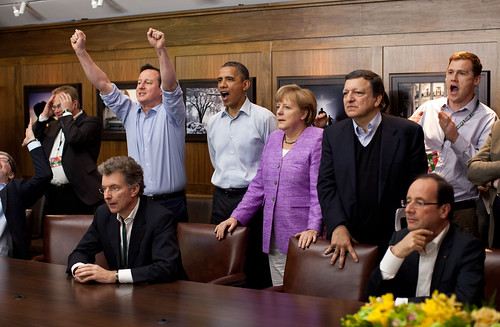
Cameron is on record as claiming an affiliation with Aston Villa, sparked by being taken to Villa Park as a boy by his uncle, Sir William Dugdale, a former chairmen of the club (no, I don't supposed he ever stood on the Holte End). A real Villain wouldn't be seen dead celebrating the success of another team, particularly a mob who play in blue. You can always tell the casual fan (or non-fan, as I sniffily prefer to think of them) when they ask you who you will be supporting as a neutral in a big match. I predictably wanted Bayern to win, for purely negative reasons (i.e. I didn't want Chelsea to lift the trophy), but I do not support them. Neutrals don't support, supporters do.
The 2011-12 season is likely to prove a watershed. The success of Man City last week and then Chelsea last night proved beyond doubt that money can buy you success. The cheerleaders of the EPL and CL will point to the last-minute drama and insist we have just witnessed two "miracles", but the bald facts don't lie. Spend enough and you will win. The only surprise has been that John Terry's slippers, dodgy refereeing, and Abramovitch's impatience with managers have conspired to delay his acquisition of the big one.
The danger for Arsenal is that the clamour for Silent Stan to spunk a billion, or move over and let Alisher Usmanov do so, will now intensify, particularly if Robin van Persie moves to a club willing to do just that. A win for Bayern would not have been a triumph for humble values. This is FC Hollywood after all, and their success has owed much to big money signings such as Robben and Ribery, though they are a club that lives within its means, albeit those means are boosted by strong commercial revenues that reflect a nationwide fanbase.
On the night their nerves got to them. Perhaps playing at home was less an advantage than a burden. How often will you see someone as stereotypically German as Schweinsteiger miss a penalty? Chelsea were dull but effective in killing most of the game, and Drogba managed one good move for the equaliser (Lampard's role in blocking the defender's run should not go unacknowledged). When it came down to penalties, despite Mata fluffing his lines, Chelsea had less to lose and were consequently the more clinical.
This final will not live long in the memory of neutrals, or at least not for footballing reasons. This was a balance sheet victory. Will Roman feel he has achieved all he can and so wind down his interest in Chelsea? He's got to spend his billions on something, and even converting Battersea Power Station into a new stadium will only soak up so much. Expect a bid for Messi or Ronaldo this summer.
Saturday, 19 May 2012
Good cop, bad cop. Still a cop.
Are you a Cavalier or a Roundhead? Perhaps you're a Cavalhead or a Roundier. Perhaps you occupy that third, indeterminate state where the light switch is poised between off and on. Tricky to sustain.
One of the key structural features of politics is the ready recourse to the false dichotomy, or false dilemma, where a topic is presented as a choice between two, and only two, options. This is not the consequence of the adversarial nature of politics (i.e. blaming the weird furniture in the Commons), or even a reflection of the dialectical method (the belief that knowledge progresses through contradiction, i.e. thesis and antithesis). It is not even a pragmatic simplification, excluding the also-rans and the don't knows, a la the BBC swingometer. There are grounds to believe that we humans are psychologically predisposed to prefer black and white propositions, i.e. extreme and clearly opposed choices, rather than shades of grey and nuance, however that doesn't necessarily mean we always reduce choices to only two options. Poker would be a different game if we did.
The main impetus in politics for the false dichotomy is a conscious attempt to exclude heterodox ideas from the frame of reference. In other words, when we said that Spurs could win the Premier League, we were only messing about. C'mon, be serious, only a Manchester club is allowed to win it (until Roman purges the ancients from the Chelski squad). A recent example of this was the minor spat over Lords reform, where the idea that we might just abolish the fuckers altogether was studiously ignored in favour of a debate about what percentage should be elected (the "angels on a pin" metaphor is surely in danger of losing its popularity in the face of such competition).
With the assimilation of the LibDems into the Conservative government, the false dichotomy has become even more pronounced as they have given up trying to establish a third position on many topics. Thus Clegg parrots the Tory line that our debt is unsustainable, it was Labour's fault, and the double-dip is a consequence of the Euro crisis. This display of wilful stupidity will come back to haunt him as much as tuition fees. The space between Conservative and Labour is too narrow to support much in the way of a distinctive position anyway, so this was always more cosmetic than real, but the absence of even a token attempt to establish a third way has been revealing.
The loud rejection of a plan B for the economy has helped give the impression that the binary clash between austerity and growth is a chalk and cheese choice. In reality, the growth plans being floated by Labour and the French Socialists include a lot of austerity, just not as much as advocated by the Tories. Even Syriza in Greece has been cautious about its policy beyond a generally anti-austerity and pro-Euro stance (and their sartorial policy is unconvincing - auditors enjoying Friday beers). Similarly, the government is now being criticised from the right because austerity is shrinking neither the state nor the deficit quickly enough. We are not facing a black and white choice, indeed the general air of frustration may reflect the lack of such a clear choice.
TV loves the simple and colourful clash of opposites, so we should not be surprised that false dichotomies are particularly rife in its treatment of history. A hilarious example this week was a programme that suggested that Britain has been spiritually divided into Cavaliers and Roundheads since the 17th century. The conflict was presented almost as a face-off over fashion, sober black versus beribonned cod-pieces. The vague attempts to introduce genuine substance were repeatedly undermined by recourse to the colourful (shots of those amusing nutters in the Sealed Knot) and spurious modern parallels: Boris as a Cavalier and Ken as a Roundhead (Boris is the City's man - The City was the key supporter of the Parliamentary cause).
There were passing references to the Levellers (but not the Diggers), but broadly the desire was to present the Civil War as a conflict between killjoys and roaring boys. There were no references to Catholicism, the Irish, or the Scots, let alone the economic basis of the rise of the Puritan bourgeoisie and the new gentry. No wonder the battle of The Boyne baffles the English.
In this the producers were unconsciously influenced by Sellar and Yeatman's 1066 And All That, which characterised the Civil War as the struggle between the Cavaliers ("Wrong but Wromantic") and the Roundheads ("Right but Repulsive"). This comic classic had in turn been a 1930s reaction to the Victorian romantic rewriting of history in such novels as Children of the New Forest. It was, in other words, a conscious satire. How strange that in the early 21st century we should have missed the joke and taken this as a serious analysis.
Meanwhile "growth" is being recast as compassionate austerity. Cut back the welfare state, just don't do it so quickly or so gleefully. Don't cut tax for the "wealth creators" today, but be ready to do so once the storm has passed. Invest in infrastructure, but be ready to flog it off at a discount to private business ASAP. A false dichotomy was false because it presumed there were only two options. Increasingly the modern version is false because it presents two options that are merely variations on a single theme.
One of the key structural features of politics is the ready recourse to the false dichotomy, or false dilemma, where a topic is presented as a choice between two, and only two, options. This is not the consequence of the adversarial nature of politics (i.e. blaming the weird furniture in the Commons), or even a reflection of the dialectical method (the belief that knowledge progresses through contradiction, i.e. thesis and antithesis). It is not even a pragmatic simplification, excluding the also-rans and the don't knows, a la the BBC swingometer. There are grounds to believe that we humans are psychologically predisposed to prefer black and white propositions, i.e. extreme and clearly opposed choices, rather than shades of grey and nuance, however that doesn't necessarily mean we always reduce choices to only two options. Poker would be a different game if we did.
The main impetus in politics for the false dichotomy is a conscious attempt to exclude heterodox ideas from the frame of reference. In other words, when we said that Spurs could win the Premier League, we were only messing about. C'mon, be serious, only a Manchester club is allowed to win it (until Roman purges the ancients from the Chelski squad). A recent example of this was the minor spat over Lords reform, where the idea that we might just abolish the fuckers altogether was studiously ignored in favour of a debate about what percentage should be elected (the "angels on a pin" metaphor is surely in danger of losing its popularity in the face of such competition).
With the assimilation of the LibDems into the Conservative government, the false dichotomy has become even more pronounced as they have given up trying to establish a third position on many topics. Thus Clegg parrots the Tory line that our debt is unsustainable, it was Labour's fault, and the double-dip is a consequence of the Euro crisis. This display of wilful stupidity will come back to haunt him as much as tuition fees. The space between Conservative and Labour is too narrow to support much in the way of a distinctive position anyway, so this was always more cosmetic than real, but the absence of even a token attempt to establish a third way has been revealing.
The loud rejection of a plan B for the economy has helped give the impression that the binary clash between austerity and growth is a chalk and cheese choice. In reality, the growth plans being floated by Labour and the French Socialists include a lot of austerity, just not as much as advocated by the Tories. Even Syriza in Greece has been cautious about its policy beyond a generally anti-austerity and pro-Euro stance (and their sartorial policy is unconvincing - auditors enjoying Friday beers). Similarly, the government is now being criticised from the right because austerity is shrinking neither the state nor the deficit quickly enough. We are not facing a black and white choice, indeed the general air of frustration may reflect the lack of such a clear choice.
TV loves the simple and colourful clash of opposites, so we should not be surprised that false dichotomies are particularly rife in its treatment of history. A hilarious example this week was a programme that suggested that Britain has been spiritually divided into Cavaliers and Roundheads since the 17th century. The conflict was presented almost as a face-off over fashion, sober black versus beribonned cod-pieces. The vague attempts to introduce genuine substance were repeatedly undermined by recourse to the colourful (shots of those amusing nutters in the Sealed Knot) and spurious modern parallels: Boris as a Cavalier and Ken as a Roundhead (Boris is the City's man - The City was the key supporter of the Parliamentary cause).
There were passing references to the Levellers (but not the Diggers), but broadly the desire was to present the Civil War as a conflict between killjoys and roaring boys. There were no references to Catholicism, the Irish, or the Scots, let alone the economic basis of the rise of the Puritan bourgeoisie and the new gentry. No wonder the battle of The Boyne baffles the English.
In this the producers were unconsciously influenced by Sellar and Yeatman's 1066 And All That, which characterised the Civil War as the struggle between the Cavaliers ("Wrong but Wromantic") and the Roundheads ("Right but Repulsive"). This comic classic had in turn been a 1930s reaction to the Victorian romantic rewriting of history in such novels as Children of the New Forest. It was, in other words, a conscious satire. How strange that in the early 21st century we should have missed the joke and taken this as a serious analysis.
Meanwhile "growth" is being recast as compassionate austerity. Cut back the welfare state, just don't do it so quickly or so gleefully. Don't cut tax for the "wealth creators" today, but be ready to do so once the storm has passed. Invest in infrastructure, but be ready to flog it off at a discount to private business ASAP. A false dichotomy was false because it presumed there were only two options. Increasingly the modern version is false because it presents two options that are merely variations on a single theme.
Subscribe to:
Posts (Atom)